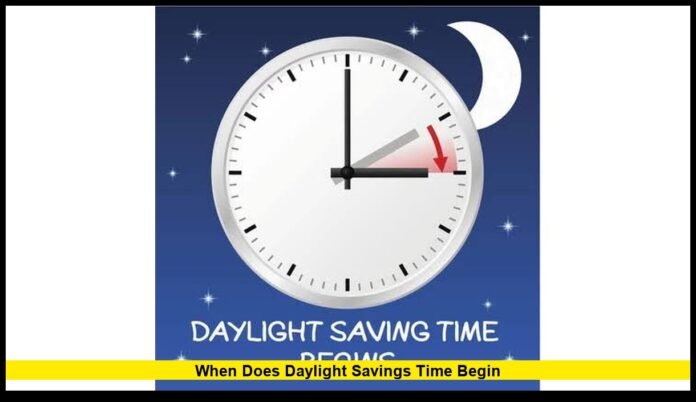

When does daylight savings time begin? In most of the United States, the next Daylight Saving Time change will begin on Sunday, March 14, 2027, at 2:00 a.m. local standard time. At that moment, clocks will move forward one hour to 3:00 a.m. local daylight time. The current federal schedule remains in effect, so most Americans will continue using the seasonal clock change in 2027.
The 2026 Daylight Saving Time period will end first. On Sunday, November 1, 2026, clocks in participating areas will move back one hour. Standard time will then remain in effect until the March 2027 transition.
The seasonal clock change does not apply everywhere in the United States. Hawaii and most of Arizona remain on standard time throughout the year, while several U.S. territories also do not observe Daylight Saving Time.
When does daylight savings time begin in 2027?
Daylight Saving Time will begin in most of the United States on March 14, 2027.
The transition takes place at 2:00 a.m. local standard time. Clocks then jump forward to 3:00 a.m. local daylight time.
That means the local clock skips the hour from 2:00 a.m. through 2:59 a.m.
The change is commonly called “spring forward.”
The federal schedule sets the start of Daylight Saving Time on the second Sunday in March for states that observe it. The current law also establishes the first Sunday in November as the end of the seasonal period.
For 2027, the dates are:
| Event | Date | Clock change |
|---|---|---|
| Daylight Saving Time begins | March 14, 2027 | Forward 1 hour |
| Daylight Saving Time ends | November 7, 2027 | Back 1 hour |
The March change will give participating areas later sunsets by the clock.
What happens when the clocks move forward?
At the start of Daylight Saving Time, clocks move ahead by one hour.
A clock showing 1:59 a.m. continues normally until it reaches 2:00 a.m. At that point, the clock changes directly to 3:00 a.m.
The missing hour is not added later that day.
As a result, the March transition creates a 23-hour clock day for areas observing the change.
The effect on daylight is also noticeable. Sunrise and sunset occur about one hour later according to the clock than they did the previous day.
This does not mean the Sun produces an extra hour of light.
The amount of daylight remains determined by Earth’s rotation, orbit and position relative to the Sun. Daylight Saving Time simply changes the clock used to organize daily activities.
Why does the United States change clocks in March?
The current U.S. system shifts one hour of daylight from the morning toward the evening.
People generally experience later sunsets after the March transition.
For example, if sunset occurred at approximately 6:30 p.m. before the change, it could occur closer to 7:30 p.m. by the clock after the transition. The exact difference depends on location and date.
Sunrise also becomes later by the clock.
This creates a tradeoff between morning and evening daylight. There is less morning light at a particular clock time, while evening daylight continues later.
The federal government established the current national schedule through federal law. The Department of Transportation oversees the nation’s time zones and uniform observance of Daylight Saving Time.
When does Daylight Saving Time end in 2026?
Before the next March start date, the current Daylight Saving Time period will end on November 1, 2026.
At 2:00 a.m. local daylight time, clocks move backward to 1:00 a.m. standard time.
This change is commonly known as “fall back.”
The November transition creates an extra clock hour because the hour from 1:00 a.m. to 2:00 a.m. occurs again.
The sequence is therefore opposite to the March change:
- March: clocks move forward one hour.
- November: clocks move backward one hour.
- March: one clock hour is skipped.
- November: one clock hour repeats.
The 2026 schedule remains unchanged under current federal rules.
Why does the date change every year?
The United States does not use the same calendar date for the clock change every year.
Instead, federal law defines the timing by the day of the week.
Daylight Saving Time begins on the second Sunday in March and ends on the first Sunday in November in states that observe it.
Because Sundays fall on different calendar dates each year, the exact date changes.
For example:
- 2026: March 8
- 2027: March 14
- 2028: March 12
- 2029: March 11
The underlying rule remains the same.
Therefore, people who want to know the exact date for a particular year should check the calendar for the second Sunday in March.
Which states observe Daylight Saving Time?
Most U.S. states observe Daylight Saving Time.
The major state-level exceptions are Hawaii and most of Arizona. These areas remain on standard time throughout the year.
Arizona has an unusual exception within the state.
The Navajo Nation observes Daylight Saving Time, while most of the rest of Arizona does not.
That means Arizona can have different clock practices depending on the location.
Hawaii does not make the seasonal change.
Several U.S. territories also remain on standard time throughout the year, including Puerto Rico, Guam, American Samoa, the Northern Mariana Islands and the U.S. Virgin Islands.
Why doesn’t Arizona change its clocks?
Arizona’s decision not to observe Daylight Saving Time applies to most of the state.
The state remains on standard time throughout the year.
The decision creates a difference between Arizona and neighboring states that observe Daylight Saving Time.
During the months when surrounding states move their clocks forward, most of Arizona does not.
The Navajo Nation is the important exception. Because it observes Daylight Saving Time, its clocks follow the seasonal schedule.
The result can be particularly noticeable for people traveling through the region.
Why doesn’t Hawaii observe Daylight Saving Time?
Hawaii remains on standard time throughout the year.
The state does not move clocks forward in March or backward in November.
Its location means seasonal changes in sunrise and sunset do not create the same clock-setting considerations found in many mainland locations.
As a result, Hawaii residents will not participate in the March 14, 2027, clock change.
What is the federal law behind Daylight Saving Time?
The federal framework comes from the Uniform Time Act of 1966, as later amended.
Current federal law states that participating areas advance standard time by one hour beginning at 2:00 a.m. on the second Sunday in March. The seasonal period ends at 2:00 a.m. on the first Sunday in November.
States have the option to exempt themselves from observing Daylight Saving Time.
However, a state that does observe it must follow the federally established dates.
The U.S. Department of Transportation oversees the nation’s time zones and the uniform observance of Daylight Saving Time. The department also states that it does not have the authority to change or repeal Daylight Saving Time itself.
That authority rests with federal law.
Does Daylight Saving Time create more daylight?
No.
Daylight Saving Time does not increase the total amount of sunlight in a day.
The Sun’s movement does not change because people adjust their clocks.
Instead, the time displayed on clocks shifts by one hour.
After the March change, daylight occurs later according to the clock.
This is why many people notice brighter evenings after work or school.
Morning daylight, however, also shifts later.
The effect varies by latitude, location and season. A city in Florida can experience a different sunrise and sunset pattern from a city in Washington, even though both follow the same federal clock-change schedule.
What does “spring forward” mean?
“Spring forward” is a simple reminder for the March clock change.
It means clocks move forward one hour.
The opposite expression is “fall back,” which describes the November transition.
The two expressions make the direction easier to remember:
Spring forward, fall back.
These expressions are common descriptions rather than official legal terms.
The federal rule itself simply establishes when standard time advances by one hour and when that seasonal adjustment ends.
Will the March 2027 change affect sleep?
The March transition reduces the number of clock hours in the day from the perspective of local timekeeping.
Someone who normally sleeps from 11 p.m. to 7 a.m. may have less clock time available for sleep during the transition night if their schedule does not change.
The November transition works in the opposite direction.
People often prepare by adjusting their bedtime and wake-up schedule around the transition. Digital devices can also make the change easier because many automatically update their clocks.
The actual effect varies from person to person.
Will phones automatically change time?
Most modern smartphones and computers can automatically adjust their clocks when they have the correct time-zone settings.
Connected devices generally use time-zone information to determine when the local clock should change.
However, not every clock adjusts automatically.
People should check:
- Wall clocks
- Alarm clocks
- Watches
- Vehicle clocks
- Kitchen appliances
- Office equipment
- Other manually set devices
A clock that does not connect to an automatic time service may need manual adjustment.
For important appointments, travel and alarms, checking the displayed time after the transition can prevent confusion.
What happens to businesses when the clocks change?
Businesses generally continue operating according to local clock time.
Restaurants, stores, offices, schools and other organizations can publish their regular operating hours without changing the duration of their workday.
The clock simply moves forward by one hour during the March transition.
Transportation schedules can require additional attention because airlines, rail services and other transportation systems operate across multiple time zones.
Travelers should always use the local time shown on their tickets and official schedules.
How does Daylight Saving Time affect different time zones?
The United States has several time zones, and each participating location makes the transition according to its own local clock.
The March change therefore occurs at 2:00 a.m. local standard time in each area.
The Eastern, Central, Mountain and Pacific time zones do not all experience the transition at the same moment in absolute time.
For example, when the Eastern Time Zone changes at 2:00 a.m. Eastern time, other time zones are still operating according to their own local clocks.
The same principle applies to Alaska and other U.S. time zones that observe the seasonal change.
Is Daylight Saving Time permanent in the U.S.?
No.
Under the current federal rules, Daylight Saving Time remains a seasonal system.
Most participating areas switch to daylight time in March and return to standard time in November.
The current law does not establish permanent Daylight Saving Time nationwide.
States may choose to remain on standard time, but states cannot independently adopt permanent Daylight Saving Time under the existing federal framework.
Therefore, unless federal law changes, the March and November clock changes will continue according to the established schedule.
What is the difference between Daylight Saving Time and standard time?
Standard time represents the normal time used by a time zone outside the seasonal Daylight Saving Time period.
Daylight Saving Time advances that clock by one hour.
For the four major continental U.S. time zones, the abbreviations change during the seasonal period:
| Standard Time | Daylight Time |
|---|---|
| Eastern Standard Time (EST) | Eastern Daylight Time (EDT) |
| Central Standard Time (CST) | Central Daylight Time (CDT) |
| Mountain Standard Time (MST) | Mountain Daylight Time (MDT) |
| Pacific Standard Time (PST) | Pacific Daylight Time (PDT) |
The transition changes the clock time rather than the underlying geographic time zone.
What should Americans do before March 14, 2027?
The clock change is simple, but preparation can help avoid missed appointments and incorrect alarms.
Before the transition, Americans can:
- Check automatic time settings.
- Confirm the correct time zone.
- Adjust clocks that require manual changes.
- Review alarms.
- Check vehicle clocks.
- Review important appointments.
- Confirm travel schedules.
- Remember whether their location observes Daylight Saving Time.
People living in Hawaii and most of Arizona do not need to make the seasonal adjustment.
Residents of the Navajo Nation follow Daylight Saving Time.
When does daylight savings time begin next?
When does daylight savings time begin next? For most Americans, the answer is Sunday, March 14, 2027.
At 2:00 a.m. local standard time, participating areas will move their clocks forward to 3:00 a.m. The change will mark the beginning of the 2027 Daylight Saving Time period.
The current 2026 period will end first on November 1, 2026.
After that November change, most participating areas will remain on standard time during the winter.
The next spring transition will then move clocks forward again in March 2027.
For most of the United States, the key dates are easy to remember:
- November 1, 2026: clocks move back one hour.
- March 14, 2027: clocks move forward one hour.
- November 7, 2027: clocks move back one hour.
The federal schedule currently remains in place, so these are the dates that matter for Americans preparing for the next seasonal clock changes.
Mark March 14, 2027, on your calendar and remember to move your clocks forward when Daylight Saving Time returns.