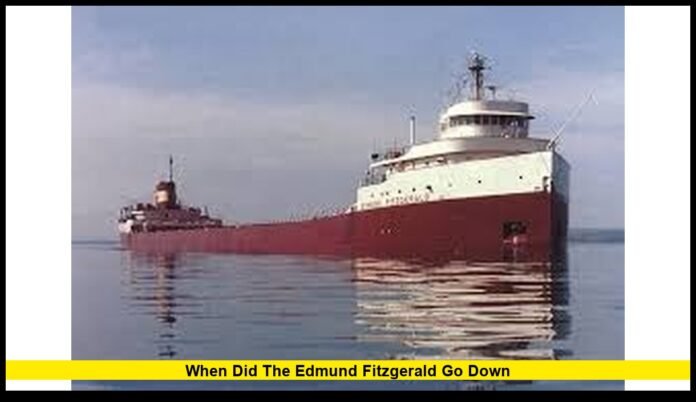

A Storm That Shook the Great Lakes Forever
When did the Edmund Fitzgerald go down? On November 10, 1975, the giant freighter SS Edmund Fitzgerald sank in the cold, storm-tossed waters of Lake Superior. In just a few terrifying moments, the largest ship ever to sail the Great Lakes disappeared beneath the waves—taking all 29 crew members with her. The tragedy shocked the nation, leaving behind questions that still echo nearly five decades later.
The Mighty Ship and Her Final Journey
The Edmund Fitzgerald was a legend even before her tragic end. Launched in 1958, she stretched 729 feet long and was the pride of Great Lakes shipping. She could carry over 26,000 tons of taconite iron ore pellets, the lifeblood of the American steel industry. Her owners, the Northwestern Mutual Life Insurance Company, named her after their then-chairman, Edmund Fitzgerald, who often referred to the ship as his “beautiful giant.”
On November 9, 1975, the Fitzgerald set out from Superior, Wisconsin, bound for Detroit, Michigan, loaded with iron ore. At her helm was Captain Ernest McSorley, a veteran sailor who was due to retire after this voyage. The ship traveled alongside another freighter, the Arthur M. Anderson, as both headed east across Lake Superior.
By late that night, a powerful storm was brewing. The National Weather Service had issued gale warnings, but no one expected what was coming—a monster storm with winds reaching hurricane strength and waves towering over 25 feet.
The Storm of November 10, 1975
As dawn broke on November 10, the lake was raging. Waves slammed into the ships, visibility dropped to near zero, and blinding snow squalls swept across the water. The Fitzgerald lost her radar early in the day, forcing her to rely on radio contact with the Anderson.
By afternoon, the situation worsened. Water began flooding the ship’s decks, and two of her massive fence rails were damaged. Around 3:30 p.m., Captain McSorley radioed that he had “a bad list” and that both radars were down. He reported minor leaks but said they were under control.
As the evening darkened, the wind howled at nearly 60 miles per hour, and waves grew to nearly 30 feet high. Around 7:10 p.m., McSorley made his last radio transmission to the Arthur M. Anderson:
“We are holding our own.”
Minutes later, the Edmund Fitzgerald vanished from radar. No distress signal. No flare. Just silence.
When did the Edmund Fitzgerald go down? Somewhere between 7:10 and 7:25 p.m. on that cold November night—swallowed whole by Lake Superior.
Where She Lies
The ship sank approximately 17 miles northwest of Whitefish Point, Michigan, in water more than 530 feet deep. Search efforts began that night, but fierce winds and towering waves delayed rescue attempts. By the next morning, debris—lifeboats, rafts, and pieces of the ship—floated to the surface. Not a single survivor was found.
In May 1976, the wreck was discovered in two large pieces resting on the lakebed. The bow section was upright, while the stern lay upside down. The damage showed the ship had likely broken apart as it sank, descending rapidly—too fast for anyone to react.
Theories About the Sinking
Even today, the exact reason why the Edmund Fitzgerald went down remains uncertain. Investigations over the years have offered several theories:
- Hatch cover failure: Some experts believe powerful waves forced water through the cargo hatch covers, flooding the hold and causing the ship to lose buoyancy.
- Structural failure: The immense stress of the storm might have cracked or split the hull, allowing water to rush in instantly.
- Rogue waves: Sailors often speak of “three sisters” — a trio of giant waves that can hit in quick succession. Some survivors from other ships reported waves over 35 feet high that night.
- Shoaling: Others speculate the Fitzgerald may have unknowingly struck a shoal, weakening her structure before the final blow.
Whatever the cause, the evidence shows the ship went down quickly—possibly in less than 20 seconds.
The Human Cost
All 29 crew members aboard the Edmund Fitzgerald perished. Their ages ranged from 20 to 63, and most were from Michigan, Ohio, Wisconsin, and Minnesota. Their names are still honored every year at memorials across the Great Lakes.
Some of those lost included:
- Captain Ernest McSorley, 63 – the ship’s final master.
- First Mate John McCarthy, 62 – from Bay City, Michigan.
- Cook George Holl, 60 – who famously prepared hearty meals to keep spirits high at sea.
- Deckhand Karl Peckol, 20 – the youngest member of the crew, just beginning his maritime career.
Their courage and dedication are remembered as symbols of the American worker’s resilience on the Great Lakes.
The Aftermath and Investigation
The U.S. Coast Guard conducted an extensive investigation, releasing its official report in 1977. It concluded that the most likely cause was flooding through damaged or ineffective hatch covers. However, this explanation has been debated for decades.
The National Transportation Safety Board (NTSB) later suggested structural failure due to stress and fatigue. Independent studies have pointed toward a combination of factors, including rogue waves, equipment damage, and the ship’s heavy load.
The Canadian authorities also conducted their own inquiry, emphasizing the dangers of November storms and recommending stricter safety standards for Great Lakes vessels.
Legacy and Lasting Impact
The loss of the Edmund Fitzgerald changed Great Lakes shipping forever. Following the disaster:
- Survival suits became mandatory on all Great Lakes freighters.
- Cargo hatch standards were redesigned to withstand extreme waves.
- Weather forecasting for the region improved dramatically.
- Communication protocols between ships and the Coast Guard were strengthened.
The sinking also inspired one of the most famous songs in American folk history: “The Wreck of the Edmund Fitzgerald” by Gordon Lightfoot. Released in 1976, it became an enduring tribute to the ship and her crew. Lightfoot’s haunting lyrics—“Does anyone know where the love of God goes, when the waves turn the minutes to hours?”—cemented the tragedy in the nation’s collective memory.
50 Years Later: Remembering the Edmund Fitzgerald
In 2025, Americans mark the 50th anniversary of the ship’s loss. Across Michigan, Wisconsin, and Minnesota, communities continue to honor the memory of the crew:
- At the Great Lakes Shipwreck Museum in Whitefish Point, the ship’s recovered bell is rung 30 times each November 10—once for each of the 29 lost crew members, and once for all others lost on the Great Lakes.
- Schools and museums across the region host exhibits retelling the story for new generations.
- Documentaries and local events revisit the storm, the investigation, and the human stories behind the tragedy.
Lake Superior has given up few answers—but it has never given up the men of the Edmund Fitzgerald.
Why the Story Still Matters
The question “when did the Edmund Fitzgerald go down?” carries more than just a date—it’s a symbol of courage, loss, and respect for nature’s power. Every year, November storms remind sailors of the dangers that still lurk on the Great Lakes.
The Fitzgerald’s sinking is not just a story about a ship—it’s about the spirit of the people who built, sailed, and depended on these vessels. It’s about families who still visit memorials, hold photos, and whisper prayers for those lost. And it’s about how one night on Lake Superior changed maritime safety forever.
Final Thoughts
When did the Edmund Fitzgerald go down? It was on November 10, 1975—a night that turned calm waters into chaos and courage into legend. The tragedy reminds us that even in the heart of America, nature commands respect, and heroes can emerge from even the darkest storms.
If you have memories, thoughts, or personal stories connected to the Edmund Fitzgerald, share them below—your voice helps keep the legacy alive.