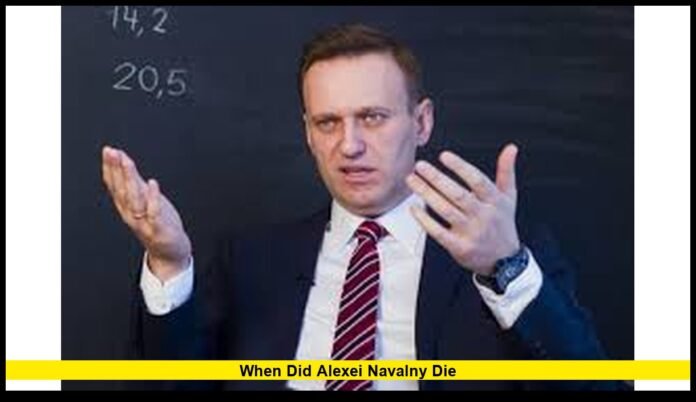

For readers searching when did Alexei Navalny die, the confirmed date is February 16, 2024. Russian prison authorities announced that the opposition leader died that day while serving a lengthy sentence in a high-security penal colony above the Arctic Circle. He was 47 years old.
His death sent shockwaves across Russia, Europe, and the United States. Governments issued statements within hours. Supporters gathered in cities despite police monitoring. Sanctions followed. As of February 14, 2026, the official date of death remains unchanged, though disagreements about the cause persist.
This report presents verified details about the date, the prison facility, the timeline leading up to his death, and the global response that followed.
The Confirmed Date and Official Announcement
Alexei Navalny died on February 16, 2024.
Russia’s Federal Penitentiary Service released a statement the same day. Officials said Navalny felt unwell after a walk at the penal colony. He reportedly lost consciousness soon afterward. Medical staff attempted resuscitation, but those efforts failed.
Authorities later informed his family. Public confirmation spread quickly across international media outlets.
Navalny was serving sentences that totaled more than 30 years on charges including extremism and fraud. Western governments criticized those convictions as politically motivated. Russian officials rejected that criticism.
Where Did Alexei Navalny Die?
Navalny died at Penal Colony No. 3 (IK-3) in Kharp, located in the Yamalo-Nenets Autonomous Okrug.
Key details about the prison:
- Situated north of the Arctic Circle
- Known informally as “Polar Wolf”
- Designed for high-security inmates
- Located in a region with extreme winter temperatures
Authorities transferred Navalny there in December 2023. His team said they lost contact with him during the transfer period. Weeks later, they confirmed his location at IK-3.
The remote setting raised concerns among supporters about access to medical care and communication.
Events in the Days Before His Death
In the weeks before February 16, Navalny appeared at court hearings via video link. He looked alert in those appearances and made remarks criticizing prison conditions.
Prison authorities stated he participated in routine daily activities. There were no public reports of sudden medical emergencies before the day of his death.
On February 16, officials reported that he felt ill following a scheduled outdoor walk. The official statement said he lost consciousness shortly afterward.
Emergency personnel were called. Resuscitation attempts continued for several minutes. He was pronounced dead the same day.
No independent autopsy findings have been released publicly as of early 2026.
Family Access and Funeral Arrangements
After his death, Navalny’s mother sought access to his body. Officials initially delayed the release. Authorities later transferred the body to his family on February 24, 2024.
Navalny’s funeral took place on March 1, 2024, in Moscow.
Large crowds gathered outside the church and at the cemetery. Police monitored the area heavily. Videos from the day showed thousands lining the streets. Some attendees reported brief detentions in the days surrounding memorial events.
The burial became one of the most visible public gatherings connected to Russia’s political opposition in recent years.
Background: Imprisonment and Legal Cases
Navalny had been a prominent critic of President Vladimir Putin for more than a decade. He gained recognition through investigations into alleged corruption among high-level officials.
In August 2020, Navalny fell seriously ill during a flight within Russia. He was later treated in Germany after doctors identified a nerve agent in his system. He recovered and returned to Russia in January 2021, where authorities arrested him at the airport.
From 2021 through 2023:
- Courts convicted him on multiple charges.
- Judges extended his prison terms.
- Authorities placed him in solitary confinement several times.
- Transfers between facilities limited communication with lawyers.
In August 2023, a court sentenced him to an additional 19 years in prison on extremism-related charges. Officials later moved him to the Arctic penal colony.
Health Concerns During Incarceration
Throughout his imprisonment, Navalny’s legal team reported health concerns.
Public court filings and statements indicated:
- Significant weight loss
- Periods of restricted medical access
- Frequent solitary confinement
- Hunger strikes to protest prison conditions
Prison authorities stated he received medical supervision. Disputes over his treatment continued until his death.
His previous poisoning in 2020 remained part of international discussions about his health risks.
International Reaction
Within hours of the announcement, world leaders responded.
In the United States:
- The White House condemned the circumstances surrounding his imprisonment.
- Members of Congress issued bipartisan statements.
- Additional sanctions targeted Russian officials and institutions.
The European Union imposed new restrictive measures. Several European capitals saw public memorials.
Russian authorities rejected accusations of wrongdoing. Officials maintained that Navalny died of natural causes.
The disagreement intensified diplomatic tensions that were already strained.
Impact on U.S.–Russia Relations
Navalny’s death deepened existing divides between Washington and Moscow.
U.S. policymakers referenced his case during debates about:
- Sanctions policy
- Support for Ukraine
- Human rights measures
- Relations with Russian civil society
Sanctions introduced in 2024 expanded financial and travel restrictions on certain Russian figures.
As of 2026, many of those measures remain in place.
Domestic Reaction Inside Russia
Inside Russia, reactions varied.
Supporters attempted to lay flowers at public memorial sites in multiple cities. Authorities removed some of those memorials. Reports indicated temporary detentions in several urban centers.
State media coverage focused primarily on official statements. Independent outlets faced restrictions or had already relocated operations outside the country.
Despite the heavy security presence, images from Moscow during the funeral circulated widely on social media platforms.
Timeline of Key Events
Here is a clear overview of major dates connected to Navalny’s death:
| Date | Event |
|---|---|
| August 2020 | Navalny poisoned and later treated in Germany |
| January 2021 | Arrested upon return to Russia |
| August 2023 | Sentenced to 19 additional years |
| December 2023 | Transferred to IK-3 in Kharp |
| February 16, 2024 | Authorities announce his death |
| February 24, 2024 | Body released to family |
| March 1, 2024 | Funeral held in Moscow |
This timeline remains consistent across official records and international reporting as of February 2026.
Political Context at the Time of His Death
Navalny died one month before Russia’s presidential election in March 2024.
President Vladimir Putin secured another term in that election. Navalny’s political organization had already been designated extremist and banned inside Russia.
Most of his closest associates were living abroad by early 2024.
His death removed the country’s most prominent opposition figure from the political landscape.
Why the Date Matters
The question of when did Alexei Navalny die carries historical weight beyond the basic fact of the calendar.
February 16, 2024, now marks:
- A turning point in Russia’s opposition movement
- A catalyst for expanded international sanctions
- A defining moment in modern Russian political history
The date appears in government statements, legal records, and diplomatic discussions.
Two years later, it continues to influence debates about political repression and accountability.
Ongoing Disputes About Cause of Death
Russian authorities stated that Navalny died of natural causes. His allies strongly disputed that claim.
As of today:
- No international tribunal has issued a legal finding assigning responsibility.
- Russian investigators have not released detailed public medical documentation.
- Western governments maintain criticism of the conditions surrounding his imprisonment.
The lack of an independent public report leaves some questions unresolved. However, the confirmed date of death has not changed.
Navalny’s Legacy
Navalny built his public profile through anti-corruption investigations that drew millions of online viewers. His political campaigns mobilized younger voters in several major cities.
He positioned himself as a nationalist reformer who challenged entrenched political elites.
After his death, supporters held memorial events in cities including Washington, New York, London, and Berlin. His speeches and investigative videos continue to circulate online.
His name remains central in discussions about political opposition in Russia.
Clear Answer for Readers
To state it directly: Alexei Navalny died on February 16, 2024, at Penal Colony No. 3 in Kharp, Russia.
That date has been confirmed by Russian authorities and acknowledged worldwide. As of February 14, 2026, there has been no official revision to that timeline.
The broader political consequences continue to unfold, but the date itself stands firmly in the historical record.
What are your thoughts on the long-term global consequences of Navalny’s death? Join the conversation and stay informed as developments continue to shape international affairs.