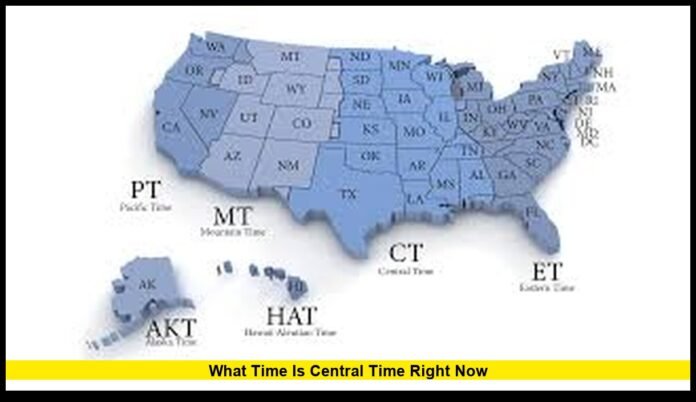

As of January 21, 2026, millions of Americans are asking what time is central time right now to keep their schedules synchronized with one of the country’s most widely used time zones. The Central Time Zone, often referred to simply as “Central Time,” covers a massive portion of the U.S., stretching from the Great Lakes down through the South and into parts of the Midwest. Understanding exactly what hour it is in this zone is critical for travelers, business professionals, and anyone coordinating across different regions of the country.
Currently, the United States is observing Central Standard Time (CST), which is six hours behind Coordinated Universal Time (UTC−6). The shift to Central Daylight Time (CDT)—which is one hour ahead at UTC−5—will not occur until March 8, 2026, when daylight saving time begins nationwide.
Understanding the Central Time Zone
Central Time is the second of four main continental U.S. time zones, positioned between Eastern and Mountain Time. It runs from portions of the Great Lakes region down to the Gulf of Mexico, covering both major metropolitan areas and vast rural territories.
Some of the most populated cities using Central Time include:
- Chicago, Illinois
- Dallas, Texas
- Houston, Texas
- Minneapolis, Minnesota
- Kansas City, Missouri
- New Orleans, Louisiana
Each of these cities shares the same time year-round, except when daylight saving adjustments occur in spring and fall. During winter months, the region operates under CST (UTC−6). Once daylight saving begins in March, clocks shift to CDT (UTC−5) for eight months.
Current Time and Daily Conversions
When comparing Central Time to other U.S. zones, the difference is simple:
- One hour behind Eastern Time (ET)
- One hour ahead of Mountain Time (MT)
- Two hours ahead of Pacific Time (PT)
For example, if it’s 12:00 PM in New York (Eastern Time), the current time in Chicago is 11:00 AM Central Time. These differences are consistent throughout the winter, changing only when daylight saving time begins or ends.
In early 2026, most devices and systems in the U.S. automatically adjust to these time changes. Smartphones, computers, smart home assistants, and even car dashboards rely on network data to stay synchronized. Still, for travelers or professionals managing events across states, manually confirming local time remains a smart habit.
States in the Central Time Zone
The Central Time Zone spans 20 states, though not all are entirely within its boundaries. Some states share borders where time zones split, requiring residents and travelers to be aware of which section they’re in.
| State | Coverage |
|---|---|
| Alabama | Entire state |
| Arkansas | Entire state |
| Illinois | Entire state |
| Iowa | Entire state |
| Louisiana | Entire state |
| Minnesota | Entire state |
| Mississippi | Entire state |
| Missouri | Entire state |
| Oklahoma | Entire state |
| Wisconsin | Entire state |
| Florida | Western Panhandle only |
| Indiana | Northwest and Southwest corners |
| Kansas | Most of the state |
| Kentucky | Western region |
| Michigan | Western Upper Peninsula |
| Nebraska | Eastern region |
| North Dakota | Eastern half |
| South Dakota | Eastern half |
| Tennessee | Western and Central regions |
| Texas | Most of the state |
The Central Time Zone’s reach includes several of the nation’s most important commercial and agricultural areas, making accurate timekeeping vital for industries such as logistics, finance, energy, and communications.
Daylight Saving Time in 2026
In 2026, daylight saving time in the Central Zone will begin on Sunday, March 8, at 2:00 AM CST, when clocks jump forward one hour to 3:00 AM CDT. This shift will last until Sunday, November 1, 2026, when clocks return to 2:00 AM CST.
The seasonal adjustment allows for longer daylight hours in the evening during spring and summer. Businesses, schools, and broadcasters all align their schedules to these transitions, ensuring consistency across the country. While some states have debated permanent daylight saving time, all Central Time states currently follow the national standard.
How Central Time Impacts Daily Life
Central Time influences almost every aspect of daily life in the United States—from the opening of financial markets to live sports broadcasts and nationwide news coverage.
Business and Finance:
- The Chicago Mercantile Exchange (CME), one of the largest derivatives marketplaces in the world, operates on Central Time.
- The New York Stock Exchange opens at 8:30 AM Central and closes at 3:00 PM Central, setting the rhythm for national financial activity.
Broadcasting and Entertainment:
- Most major television networks schedule their shows for 8:00 PM Eastern / 7:00 PM Central.
- National events like award shows, debates, and sports championships often list both Eastern and Central start times to reach the widest audience.
Air Travel:
- Major airline hubs such as Dallas/Fort Worth (DFW), Chicago O’Hare (ORD), and Houston Intercontinental (IAH) operate on Central Time. Accurate coordination ensures flight schedules remain synchronized nationwide.
The Importance of Accurate Timekeeping
Time synchronization in 2026 is largely automated. Modern devices connect to online servers that update to the correct time based on GPS and internet data. However, maintaining accurate time remains critical for businesses and individuals.
If your phone or computer displays incorrect time, verify the settings under “Automatic Time Zone” or manually select a city like Chicago or Dallas to reset it to Central Time.
Smartwatches, voice assistants, and even vehicle infotainment systems now rely on cloud synchronization. This eliminates most manual errors, but travelers crossing multiple time zones in a single day—by flight or road—should double-check upon arrival.
Global Relevance of Central Time
In the global context, Central Time serves as a reference point for many international transactions and communications. Because it’s offset by six hours from UTC, converting time between Central and global standards is straightforward.
For example:
- When it’s 12:00 PM CST, it’s 6:00 PM UTC.
- During daylight saving time, 12:00 PM CDT equals 5:00 PM UTC.
This alignment supports global business operations, especially between U.S. companies and partners in Europe or South America.
Frequently Asked Questions About Central Time
1. What’s the difference between CST and CDT?
CST (Central Standard Time) is used from November through early March and is six hours behind UTC. CDT (Central Daylight Time) begins in March and is five hours behind UTC.
2. Does every U.S. state in Central Time observe daylight saving?
Yes. Every state currently following Central Time observes daylight saving time, adjusting clocks forward in March and backward in November.
3. Why do TV schedules list both Eastern and Central times?
Because these two zones cover the majority of the U.S. population, dual listings help viewers know exactly when a show or event begins in their region.
4. How can I check the exact Central Time right now?
The easiest methods are using your smartphone, asking a smart speaker, or adding a city like Chicago to your device’s world clock list.
5. Is Central Time used in Mexico or Canada?
Yes. Parts of both countries share Central Time, creating seamless business coordination across North America.
Technology and the Future of Time Zones
As digital systems continue to advance, the accuracy of timekeeping will only improve. Cloud servers, global positioning satellites, and atomic clock synchronization ensure near-perfect consistency between devices.
In 2026, most connected systems adjust for daylight saving automatically, reducing confusion for users. Some discussions have resurfaced about eliminating daylight saving altogether to simplify time management, but no national policy change has been enacted. For now, Central Time will continue to switch between CST and CDT each year.
How to Stay On Track Across Time Zones
For professionals working with national teams or traveling frequently, time zone management can be simplified with a few practical habits:
- Add multiple clocks to your device for key cities in different zones.
- Enable automatic updates for daylight saving time.
- Plan meetings using time zone converters to avoid scheduling errors.
- Check flight itineraries closely, as departure and arrival times are always listed in local time.
Keeping these steps in mind ensures you always know the correct time, no matter where you are.
Economic and Cultural Role of Central Time
The Central Time Zone is more than just a clock boundary—it’s a defining element of American life. The region represents a blend of economic powerhouse states, agricultural hubs, and cultural landmarks.
From the trading floors of Chicago to the music stages of Nashville and the energy fields of Texas, this zone drives commerce, innovation, and creativity. Events like Mardi Gras in New Orleans, State Fairs in Texas, and sports championships in Minneapolis all run on Central Time, anchoring local and national schedules alike.
Businesses across the U.S. often use Central Time as a neutral reference point when coordinating with both coasts, giving it a balanced position in national logistics and communication networks.
Final Thoughts
As of this moment, Central Standard Time continues to guide millions of Americans through their daily routines. From major corporate operations to family dinner times, this time zone remains at the heart of the nation’s rhythm. Whether you live within its borders or work with partners across states, understanding Central Time ensures your day runs smoothly.
Always double-check your devices, especially during daylight saving transitions, to make sure you’re perfectly aligned with the Central Time schedule.