
The bright “star” next to the Moon tonight, January 4, 2026, is actually the planet Jupiter
If you have looked up this evening and wondered what star is next to the Moon tonight, the answer is as dazzling as the view itself. Across the United States, a bright, steady “star” rests close to the Moon in the early evening sky. That object isn’t a star at all—it’s Jupiter, the king of planets, glowing beside the slender crescent Moon in one of January’s most eye-catching celestial displays.
A Stunning Lunar–Jovian Encounter
As darkness settles on the evening of January 4, 2026, the sky offers one of the most visually striking planetary pairings of the year. A young crescent Moon, only a few days removed from its new phase, appears in close alignment with Jupiter, the largest planet in the solar system. Together, they command attention low in the southwestern sky, emerging about 45 minutes after sunset as twilight slowly fades.
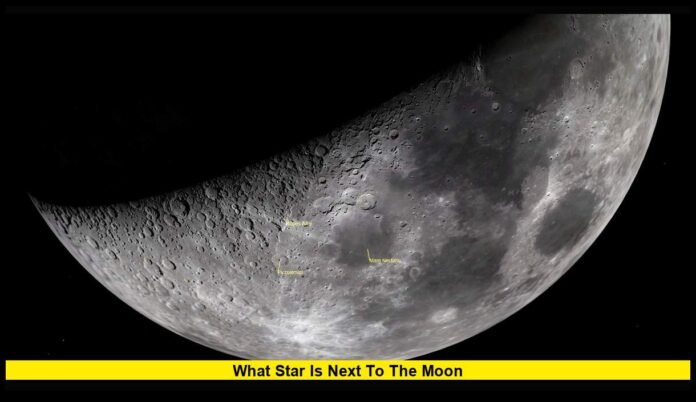
The contrast between the two objects is especially captivating. The Moon displays a thin, softly glowing crescent, its unlit portion faintly visible through earthshine—a subtle illumination caused by sunlight reflecting off Earth’s surface. Nearby, Jupiter shines with a steady, brilliant light that far outshines surrounding stars. Unlike stars, which tend to twinkle, Jupiter’s glow remains calm and unwavering, making it easy to identify even for casual observers.
Separated by roughly four degrees—about the width of two fingers held at arm’s length—the Moon and Jupiter appear almost side by side to the naked eye. This close spacing gives the illusion of a celestial partnership, drawing the eye naturally from the Moon’s curved edge to Jupiter’s bright point of light. Binoculars enhance the view even further, revealing Jupiter’s four largest moons lined up beside the planet and sharpening the Moon’s rugged surface along its terminator, where night meets day.
For most locations across the United States, the Moon passes slightly above Jupiter as the evening progresses. Their closest apparent approach occurs between approximately 6:30 and 8:00 p.m. local time, depending on location. During this window, the pairing is at its most dramatic, hanging gracefully against a deepening blue-to-black sky.
As the night continues, both objects drift lower together, maintaining their visual relationship as they slowly sink toward the horizon. By around 9:00 p.m., the Moon and Jupiter set in the western sky, concluding a brief but memorable display. Clear skies are all that’s needed to enjoy this event, making it an accessible and rewarding moment for both seasoned stargazers and anyone who happens to glance upward after sunset.
This lunar–Jovian encounter serves as a reminder of the dynamic motion of our solar system and the simple beauty that unfolds when familiar celestial objects briefly share the same patch of sky.
Why Jupiter Shines So Brightly
Jupiter’s exceptional brightness makes it one of the most eye-catching objects in the night sky, surpassed only by the Moon and Venus. Unlike stars, which generate their own light, Jupiter shines by reflecting sunlight, and it does so with remarkable efficiency. The planet is wrapped in thick layers of clouds made primarily of ammonia ice crystals, water ice, and other reflective compounds. These clouds act like a vast cosmic mirror, bouncing sunlight back toward Earth and giving Jupiter its distinctive golden-white glow.
Another reason Jupiter appears so bright is its immense size. As the largest planet in the solar system, it presents a broad reflective surface to the Sun. Even though it orbits far beyond Mars, its sheer scale allows it to rival much closer objects in apparent brightness. Its light also appears steady rather than twinkling because Jupiter’s disk is large enough to resist the atmospheric distortion that causes stars to flicker.
In early 2026, Jupiter’s brilliance is enhanced by its position in relation to Earth and the Sun. During this period, the planet lies close to opposition, a configuration in which Earth passes between Jupiter and the Sun. From our perspective, Jupiter is then both closer than usual and fully illuminated, much like a full Moon. This alignment causes the planet to appear noticeably brighter and slightly larger in the sky than at other times of the year.
Because of these conditions, Jupiter is impossible to miss on clear evenings. It stands out even in light-polluted areas, making it a familiar beacon for casual skywatchers. A simple pair of binoculars reveals its four largest moons—Io, Europa, Ganymede, and Callisto—while a small telescope brings its cloud bands into view. Jupiter’s brilliance during this season is a vivid reminder that even distant worlds can dominate the night sky when geometry and reflection align just right.
How to Find Jupiter Beside the Moon Tonight
You don’t need to be an astronomer to enjoy this event. Here’s how to locate it:
- When to Look: Begin watching about 30–60 minutes after sunset.
- Where to Look: Face the southwest. The Moon will appear low on the horizon with Jupiter shining just to its lower right.
- What You’ll See: The slender crescent Moon glowing softly, with Jupiter gleaming nearby.
- Equipment Tip: Binoculars reveal Jupiter as a small disk, and a telescope can show its four largest moons — Io, Europa, Ganymede, and Callisto — as tiny specks lined up beside it.
Even in cities, where light pollution dims many stars, the Moon and Jupiter remain bright enough to pierce through the haze. For those in rural or suburban areas, the view becomes even more vivid against a dark sky.
A Celestial Coincidence Worth Watching
Events like tonight’s alignment happen because both the Moon and planets travel along nearly the same path in the sky, known as the ecliptic. As the Moon orbits Earth every 27.3 days, it regularly passes close to bright planets and stars. Occasionally, the alignment becomes tight enough that the Moon actually passes in front of a planet, temporarily hiding it from view. That’s called an occultation, though tonight’s encounter stops just short of that.
The Moon–Jupiter pairing tonight is particularly photogenic because of the thin lunar crescent. The soft Earthshine—the gentle glow illuminating the Moon’s darker side—adds a delicate beauty to the scene. This light is sunlight reflected off Earth’s surface and back onto the Moon, creating a subtle blue-gray shimmer.
What Makes January’s Sky Special
January evenings bring some of the clearest skies of the year for most of the U.S., especially across the western and central states. Cold, dry air enhances visibility, and with early sunsets, even children can catch sight of major celestial events before bedtime.
Alongside the Moon and Jupiter, several other bright objects enhance tonight’s sky:
- Saturn glows faintly higher in the southwest as twilight fades.
- Aldebaran, the red-orange “eye” of Taurus the Bull, rises in the east.
- The famous Pleiades star cluster sparkles nearby.
These sights make early January an excellent time for casual stargazing, even without telescopes or advanced equipment.
Why Jupiter Often Appears Near the Moon
The Moon and planets share the same general celestial highway — the ecliptic. Because of this, the Moon passes near each of the major planets every month. Jupiter, being one of the brightest and slowest-moving, tends to create the most dramatic encounters.
During early 2026, Jupiter resides in the constellation Aries, moving gradually eastward. The Moon, which travels much faster across the sky, catches up with and overtakes Jupiter every few weeks. These regular alignments allow astronomers and hobbyists alike to track the Moon’s orbit with simple visual observation.
For Amateur Astronomers: What to Expect Through a Telescope
If you own even a modest backyard telescope, tonight’s event offers more than a pretty pairing. Through a telescope of 3–4 inches in diameter, Jupiter appears as a large, banded disk. The planet’s equatorial cloud belts—alternating light and dark stripes—become visible, shifting subtly in color tones of beige and rust.
You may also see up to four tiny moons. Depending on their orbits tonight, one or more may appear on either side of the planet. These moons move noticeably over a few hours, providing an exciting, dynamic view.
The Moon, meanwhile, reveals intricate surface details. The terminator line—the boundary between sunlight and shadow—shows craters and mountains in sharp relief. The contrast between the Moon’s surface and Jupiter’s glow makes tonight’s sky one of the most rewarding for small-scope observers.
Photographing the Event
For photographers, this is a perfect opportunity to capture a lunar-planetary conjunction. A few tips help ensure success:
- Use a tripod to avoid blurring.
- Set ISO between 100–400 to reduce noise.
- Expose briefly (1/10 to 1/20 second) so the Moon’s brightness doesn’t overpower Jupiter.
- Frame with foreground objects—trees, hills, or city skylines—for visual depth.
A simple smartphone camera can capture the pairing if stabilized properly. Apps like NightCap Camera or ProCam allow manual control of exposure and focus, enhancing results dramatically.
The Science Behind Their Alignment
Astronomers calculate conjunctions like this using precise orbital mechanics. The Moon’s orbit is tilted about five degrees relative to Earth’s path around the Sun. This slight tilt means it doesn’t always pass directly over planets, but every few weeks, it appears near one.
Using data from the Jet Propulsion Laboratory’s Horizons system, scientists can predict exact times and separations decades ahead. For January 4, 2026, the Moon’s closest apparent pass north of Jupiter occurs around 7:15 p.m. Central Time, visible across the lower 48 states.
These projections ensure that observers everywhere—from Florida to Oregon—can look up and share the same cosmic moment.
Upcoming Sky Highlights
If tonight’s spectacle inspires you to explore the sky more often, mark your calendar for a few other notable events in early 2026:
- January 9: The Moon passes near the Pleiades and bright star Aldebaran in Taurus.
- January 22: A stunning morning alignment between the Moon and Venus.
- February 2: Another close meeting of the Moon and Jupiter in the evening sky.
- March 14: The Moon glides past Mars before dawn.
Each of these pairings creates its own unique photo opportunity and learning moment for sky enthusiasts.
The View Across Different Regions of the U.S.
While the Moon–Jupiter pairing is visible nationwide, the viewing angles differ slightly by location:
| Region | Best Viewing Time | Position of Jupiter |
|---|---|---|
| East Coast | 6:15–7:30 p.m. | To the lower right of the Moon |
| Central U.S. | 6:45–8:00 p.m. | Slightly below the Moon |
| Mountain States | 7:00–8:30 p.m. | To the right of the Moon |
| West Coast | 7:15–8:45 p.m. | Just below the Moon |
Viewers near the Pacific coast will see the pair set later and slightly closer to the horizon, offering a deep-orange twilight backdrop perfect for photography.
Cultural Significance of Moon–Planet Pairings
Throughout history, bright planetary alignments with the Moon have carried symbolic meaning. Ancient civilizations tracked these pairings to mark time, celebrate seasonal changes, and forecast celestial cycles. Jupiter, often associated with kingship and prosperity, was viewed as a sign of strength and renewal when appearing beside the Moon.
While modern astronomy now explains these events scientifically, the sense of wonder remains. Watching the Moon and Jupiter together connects us to a timeless rhythm shared by every generation that has ever looked up at the night sky.
Why You Should Step Outside Tonight
It’s easy to overlook the sky amid modern routines, but nights like this offer a gentle reminder of our place in the cosmos. You don’t need to travel or use expensive tools—just step outdoors, breathe the cool January air, and take a few quiet moments to look southwest. The Moon and Jupiter will be shining there, side by side, offering beauty that’s both ancient and immediate.
Whether you’re sharing the view with family, capturing it on camera, or simply pausing for reflection, tonight’s scene promises to be one of the most memorable sights of the winter sky.
Take a moment to look up tonight — and share what you spot near the Moon in the comments below. Your observation might encourage someone else to rediscover the joy of the night sky.