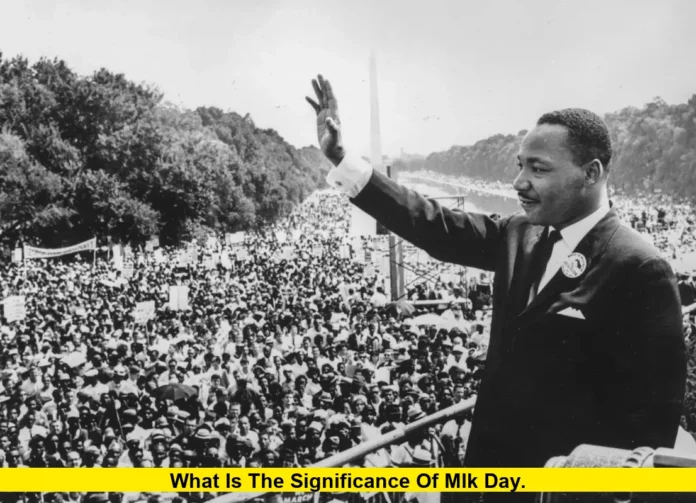

Each year on the third Monday of January, the United States observes what is the significance of MLK Day, a federal holiday that honors the life, leadership, and lasting impact of Dr. Martin Luther King Jr. In 2026, the holiday is observed on Monday, January 19, bringing together millions of Americans in reflection, learning, and service. More than a commemorative date, this day represents the nation’s ongoing commitment to civil rights, equality, and the belief that nonviolent action can bring meaningful social change.
Dr. King’s work transformed the legal and moral landscape of the United States. His leadership during the Civil Rights Movement helped end legally enforced racial segregation, strengthened voting rights, and inspired a broader movement for human dignity. The holiday that bears his name stands as a reminder that the pursuit of justice is not limited to history books but remains a living responsibility.
How MLK Day Became a Federal Holiday
Martin Luther King Jr. was born on January 15, 1929, in Atlanta, Georgia. He rose to national prominence during the 1950s and 1960s as a Baptist minister and civil rights leader who championed nonviolent protest. From the Montgomery Bus Boycott to the Birmingham Campaign and the March on Washington, his leadership helped bring about landmark changes in American law and society.
Following his assassination in 1968, there was a nationwide call to honor his legacy with a national holiday. After years of advocacy and legislative efforts, the U.S. government officially established Martin Luther King Jr. Day as a federal holiday in 1983. The first nationwide observance took place in 1986. The holiday is now observed on the third Monday of January each year, close to Dr. King’s birthday, and is recognized in all 50 states.
Why the Holiday Is More Than a Day Off
While MLK Day provides a break from regular work and school schedules for many Americans, its purpose goes far deeper. The day honors a leader whose vision of equality and justice reshaped the nation. It also serves as a time to reflect on the progress made since the Civil Rights Movement and the challenges that continue to exist.
Dr. King’s message centered on nonviolence, moral courage, and the belief that change could be achieved through peaceful action. His “I Have a Dream” speech in 1963 remains one of the most influential speeches in American history, calling for a nation where people are judged by their character rather than the color of their skin. The holiday encourages Americans to revisit these ideals and consider how they apply in today’s society.
A National Day of Service
One of the defining features of MLK Day is its designation as a National Day of Service. The holiday is often described as “a day on, not a day off,” emphasizing community involvement and volunteerism. Across the country, individuals and organizations participate in service projects that address local needs, such as food distribution, neighborhood cleanups, educational mentoring, and support for underserved communities.
This focus on service reflects Dr. King’s belief in collective responsibility and the power of community action. By encouraging Americans to give back, the holiday turns remembrance into action and transforms reflection into meaningful contribution.
Educational and Cultural Observances
Schools, universities, museums, and cultural institutions play a major role in observing MLK Day. Many hold lectures, panel discussions, and special programs that explore Dr. King’s life, his philosophy of nonviolence, and the broader history of the Civil Rights Movement.
Students learn about key events such as the Selma to Montgomery marches, the passage of the Civil Rights Act, and the Voting Rights Act. These educational efforts help ensure that new generations understand both the struggles and the achievements that shaped modern American democracy.
Cultural programs, including music performances, art exhibits, and community forums, also mark the day. Gospel choirs, spoken-word artists, and local performers often participate in celebrations that highlight the cultural roots of the movement and the enduring influence of Dr. King’s message.
How the Holiday Is Observed Across the United States
As a federal holiday, MLK Day affects a wide range of institutions and daily activities. Government offices, courts, and the U.S. Postal Service are closed. Financial markets do not operate, and many banks and public schools suspend regular operations.
At the same time, communities host parades, commemorative marches, and public ceremonies. Cities large and small organize events that bring together civic leaders, faith groups, students, and residents. These gatherings often include readings from Dr. King’s speeches, moments of silence, and discussions about social justice and civic engagement.
Volunteer initiatives are a central feature of the day. From large, coordinated service projects to small neighborhood efforts, Americans use the holiday to address issues such as hunger, education, housing, and environmental care. This nationwide participation reinforces the idea that the values Dr. King championed remain relevant in every community.
The Ongoing Relevance of Dr. King’s Vision
Understanding what is the significance of MLK Day also means recognizing why Dr. King’s work continues to resonate decades after his death. His leadership helped bring about critical legal changes, but he also spoke about economic justice, access to opportunity, and the importance of unity.
He believed that equality under the law must be matched by fairness in daily life. His advocacy extended beyond racial segregation to issues such as poverty, workers’ rights, and peace. These themes remain central to many national conversations today, making the holiday a time not only for remembrance but also for thoughtful discussion about the future.
MLK Day in 2026
In 2026, Martin Luther King Jr. Day is observed on January 19. Communities across the country are holding events that range from volunteer drives and educational programs to cultural celebrations and interfaith services. The holiday continues to serve as a unifying moment, bringing people together to honor a leader whose influence transcended his own time.
Public institutions are using the day to highlight the importance of civic participation. Many organizations encourage voter education, community dialogue, and youth involvement, reflecting Dr. King’s belief that democracy thrives when citizens are informed and engaged.
Why the Holiday Matters for Future Generations
For younger Americans, MLK Day offers an opportunity to learn about a pivotal period in U.S. history and to understand how individual leadership can drive national change. It teaches that progress often comes through perseverance, cooperation, and moral conviction.
The holiday also emphasizes that the principles Dr. King stood for are not confined to the past. His call for justice, compassion, and peaceful action remains a guide for addressing modern challenges and building stronger communities.
A Living Legacy
The significance of MLK Day lies in its ability to connect history with the present. It honors a man whose words and actions helped reshape the nation, and it challenges Americans to continue the work he began. By combining remembrance, education, and service, the holiday keeps Dr. King’s legacy active and relevant.
From classrooms and community centers to city halls and places of worship, the observance of MLK Day reflects a shared commitment to the values of equality and respect. It stands as a reminder that the pursuit of justice is an ongoing journey, one that requires participation from every generation.
Share your thoughts on how this day inspires you and stay connected as communities across the nation continue to honor Dr. King’s enduring legacy.