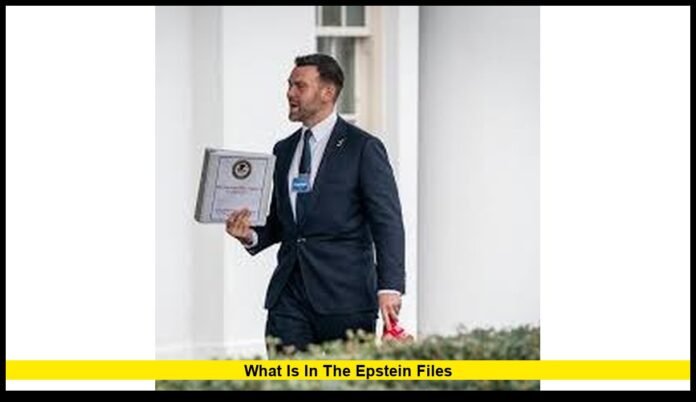

The question of what is in the Epstein files has taken center stage after thousands of pages of records were turned over to Congress by the Department of Justice and released publicly. These files include court documents, email correspondence, financial records and flight logs tied to Jeffrey Epstein—offering a deeper look into his network of influence, operations and connections.
Scope of the Epstein Files
The Epstein files encompass a vast array of materials that shed light on the operations, relationships, and alleged criminal activities of Jeffrey Epstein and his associates. Researchers and investigators categorize the materials into several major types, each offering distinct insights:
- Emails and Correspondence
Thousands of messages between Epstein, his inner circle, and numerous high-profile individuals are part of the publicly available records. These communications reveal the extent of Epstein’s social and professional network, potential influence over political and business figures, and the coordination of travel, events, and financial dealings. Analysts continue to comb through these exchanges for indications of complicity, knowledge of illicit activities, or efforts to manipulate legal outcomes. - Travel Documents and Flight Logs
Flight manifests, passenger lists, and travel itineraries tied to Epstein’s private planes, including the infamous “Lolita Express,” are central to understanding the movement of Epstein, his associates, and their guests. These records highlight the destinations, frequency of travel, and connections with prominent figures, offering potential leads on who may have been involved or aware of Epstein’s network. - Financial and Estate Records
Ledgers, banking documents, trust agreements, offshore accounts, and property transactions reveal the complexity of Epstein’s financial empire. The files detail how wealth was managed, transferred, and potentially used to support illicit activities or to maintain influence over others. Researchers use these materials to trace the flow of money and uncover possible enablers of Epstein’s operations. - Legal and Investigative Documents
Court filings, indictments, subpoenas, search warrants, seized hard drives, deposition transcripts, and investigative notes provide an unprecedented view into law enforcement’s handling of Epstein and his associates, particularly Ghislaine Maxwell. These documents expose both the legal strategies employed and the extent to which Epstein may have been shielded from full accountability for years. - Supplementary Evidence
In addition to the core categories above, the files include photographs, videos, contact lists, contracts, and personal diaries. These items provide context for social interactions, help identify potential victims or witnesses, and can corroborate other evidence in the files.
Together, these categories create a comprehensive picture of Epstein’s operations—illuminating his business dealings, social influence, and alleged criminal network. Researchers and investigators continue to analyze the files, uncovering patterns of manipulation, exploitation, and complicity that could have wide-reaching implications for understanding how Epstein’s network functioned and who may have been involved.
Newly Released Documents and What They Show
As more material from the Epstein files becomes public, a series of revelations is painting a more complete picture of the network that surrounded him and how it operated.
- Massive Document Releases
The House Oversight Committee has recently made over 33,000 pages of records publicly available, including court documents, internal communications, and investigative files that had not been previously disclosed. These documents provide insight into Epstein’s business dealings, personal connections, and the inner workings of his network. - Ongoing High-Level Connections
Certain email chains suggest that Epstein maintained active relationships with influential figures well beyond his 2008 plea deal. These communications indicate that his social and professional networks continued to operate even under legal scrutiny, potentially providing protection or access to powerful individuals. - Complex Financial Webs
The financial records reveal significant transfers among shell companies, trusts, and offshore accounts, shedding light on the mechanisms Epstein used to fund his operations and manage his estate. Analysts note that the transactions point to a highly sophisticated financial structure that may have facilitated illicit activity while minimizing scrutiny. - Travel and Flight Logs
Newly released travel records include detailed flight logs and passenger manifests, documenting trips to Epstein’s properties, including his island estate in the U.S. Virgin Islands. The logs, which include guest and crew lists, align with known visitation patterns and provide context for how Epstein coordinated his social and potentially illicit activities. - Investigative Materials and Language Patterns
Investigative documents show frequent references to “guests,” “arrivals,” and “events” at Epstein’s residences. Language analysts suggest that these terms may have been used as euphemisms to obscure illicit behavior. Cross-referencing these materials with flight logs and correspondence offers investigators leads into the broader network of participants.
Taken together, these newly released documents reveal that the Epstein files extend far beyond the actions of one individual. They illuminate a wider ecosystem spanning finance, real estate, philanthropy, and social connections, demonstrating how Epstein’s influence reached multiple sectors and raising critical questions about the role of associates, enablers, and institutions in facilitating or overlooking his activities.
Key Takeaways from the Papers
1. In-Depth Travel Network
One major insight from the Epstein files involves his global mobility: from New York to Florida, Paris to the U.S. Virgin Islands. Travel manifests list dates, names and aircraft—including attendees whose identities were previously unknown.
2. Complex Financial Architecture
Financial documents show Epstein’s estate and trust structures were significantly more intricate than previously acknowledged. Entries such as “grant,” “education donation,” or “consulting fee” appear alongside large sums leaving the United States, indicating sophisticated movement of funds.
3. High-Profile Connections in Plain Sight
The files contain communications referencing powerful persons in politics, academia, business and entertainment. While names alone do not imply wrongdoing, the volume and nature of their interactions with Epstein suggest broader relationships than were publicly recognized.
4. Efforts at Secrecy and Control
Many emails reveal Epstein’s concern with his public image and how to manage media or legal exposure. In several instances, he or his associates discussed how to “frame messages,” “monitor stories” and “lay low” in response to scrutiny.
What the Files Do Not Provide—Yet
Despite the unprecedented volume of material, the Epstein files still leave critical questions unanswered and several key gaps remain:
- No Confirmed “Client List”
To date, no comprehensive or verified list of individuals allegedly involved in Epstein’s trafficking network has been released. While speculation and indirect references exist in some documents, the files do not provide definitive confirmation of who participated in illicit activity. - Redacted Material
Many documents are heavily redacted, particularly those containing victim names, sensitive personal information, or details from ongoing investigations. These redactions limit the ability to fully reconstruct events or assess the roles of certain individuals. - Sealed Grand-Jury and Agency Records
Transcripts from grand-jury proceedings, certain DOJ internal communications, and investigative reports remain sealed or subject to strict court restrictions. These missing pieces prevent a complete legal and factual understanding of Epstein’s operations and associated networks. - Unprocessed Digital Evidence
Devices and server backups seized from Epstein’s residences may still be under forensic review. As a result, portions of his digital footprint—including communications, media, and financial data—are not yet publicly searchable or analyzed.
Until these gaps are addressed, the Epstein files provide partial transparency rather than full clarity. While they reveal significant insights into Epstein’s operations, financial networks, and social connections, the full scope of accountability—particularly regarding high-profile associates—remains uncertain.
Must Read-Epstein emails say Trump ‘knew about the girls’; new House Democrat pledges file release
Controversies and Political Fallout
The content of the Epstein files has triggered major legal and political ramifications:
- Bills like the Epstein Files Transparency Act (H.R. 4405) now seek to mandate the release of all unclassified Epstein-related records.
- Victim-advocacy groups argue the files underscore how Epstein avoided significant accountability for years and demand broader disclosure.
- Politically, accusations about select documents being withheld have created public distrust and fueled a narrative that powerful interests shielded Epstein’s activities.
- Investigations into how federal prosecutors handled earlier cases (such as Epstein’s 2008 plea deal) have reopened as lawmakers examine the files for potential prosecutorial failures or cover-ups.
Why These Files Matter to Public Oversight
Understanding what is in the Epstein files matters for several reasons:
- Accountability: The documents detail how a convicted sex offender could maintain elite access and influence despite serious charges.
- Systemic failure: They offer insight into how institutions—from financial regulators to law enforcement—may have overlooked or down-played key evidence.
- Transparency: The question of which parts of the files remain sealed speaks to broader debates about secrecy in justice and government.
- Victim empowerment: For survivors of trafficking and abuse, seeing these records public helps validate their experiences and supports legal action.
The Epstein files speak directly to questions of power, privilege and justice—in a system that too often treats wealthy perpetrators differently than ordinary criminals.
Notable Elements Found in the Files
| Category | Noteworthy Details |
|---|---|
| Travel logs | Flights to private island, guest lists with names & dates |
| Financial records | Offshore trusts, shell entities, large labeled “donations” |
| Correspondence | Emails referencing influential persons, social events |
| Investigative files | Court filings, search-warrant attachments, seized digital media |
| Network mapping | Guest lists, property visitation records, travel coordination |
These elements help explain the question of what is in the Epstein files—and how wide the scope of his operations may have been.
Latest Status & What’s Coming
- The Oversight Committee continues to review the files, with additional disclosures expected in incremental batches.
- Some members of Congress plan to hold hearings that could open the documents for public testimony from former prosecutors or agency officials.
- Litigation from Epstein’s victims may reference newly released archives in upcoming civil suits, potentially expanding publicly known names or connections.
- Some experts predict the remaining sealed parts of the files could involve foreign jurisdictions, intelligence-agency materials or highly sensitive banking records—information that may remain hidden for years.
For those tracking the case, the question of “what is in the Epstein files” remains dynamic. As more documents emerge, the picture continues to expand.
Conclusion
The phrase what is in the Epstein files now refers to a substantial body of evidence—emails, logs, financial documents, and investigation records—that reveal one of the most extensive networks of abuse, influence and secrecy in recent American history. While many questions remain unanswered and some records remain sealed, the documents released so far lay bare how Jeffrey Epstein sustained his operations and accessed elite institutions.
The files serve not only as a roadmap of Epstein’s world, but as a mirror for accountability—how systems failed, how privilege protected, and how transparency might begin to heal.
Do you believe the remaining Epstein files should be fully unsealed, no matter the names they contain? Share your thoughts below and stay tuned for further updates on this ongoing story.