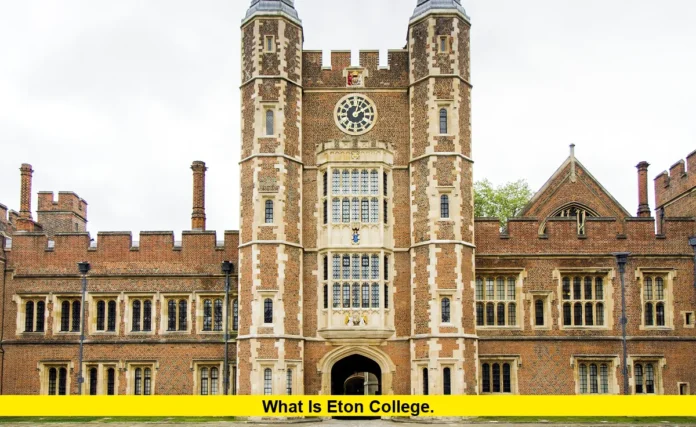

If you have recently searched what is Eton College, you are likely looking for more than just the name of a famous British school. Eton College is one of the United Kingdom’s oldest and best-known independent boarding schools, with a history dating back to the 15th century. The school has educated generations of prominent figures and is receiving renewed international attention after Prince George, the eldest son of Prince William and Catherine, Princess of Wales, began attending Eton in September 2026.
Located in Eton, Berkshire, close to Windsor Castle, the school combines centuries-old traditions with a modern academic and extracurricular program. It remains a boys’ boarding school and has approximately 1,350 pupils.
What Is Eton College?
Eton College is an independent boys’ boarding school in Eton, near Windsor in Berkshire, England. It was founded in 1440 by King Henry VI, who established the school as part of a broader educational and religious foundation.
The institution was originally created to provide education for boys, including a group of King’s Scholars who were intended to receive education without tuition costs. Other pupils, known historically as Oppidans, also attended but paid for their accommodation.
Today, Eton is a highly selective independent school serving boys primarily from around age 13 through the sixth form. Unlike a conventional day school, Eton is a boarding school, meaning pupils live in boarding houses during term time.
The school describes itself as a charity for the advancement of education, with the boys’ boarding school at its center. Its stated educational purpose emphasizes academic opportunity, personal development, creativity, independent thinking and preparation for making a positive contribution to society.
Where Is Eton College Located?
Eton College is located in the town of Eton in Berkshire, immediately across the River Thames from Windsor.
Its location is particularly notable because Windsor Castle is nearby. The school’s history has therefore been closely associated with the British monarchy for centuries.
The campus itself is extensive and historically significant. Eton’s own historical material describes the institution as having grown into a substantial community, with hundreds of buildings and a large staff supporting education, boarding and other activities.
The combination of its historic buildings, boarding houses, chapel, academic facilities and proximity to Windsor contributes to Eton’s distinctive identity.
When Was Eton College Founded?
Eton College was founded in 1440 by King Henry VI.
The school’s foundation charter dates to October 11, 1440. Henry VI envisioned an educational institution connected with a collegiate church and designed to educate scholars. The original foundation included provisions for King’s Scholars as well as other boys who could receive instruction.
Eton’s earliest educational program was very different from the curriculum offered today. In its early years, Latin was central to the school’s teaching, while Greek was added later. Historical records also show that pupils once followed extremely demanding schedules compared with modern educational standards.
Over the centuries, Eton expanded its curriculum and facilities. Mathematics was introduced during the 19th century, followed by broader academic, scientific, artistic and extracurricular opportunities.
The school gradually moved away from an education shaped primarily by family connections and toward greater emphasis on academic ability and merit. Eton states that its admissions system was changed so that boys could no longer simply have their names placed on a list at birth; modern entry involves assessment and selection.
Is Eton College a Boarding School?
Yes. Eton College is a boarding school, and boarding is a central part of the school’s structure.
According to the school’s current information, boys live in boarding houses where they receive academic, pastoral and social support. Eton currently has 25 boarding houses, with approximately 55 boys in each house. Boys have their own rooms from the beginning of their time at Eton.
The boarding system is intended to create smaller communities within the larger school. House staff oversee pupils’ welfare and progress, while older pupils can help younger boys settle into school life.
Boarding also allows students to participate in the school’s extensive range of activities outside normal classroom hours, including sports, music, drama, societies and other interests.
What Do Students Study at Eton College?
Eton offers a broad academic curriculum rather than focusing solely on traditional subjects.
The school currently lists 28 subjects, including a wide range of modern and classical languages. Its academic program is designed to encourage both strong examination performance and independent learning.
Depending on their age and academic stage, pupils can study subjects across areas such as:
- English and literature
- Mathematics
- Natural sciences
- History
- Geography
- Economics
- Politics
- Computer science
- Art and design
- Modern languages
- Latin and Greek
- Religious studies and philosophy
Eton’s sixth-form curriculum provides pupils with considerable flexibility in choosing subjects. An independent schools inspection report also noted that the curriculum allows students to combine subjects from very different academic areas, such as ancient Greek and mathematics or languages and science.
Academic education is only one part of the experience. Eton places substantial emphasis on activities such as sports, music, drama, societies and other forms of enrichment.
The school reported that 85% of GCSE grades achieved in 2025 were Grade 8 or 9, although examination results represent only one part of the school’s stated educational objectives.
How Does Admission to Eton College Work?
Admission to Eton is selective, and entry generally takes place at age 13, corresponding to Year 9 in the British education system.
For the main 13+ entry route, prospective pupils go through an assessment process. Eton’s current admissions information states that boys sit the ISEB Common Pre-Tests during Year 6, normally in October or November. The school also requests a report from the applicant’s head teacher.
The process can involve academic assessment, references and other stages before a conditional place is offered.
Eton also has specialist routes, including the King’s Scholarship. Candidates for the scholarship take examinations covering subjects including English, mathematics and science, alongside optional papers.
This means attending Eton is not simply a matter of being able to afford the fees. Applicants must satisfy the school’s admissions requirements and successfully navigate its selection process.
How Much Does Eton College Cost?
Eton is a fee-paying independent school, although it also provides financial assistance to eligible pupils.
For the 2026/27 academic year, Eton lists school fees at £21,891 per half term, including VAT. With three terms, that amounts to £65,673 in school fees over the academic year before additional charges.
There can also be additional costs. Eton states that extras vary according to the activities a pupil takes part in and are usually between approximately £500 and £1,500 per half term.
Music lessons can involve additional charges as well.
However, the school also operates financial-aid programs. Eton says that 18% of its boys received financial support toward fees during the 2023/24 academic year, with an average award of 71%. It also reported that 99 boys paid no fees at all during that period.
Consequently, the headline fee does not represent what every Eton pupil’s family necessarily pays.
Why Is Eton College So Famous?
Eton’s reputation comes from a combination of history, academic standing, alumni, royal connections and British public life.
The school has educated numerous prominent political figures. Its museum’s records include former British prime ministers such as Robert Walpole, William Pitt, William Ewart Gladstone, Arthur Balfour, Harold Macmillan and Boris Johnson, among many others.
Eton has also had a particularly visible connection with the British royal family.
King Charles III’s sons, Prince William and Prince Harry, both attended Eton. Prince William’s attendance was historically significant because he became the first British royal prince in the modern era to attend the school.
That royal connection has become especially relevant in September 2026.
Prince George Starts at Eton College
The latest major development surrounding Eton is the arrival of Prince George, the eldest child of Prince William and Catherine, Princess of Wales.
Prince George began his education at Eton College on Tuesday, September 8, 2026. He is 13 and second in line to the British throne. His parents accompanied him as he began his new school life, and he was welcomed by Eton’s headteacher, Simon Henderson.
George previously attended Lambrook School with his siblings, Princess Charlotte and Prince Louis.
His move to Eton has attracted significant international attention because it continues a family connection with the school. His father, Prince William, and uncle, Prince Harry, were both Eton pupils.
The development also illustrates why searches for what is Eton College have increased as people seek to understand the institution where the future king’s eldest son is now studying.
What Makes Eton Different From an Ordinary School?
Eton differs from many schools in several important ways.
First, it has an unusually long institutional history. The school dates to 1440, meaning its traditions and buildings have developed over more than five centuries.
Second, boarding is fundamental to the school experience. Rather than simply attending classes during the day, pupils live within house communities and participate in a wide range of academic and extracurricular activities.
Third, Eton has a highly specialized admissions system. Places are limited, and applicants must meet academic and other selection requirements.
Finally, the school maintains traditions that are distinctive to Eton. Pupils and staff use terminology that may sound unfamiliar outside the school, while formal clothing and long-established customs remain part of its identity.
At the same time, Eton presents itself as a modern educational institution. Its current curriculum includes science, technology, languages, humanities, creative subjects and a wide range of extracurricular opportunities.
Eton College and Its Changing Role
Although Eton remains strongly associated with Britain’s traditional establishment, the institution has also sought to broaden its educational reach.
The school says it provides substantial financial aid and works with educational partners beyond its own pupil population. It has also operated university preparation and summer programs involving students from state schools.
In its recent summer activities, Eton reported hosting state-school students through university preparation programs covering subjects ranging from mathematics and sciences to English, history and classics.
These initiatives reflect an effort to expand educational opportunities while retaining the school’s traditional boarding-school structure.
Eton College in 2026
Eton College remains a prominent institution in British education, but its current identity is not based solely on its history.
In 2026, it continues to operate as an independent boys’ boarding school with approximately 1,350 pupils, a broad curriculum and extensive extracurricular opportunities. Its 25 boarding houses provide the residential framework for school life, while academic departments offer a wide selection of subjects.
The arrival of Prince George has brought renewed attention to the school, but Eton’s significance extends well beyond its royal connections. Its alumni include generations of politicians, writers, academics, artists and other prominent figures.
For anyone trying to understand what is Eton College, the simplest description is that it is a historic, highly selective independent boys’ boarding school near Windsor that combines a 15th-century foundation with a modern academic and extracurricular education.
Final Thoughts
Eton College is far more than a famous name associated with Britain’s royal family. Founded by King Henry VI in 1440, it has developed into one of Britain’s most recognizable independent boarding schools, with a selective admissions process, extensive academic curriculum, distinctive traditions and a substantial financial-aid program.
The school is particularly prominent in the news in September 2026 because Prince George has begun his education there. His arrival has once again focused international attention on an institution that has played a significant role in British education and public life for centuries.
Stay updated for the latest developments about Eton College, Prince George’s education and other major education stories, and share your thoughts in the comments.