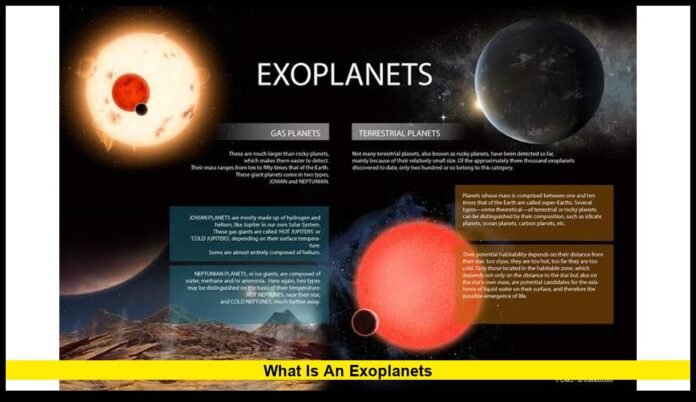

For anyone wondering what is an exoplanet, it is a planet that exists beyond our solar system, typically orbiting a star other than the Sun. These distant worlds range from small rocky planets to enormous gas giants, and some occupy orbits that are completely unlike anything found around our Sun. As astronomers continue surveying the Milky Way, the known population of these worlds is growing rapidly, giving scientists an increasingly detailed look at how planets form, evolve, and potentially develop environments capable of supporting life.
The study of exoplanets has changed dramatically since the first confirmed discoveries in the 1990s. Astronomers once had evidence of planets only within our own solar system. Today, thousands of confirmed worlds have been identified, while many more potential planets remain under investigation.
The latest NASA Exoplanet Archive data show that the confirmed total reached 6,366 exoplanets on September 11, 2026. The archive’s catalog continues to change as researchers confirm new planets, update measurements and occasionally remove objects that are determined to be false positives.
What Is an Exoplanet?
An exoplanet is a planet located outside the solar system.
Earth, Mars, Jupiter and Saturn are planets, but they are not exoplanets because they orbit the Sun. A planet orbiting another star is generally considered an exoplanet.
The term describes a planet’s location rather than its physical characteristics. That means exoplanets can be incredibly diverse.
Scientists have identified worlds that are:
- Smaller than Earth
- Similar to Earth in size
- Several times more massive than Earth
- Larger than Neptune
- Comparable to Jupiter
- Rocky
- Gaseous
- Extremely hot
- Very cold
- Located close to their stars
- Traveling around their stars at much greater distances
This diversity is one of the most important discoveries of modern astronomy. Our solar system is only one example of how planets can be arranged.
How Many Exoplanets Are Known in 2026?
The number of confirmed exoplanets has passed 6,000 and continues to increase.
The NASA Exoplanet Archive recorded 6,366 confirmed planets as of September 11, 2026. It also tracks thousands of candidates identified by missions and researchers that still require confirmation.
Recent additions demonstrate how quickly the catalog changes. In September 2026, six new planets were added in one weekly update, including two warm Jupiters and four cold giant planets discovered through gravitational microlensing.
The total should therefore be viewed as a continually changing scientific catalog rather than a fixed number.
A planet candidate may initially appear convincing but later be rejected if researchers discover that another astronomical phenomenon produced the original signal. Conversely, improved observations can confirm a candidate that had remained uncertain for years.
Why Are Exoplanets So Difficult to Find?
Finding a planet around another star is considerably harder than observing planets in our solar system.
The main problem is distance and brightness.
A star produces or reflects enormous amounts of light, while an orbiting planet is comparatively faint. When viewed from Earth, the light from the star can overwhelm the planet’s much weaker signal.
For this reason, astronomers often search for indirect evidence.
Rather than waiting to see a planet directly, researchers measure what happens to its host star.
A planet can make its star appear slightly dimmer, cause the star to wobble, or produce other measurable effects. These tiny signals can reveal the presence of a planet even when the planet itself cannot be seen.
How Are Exoplanets Discovered?
Astronomers use several techniques to locate and confirm exoplanets. Each method reveals different information.
The Transit Method
The transit method is one of the most successful approaches to finding planets beyond the solar system.
A transit occurs when a planet passes between its star and an observing telescope. From our perspective, the planet blocks a tiny amount of the star’s light.
Sensitive instruments can detect this small dip in brightness.
If the dip repeats at regular intervals, astronomers can investigate whether a planet is responsible.
Transit observations can reveal:
- The approximate radius of a planet
- Its orbital period
- The length of its year
- Its distance from its host star
- Other properties of the planetary system
NASA’s Transiting Exoplanet Survey Satellite, or TESS, is designed specifically to search for these changes in brightness around nearby bright stars.
The Radial Velocity Method
A planet’s gravity affects its host star.
Although the star is vastly more massive, the planet causes the star to move slightly around the system’s common center of mass.
Astronomers can detect this movement through changes in the star’s spectrum.
The technique is called radial velocity because scientists measure changes in the star’s motion toward or away from Earth.
Radial velocity measurements are especially valuable because they can help determine a planet’s mass.
When radial velocity data are combined with transit observations, scientists can estimate the planet’s density. That can provide clues about whether the world is likely to be rocky, gaseous or a mixture of different materials.
Gravitational Microlensing
Gravitational microlensing uses Einstein’s prediction that gravity bends light.
When a foreground star passes close to the line of sight to a more distant star, the foreground star’s gravity can temporarily magnify the background star.
If the foreground star has a planet, that planet can create an additional signal in the brightening event.
Microlensing is particularly useful because it can find planets at orbital distances that are difficult to investigate using transit observations.
It can also reveal planets that are extremely distant from Earth.
Direct Imaging
Direct imaging attempts to observe an exoplanet itself.
This is technically difficult because the planet can be dramatically fainter than its host star.
Astronomers use advanced instruments and optical systems designed to reduce the overwhelming glare of the star.
Direct imaging has already produced important discoveries. In 2026, observations with the James Webb Space Telescope helped identify Beta Pictoris d, a giant planet in the well-studied Beta Pictoris system. Unlike conventional direct imaging discoveries, researchers identified the planet through the distinctive chemical fingerprint of its atmosphere.
What Types of Exoplanets Exist?
The thousands of confirmed exoplanets do not fit into one simple category.
Rocky Worlds
Rocky exoplanets are composed largely of solid materials.
Earth is an example of a rocky planet in our solar system, along with Mercury, Venus and Mars.
Scientists are particularly interested in rocky exoplanets because they can potentially have solid surfaces and environments where complex chemistry may occur.
However, being rocky does not automatically mean that a planet is habitable.
Super-Earths
Super-Earths are planets that are more massive than Earth but generally less massive than Neptune.
Despite the name, a super-Earth is not necessarily a larger version of Earth.
These planets can have very different compositions. Some may be predominantly rocky, while others may possess substantial atmospheres or mixtures of rock and gas.
Super-Earths are particularly interesting because there is no exact equivalent in our solar system.
Mini-Neptunes
Mini-Neptunes occupy a size range between Earth and Neptune.
They may contain rocky or icy interiors surrounded by substantial gaseous atmospheres.
These planets are common among known exoplanet populations, yet their formation and atmospheric evolution remain active areas of research.
Gas Giants
Gas giants are massive planets with thick atmospheres dominated by gases.
Jupiter and Saturn are familiar examples from our solar system.
Other planetary systems contain giant planets that behave very differently from Jupiter and Saturn. Some orbit extraordinarily close to their stars and experience extreme temperatures.
Hot Jupiters
Hot Jupiters are gas giants that orbit unusually close to their host stars.
Their orbital periods can be only a few days, compared with Jupiter’s roughly 12-year journey around the Sun.
Because they are so close to their stars, hot Jupiters are often easier to detect using the transit method.
They also provide useful laboratories for studying planetary atmospheres under extreme conditions.
What Does the Habitable Zone Mean?
The habitable zone is one of the most frequently discussed concepts in exoplanet science.
It describes the range of distances around a star where temperatures could potentially allow liquid water to exist on a planet’s surface under suitable atmospheric conditions.
It is sometimes called the “Goldilocks zone.”
But the concept should not be misunderstood.
A planet inside the habitable zone is not automatically habitable, and it certainly is not proof of life.
Atmospheric composition, pressure, clouds, greenhouse effects, stellar activity and geological processes can all influence the actual environment.
A planet could technically occupy the right orbital region while having conditions that are hostile to life as we know it.
Could Exoplanets Have Life?
Earth remains the only world known to support life.
Scientists have not confirmed extraterrestrial life on any exoplanet.
Nevertheless, exoplanets give researchers a much larger collection of worlds to investigate.
Astronomers are particularly interested in planets that combine several potentially favorable characteristics, such as a rocky composition, an appropriate orbit and an atmosphere that could maintain suitable surface conditions.
Researchers also study atmospheric chemistry for possible signs of biological activity.
However, identifying a molecule associated with life would not automatically prove that life exists. Many molecules can be produced through non-biological chemical or geological processes.
The search therefore requires multiple lines of evidence.
How Do Scientists Study Exoplanet Atmospheres?
One of the biggest developments in exoplanet astronomy has been the ability to study planetary atmospheres.
When a planet crosses in front of its star, some of the star’s light can pass through the planet’s atmosphere.
Different gases absorb different wavelengths of light.
By separating the incoming light into a spectrum, scientists can search for absorption patterns associated with particular molecules.
The James Webb Space Telescope has been particularly important in this area.
Webb’s instruments can observe infrared light and analyze spectra to investigate atmospheric composition, clouds, temperature and other characteristics.
This represents a major change in exoplanet research. Scientists are no longer limited to discovering that a planet exists; in selected cases, they can begin investigating what surrounds the planet.
What Role Does the James Webb Space Telescope Play?
The James Webb Space Telescope is one of the most powerful observatories ever used for exoplanet research.
Its large mirror and infrared capabilities allow astronomers to study worlds that are difficult to characterize using visible-light observations.
Webb can investigate planetary atmospheres through techniques including transmission spectroscopy and eclipse spectroscopy.
It can also perform direct imaging of selected planets.
The telescope’s exoplanet program has already produced observations of atmospheric gases, clouds and other properties across different planetary systems.
In 2026, Webb observations of the Beta Pictoris system produced another significant example when astronomers identified Beta Pictoris d through the chemical signature of its atmosphere.
What Is TESS?
NASA’s Transiting Exoplanet Survey Satellite, better known as TESS, searches for planets by monitoring changes in the brightness of stars.
The spacecraft surveys large portions of the sky and concentrates on relatively bright nearby stars.
By 2026, TESS had become one of the major sources of confirmed exoplanets and planetary candidates.
Its discoveries are important not only because they add new planets to the catalog, but also because many of its targets are bright enough for follow-up observations with other telescopes.
This creates a powerful chain of discovery: one mission can identify a candidate, ground-based observatories can confirm it, and advanced space telescopes can then investigate its atmosphere.
What Is the Nancy Grace Roman Space Telescope?
NASA’s Nancy Grace Roman Space Telescope adds another major capability to exoplanet science.
Roman launched on August 30, 2026, beginning its journey toward its operational orbit.
The mission combines a wide field of view with infrared capabilities. For exoplanet research, Roman is expected to use gravitational microlensing to discover large numbers of distant worlds.
NASA expects Roman’s microlensing survey to reveal planets at orbital distances that are difficult to study through conventional transit searches.
Roman also carries a coronagraph technology demonstration designed to help scientists develop future methods for directly imaging planets around other stars.
The combination of Roman’s broad surveys and Webb’s detailed follow-up observations could provide a much fuller picture of planetary systems.
What Are Rogue Planets?
Not every planetary-mass object necessarily orbits a star.
Some planets can become detached from their original systems and travel through interstellar space. These are often called rogue or free-floating planets.
Without a nearby star providing substantial illumination, these worlds are extremely difficult to detect.
Microlensing provides one method for finding them because their gravitational influence can temporarily affect the light from a background star.
Rogue planets are especially intriguing because they challenge the traditional image of a planetary system as a collection of worlds permanently orbiting one central star.
Why Are Exoplanets Important to Astronomy?
The importance of exoplanet research extends far beyond simply counting distant planets.
Every planetary system provides another opportunity to investigate how worlds are created.
Astronomers can compare different systems to study:
- Planet formation
- Planetary migration
- Atmospheric evolution
- Rocky planet development
- Gas giant formation
- Star-planet interactions
- The frequency of potentially habitable environments
Studying thousands of planets also helps researchers determine how unusual or ordinary our own solar system may be.
For decades, astronomers had only one planetary system available for detailed comparison. The exoplanet revolution has transformed that situation.
What Is the Future of Exoplanet Research?
The next phase of research will increasingly focus on characterizing worlds rather than simply discovering them.
The question is gradually shifting from “Does this planet exist?” to “What is this planet actually like?”
Future studies are expected to investigate planetary atmospheres, surface conditions, orbital evolution and chemical composition in greater detail.
The arrival of Roman will also expand the search into regions of the galaxy that have been difficult to survey.
At the same time, Webb will continue conducting detailed observations of selected worlds.
Other current and future missions will contribute additional data, while increasingly sophisticated computer models and artificial intelligence tools can help researchers process enormous astronomical datasets.
As these capabilities improve, scientists may eventually be able to identify atmospheric combinations that provide much stronger evidence about whether a distant world could support life.
Why the Search for Earth-Like Planets Matters
The search for Earth-like planets is not simply a quest to find another Earth.
Scientists want to understand whether the processes that produced Earth’s environment are common or unusual.
If rocky planets with potentially suitable atmospheres turn out to be widespread, that would provide important information about planetary formation and the possible prevalence of environments suitable for life.
If such planets are rare, that would be equally significant.
Either outcome would improve our understanding of Earth’s place in the universe.
Frequently Asked Questions
What is an exoplanet in simple terms?
An exoplanet is a planet beyond our solar system. Most known exoplanets orbit stars other than the Sun.
How many confirmed exoplanets are there?
The NASA Exoplanet Archive reported 6,366 confirmed planets as of September 11, 2026. The number changes as new discoveries are confirmed and catalog entries are updated.
Is Earth an exoplanet?
No. Earth is a planet within our solar system because it orbits the Sun.
Are all exoplanets similar to Earth?
No. Exoplanets vary enormously in size, composition, temperature and orbital distance. Many are completely unlike Earth.
Does an exoplanet in the habitable zone contain life?
Not necessarily. The habitable zone only describes an orbital region where liquid water could potentially exist under appropriate atmospheric conditions. Scientists have not confirmed life beyond Earth.
Can exoplanets be seen directly?
Some can. Direct imaging is technically challenging because stars are much brighter than their planets, but specialized instruments can reveal certain large or widely separated worlds.
How far away are exoplanets?
Their distances range from relatively nearby stellar systems to thousands of light-years away. Even the nearest exoplanet systems are far beyond the reach of current human spaceflight.
The Growing Picture of Worlds Beyond the Sun
The discovery of thousands of planets beyond the solar system has fundamentally changed the way scientists view our cosmic neighborhood.
When researchers first began finding exoplanets, some of the results were surprising because many worlds did not resemble the planets in our own solar system. Over time, the growing catalog has revealed an extraordinary variety of planetary systems.
The latest discoveries continue to add to that picture. NASA’s exoplanet catalog surpassed 6,300 confirmed worlds in September 2026, while new observatories are opening additional ways to find and study planets.
For people asking what is an exoplanet, the basic answer remains straightforward: it is a planet beyond our solar system. But the science behind these distant worlds is anything but simple.
Every newly confirmed planet adds another piece to a much larger puzzle about how planetary systems form, how atmospheres develop and whether the conditions that allowed life to emerge on Earth might also exist elsewhere.
With TESS continuing its search, Webb examining planetary atmospheres and Roman beginning a new era of wide-field exoplanet surveys, the catalog of known worlds is likely to keep growing. The most important discoveries may ultimately be not just new planets, but new evidence about what makes a planet capable of becoming a world like our own.