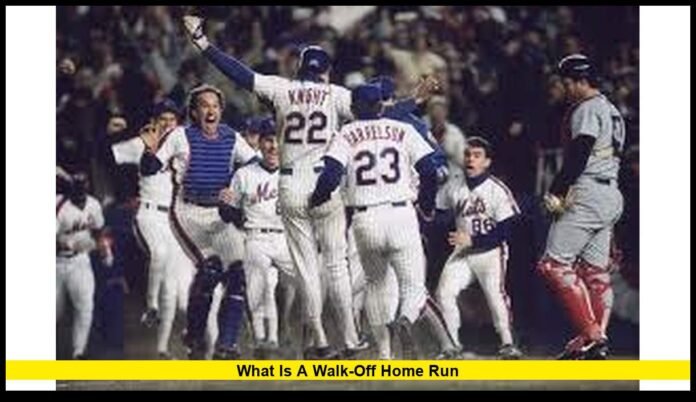

When fans talk about the most thrilling finishes in sports, one question always comes up — what is a walk-off home run? In the world of baseball, few moments match the sheer drama, adrenaline, and emotion of a walk-off homer. It’s a single swing that ends the game instantly, turning tension into euphoria for the home crowd and heartbreak for the visiting team.
A walk-off home run is not just a play — it’s the ultimate statement of victory. From its roots in baseball’s early days to the unforgettable moments that define modern Major League Baseball (MLB), this spectacular feat remains one of the sport’s most iconic and celebrated achievements.
Let’s break down exactly what makes a walk-off home run so special, how it happens, its history, and why it continues to capture the hearts of baseball fans across America.
Defining the Moment: What Is a Walk-Off Home Run?
A walk-off home run occurs when the home team hits a home run that immediately ends the game. It can only happen in the bottom half of the final inning — usually the ninth, or during extra innings — when the home team is tied or trailing.
The name comes from what happens next: the visiting team “walks off” the field in defeat, while the home team celebrates an instant, game-ending victory.
Here’s how it works step-by-step:
- The home team is either tied or losing by a small margin.
- A batter hits a home run that puts their team ahead.
- Since the home team now has the lead, the game immediately ends — no more pitches, no more outs.
- The crowd explodes in celebration, and the batter rounds the bases as their teammates wait at home plate for the victory celebration.
It’s the most dramatic ending possible in baseball — a single swing that flips the outcome in an instant.
Why It’s Called a “Walk-Off”
The term “walk-off” was first popularized in the 1980s by Hall of Fame pitcher Dennis Eckersley. He used it to describe a pitcher’s frustration after giving up a game-ending hit — meaning, the only thing left to do was “walk off” the field.
Over time, the term evolved into something more celebratory for the winning team. Today, it’s universally used to describe any game-ending play, but the walk-off home run remains the most iconic version of all.
The Emotional Impact of a Walk-Off Home Run
There’s a reason walk-offs are replayed endlessly on sports networks — they embody every emotion that makes baseball special.
- For the home team: It’s the ultimate triumph, often celebrated with wild on-field pileups, Gatorade showers, and joyous chaos.
- For the fans: It’s an instant release of tension, transforming quiet anxiety into euphoric cheers.
- For the losing team: It’s heartbreak. One pitch changes everything, and there’s no chance to respond.
Unlike other sports, baseball doesn’t use a game clock. That means a walk-off is truly final — a sudden ending that nobody can predict until it happens.
How a Walk-Off Home Run Happens
Walk-off home runs depend on both timing and game situation. Here are the specific scenarios in which they occur:
- The home team is batting in the bottom of the ninth or later (extra innings).
- The score is tied or close (e.g., 3–3 or 4–3 with runners on base).
- A batter hits a home run, giving the home team a lead they didn’t previously have.
- Since the home team doesn’t need to bat again, the game ends instantly.
Walk-offs can happen with the bases empty, with runners on base, or even with the bases loaded — which leads to one of baseball’s most dramatic plays: the walk-off grand slam.
Types of Walk-Off Home Runs
Not all walk-off home runs are created equal. Depending on the situation, the emotional impact and rarity can vary significantly.
1. Walk-Off Solo Home Run
A one-run shot when the score is tied. It’s the most common type and often delivers pure, classic excitement.
2. Walk-Off Two-Run or Three-Run Home Run
Occurs when runners are on base and the home team is behind. The hit clears the fence, the lead flips, and the game ends in spectacular fashion.
3. Walk-Off Grand Slam
The rarest and most jaw-dropping version. The bases are loaded, the home team is trailing by three, and the batter crushes a home run that brings in four runs for an instant 9th-inning win. Fans often call it “the ultimate walk-off.”
4. Inside-the-Park Walk-Off Home Run
Extremely rare — happens when the batter manages to circle the bases on a ball that stays in play, usually due to defensive mistakes or unusual bounces.
Each version brings its own flavor of magic, but all share the same result — a sudden and thrilling end to the game.
Famous Walk-Off Home Runs in Baseball History
Throughout MLB’s long history, several walk-off home runs have transcended sports to become cultural milestones.
- Bill Mazeroski (1960 World Series) – The Pittsburgh Pirates legend hit the only Game 7 walk-off home run in World Series history, defeating the New York Yankees 10–9.
- Kirk Gibson (1988 World Series) – Playing through severe injuries, Gibson’s pinch-hit walk-off for the Los Angeles Dodgers in Game 1 remains one of the most iconic home runs in baseball history.
- Joe Carter (1993 World Series) – Carter’s three-run walk-off gave the Toronto Blue Jays back-to-back championships and sealed his place in MLB legend.
- David Ortiz (2004 ALCS) – “Big Papi” launched a walk-off homer in Game 4, helping the Red Sox begin their historic comeback against the Yankees.
- Freddie Freeman (2025) – In one of the most recent walk-offs, Freeman crushed an 18th-inning home run for the Los Angeles Dodgers, giving them a dramatic postseason win and continuing the Dodgers’ dominance in clutch situations.
Each of these moments created baseball history — they weren’t just game-winners; they became unforgettable symbols of clutch performance and passion.
Walk-Off Home Runs by the Numbers
Walk-off home runs might seem common in highlight reels, but statistically, they’re rare. Here’s what recent MLB data shows:
| Category | Details |
|---|---|
| Average Walk-Off Homers per MLB Season | Around 60–70 |
| Most Common Inning | Bottom of the 9th |
| Rarest Type | Walk-Off Grand Slam |
| All-Time Leader | Jim Thome (13 career walk-off home runs) |
| Most Recent Postseason Walk-Off | Freddie Freeman, October 2025 |
| Teams with Most Walk-Off Wins (2024–2025 Seasons) | Los Angeles Dodgers, Atlanta Braves, New York Yankees |
Every walk-off home run is celebrated as a rare feat — a moment that can define an entire season or player’s career.
The Celebration: Why Fans Love Walk-Offs
There’s nothing quite like the spectacle of a walk-off celebration. From bat flips and helmet tosses to teammates waiting at home plate, each walk-off moment turns into a mini-party on the field.
Fans cherish these celebrations for a few reasons:
- Instant joy: The game ends the moment the ball clears the fence.
- Unity: Every player rushes the field to celebrate.
- Tradition: Walk-off celebrations have become part of baseball culture, often replayed for decades.
These are the kinds of moments that make highlight reels, inspire young players, and remind fans why baseball is called America’s pastime.
The Psychology Behind the Walk-Off
What makes the walk-off so thrilling isn’t just the hit itself — it’s the build-up.
Every pitch leading up to that moment carries tension. The batter faces immense pressure, the pitcher tries to stay composed, and fans collectively hold their breath. Then, with one perfect swing, the emotional dam breaks.
This sudden release of tension is what psychologists call a “peak emotional event” — a rare, high-impact experience that people remember vividly for years. For players, it’s career-defining. For fans, it’s unforgettable.
Modern-Day Walk-Off Heroes
Today’s generation of players continues to deliver walk-off fireworks. Stars like Shohei Ohtani, Aaron Judge, and Bryce Harper have all produced memorable walk-off home runs in recent seasons, showing that the tradition is alive and thriving in modern baseball.
Shohei Ohtani, in particular, has added global appeal to the walk-off phenomenon. His 2025 walk-off blast against San Francisco made headlines around the world, proving that baseball’s biggest moments now transcend borders.
Why Walk-Off Home Runs Define Baseball’s Magic
Baseball is a sport of moments — and none are as final or emotional as a walk-off home run. It represents everything that makes the game great: strategy, suspense, precision, and the possibility of glory in a single swing.
A walk-off home run doesn’t just win a game — it creates history, inspires fans, and reminds everyone why baseball is one of the most beloved sports in America.
Final Thoughts
The next time you hear someone ask, “What is a walk-off home run?”, remember that it’s not just about the rules. It’s about the moment. It’s the sound of the bat, the roar of the crowd, and the sight of teammates waiting at home plate to celebrate an unforgettable finish.
Have you ever witnessed a walk-off home run live or on TV? Share your favorite moment in the comments and relive the excitement of baseball’s greatest ending!