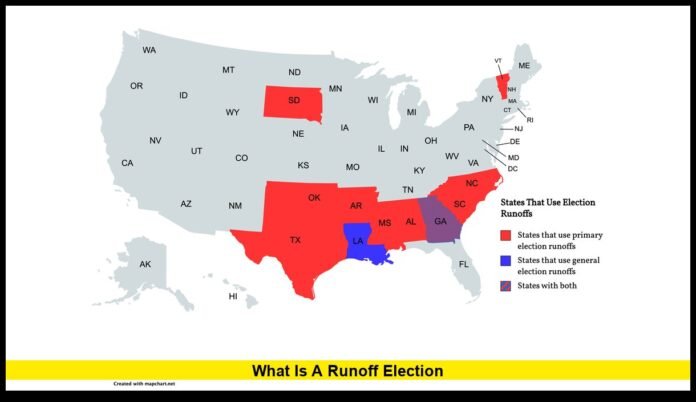

What is a runoff election? It is a second round of voting that takes place when no candidate receives more than 50% of the vote in the first election. Runoff elections remain part of the U.S. electoral process in several states and are used to ensure that the eventual winner has majority support from voters.
When multiple candidates compete in the same race, the vote can split among them. If no one reaches a majority, the top candidates move to a runoff election where voters make the final decision. This system is used in various federal, state, and local elections across the United States.
What Is a Runoff Election?
A runoff election is a follow-up vote held after an initial election fails to produce a candidate with a majority of votes. In most cases, only the two candidates with the highest vote totals advance to the runoff.
The winner of the runoff becomes the final officeholder.
The system ensures that the elected candidate has the backing of more than half of participating voters instead of winning with only a plurality.
Why Runoff Elections Are Necessary
Runoff elections are used to prevent candidates from winning with only a small share of the vote when many candidates are on the ballot.
For example, imagine an election with four candidates:
| Candidate | Vote Share |
|---|---|
| Candidate A | 42% |
| Candidate B | 33% |
| Candidate C | 15% |
| Candidate D | 10% |
Although Candidate A leads the race, that candidate does not have majority support. A runoff between Candidates A and B allows voters to choose a clear winner.
This process helps produce outcomes that better reflect the preference of most voters.
How a Runoff Election Works
The runoff election process usually follows several steps.
1. Initial Election
All candidates appear on the ballot and voters cast their votes.
2. Vote Counting
Election officials count the ballots to determine the results.
3. Majority Check
If a candidate receives more than 50% of the vote, the race ends and that candidate wins.
4. Runoff Announcement
If no candidate reaches the majority threshold, the election moves to a runoff.
5. Second Round
The top two candidates compete in the runoff election.
6. Final Result
The candidate who receives the most votes in the second round wins the race.
This two-step voting system helps resolve close or crowded elections.
States That Use Runoff Elections
Runoff elections are most common in Southern states. These states often require majority support for candidates seeking party nominations or public office.
States That Use Primary Runoffs
Some states require candidates to win more than 50% of the vote in a party primary. If no candidate achieves that threshold, a runoff determines the nominee.
Examples include:
- Alabama
- Arkansas
- Georgia
- Mississippi
- Oklahoma
- South Carolina
- Texas
Primary runoffs typically occur a few weeks after the first election.
States With Runoffs in General Elections
A smaller number of states may hold runoff elections during general elections if no candidate secures a majority.
Examples include:
- Georgia
- Louisiana
- Mississippi
These rules can apply to statewide offices, congressional races, and certain local elections.
Where Runoff Elections Commonly Occur
Runoff elections can happen at several levels of government in the United States.
They often occur in:
- Congressional special elections
- Statewide offices such as governor or senator
- Party primary elections
- City and mayoral races
- Local government contests
Crowded candidate fields make runoffs more likely because votes are divided among multiple contenders.
Benefits of Runoff Elections
Supporters say runoff elections improve the democratic process.
Majority Support
Runoff elections ensure that the winning candidate receives backing from more than half of voters participating in the final round.
Clear Final Choice
The runoff simplifies the ballot by narrowing the race to two candidates.
Broader Campaign Outreach
Candidates often reach out to voters who supported eliminated candidates, encouraging broader engagement.
Criticism of Runoff Elections
Despite their benefits, runoff elections also have drawbacks.
Lower Voter Participation
Turnout in runoff elections is often lower than in the first round because voters must return to the polls.
Higher Election Costs
Running a second election requires additional funding for staff, ballots, and polling operations.
Longer Election Cycles
Runoff elections extend campaign periods and delay final results.
These challenges have led some states to consider alternative voting methods.
Alternative Voting Systems
Some states and cities have introduced voting systems designed to avoid holding a separate runoff election.
Ranked-Choice Voting
In ranked-choice voting, voters rank candidates in order of preference rather than selecting just one.
If no candidate wins a majority, the lowest-ranked candidate is eliminated and those votes are redistributed according to voter preferences. The process continues until a candidate reaches a majority.
This approach allows elections to achieve majority support without requiring voters to return for another round.
Why Understanding Runoff Elections Matters
Runoff elections continue to influence the outcome of many political races in the United States. They are especially common in elections with multiple candidates competing for the same position.
Understanding what is a runoff election helps voters better follow election results and understand why some races require a second vote before a final winner is declared.
Runoffs ensure that the final outcome reflects majority support rather than a divided vote.
Do you think runoff elections help produce fairer results, or should states adopt new voting systems? Share your thoughts and keep following election updates.