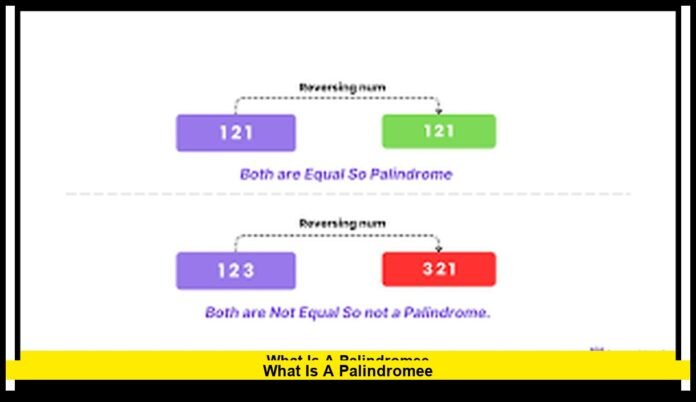

What is a palindrome is a common question asked by students, puzzle lovers, and language learners across the United States in 2026. A palindrome is a word, number, or sequence that reads exactly the same forward and backward. Examples such as “racecar,” “level,” and “121” clearly demonstrate this symmetrical structure.
The concept appears in language studies, mathematics, computer science, and educational games. Because the rule is simple but the results can be creative, palindromes remain a popular topic in classrooms and word puzzles. Teachers often use them to explain patterns, while programmers use them to practice logical problem solving.
Across digital learning platforms and puzzle communities, palindromes continue to capture attention due to their balance and structure.
Understanding the Definition of a Palindrome
A palindrome follows a straightforward rule. When the characters in the sequence are reversed, the result remains identical to the original.
The sequence may include letters or numbers. In many cases, punctuation and spacing do not affect the result.
For example:
| Example | Reverse | Result |
|---|---|---|
| level | level | Palindrome |
| radar | radar | Palindrome |
| apple | elppa | Not a palindrome |
| 1221 | 1221 | Palindrome |
The defining characteristic is perfect symmetry.
If any letter or number changes position when reversed, the sequence no longer qualifies as a palindrome.
Common Palindrome Words in English
English contains several familiar palindrome words. Many of them are short and easy to recognize.
Common examples include:
- level
- radar
- civic
- rotor
- madam
- refer
- kayak
- racecar
These words maintain the same letter order whether read from left to right or right to left.
Some palindrome words appear in everyday language. For instance, the word radar describes a detection system used in aviation and weather tracking. The word kayak refers to a small watercraft used for paddling sports.
Because these words are practical and recognizable, they often appear in educational exercises.
Palindrome Sentences and Creative Writing
Longer palindromes can appear in complete sentences. Writers construct these carefully so that the letters remain symmetrical.
A well-known example reads:
“A man, a plan, a canal: Panama.”
When punctuation and spaces are removed, the sentence becomes perfectly symmetrical.
Other popular examples include:
- “Never odd or even”
- “Was it a rat I saw?”
- “Able was I ere I saw Elba”
These examples show how creative language can produce symmetrical structures.
Constructing such sentences requires careful planning. Every letter must align with its counterpart when reversed.
Writers often treat palindrome construction as a word puzzle.
Palindromes in Numbers
Numbers also follow palindrome patterns.
A numeric palindrome appears identical when the digits are reversed.
Examples include:
- 121
- 1331
- 3443
- 12321
These numbers remain unchanged when read in reverse order.
Palindromic numbers attract attention because they demonstrate symmetry within mathematics.
Examples of Numeric Palindromes
| Number | Reverse | Palindrome |
|---|---|---|
| 101 | 101 | Yes |
| 404 | 404 | Yes |
| 567 | 765 | No |
| 1221 | 1221 | Yes |
Mathematics teachers often use these examples when teaching patterns and number relationships.
Palindrome Dates and Calendar Patterns
Certain calendar dates also create palindromes.
A palindrome date reads the same forward and backward when written numerically.
One famous example occurred on February 2, 2020 (02/02/2020).
This date attracted attention worldwide because it remained symmetrical in the month-day-year format used in the United States.
Another example appeared on January 2, 2021 (01/02/2021).
Palindrome dates occur only occasionally. Many people celebrate them by sharing the unique date on social media or using them as examples in classrooms.
These dates highlight how symmetrical patterns appear even in everyday calendar systems.
Why Teachers Use Palindromes in Education
Palindromes help students develop several learning skills.
Teachers often introduce them during language lessons and logic exercises.
Students benefit from recognizing patterns in words and numbers.
Key educational benefits include:
- Improved spelling awareness
- Pattern recognition
- Logical reasoning skills
- Creative writing practice
Young learners enjoy identifying palindrome words because they are easy to test. Simply reversing the letters reveals the answer.
Teachers sometimes encourage students to invent their own palindrome sentences, which strengthens vocabulary and creativity.
Palindromes in Computer Programming
Computer programming frequently uses palindromes as beginner exercises.
Many coding lessons include a simple challenge: determine whether a word or number is a palindrome.
A basic algorithm usually follows these steps:
- Take the original word or number.
- Reverse the sequence.
- Compare the reversed result with the original.
If the two sequences match, the program identifies a palindrome.
This exercise teaches essential programming skills such as:
- loops
- conditional statements
- string manipulation
- logical comparison
Coding interviews also include palindrome questions because they test problem-solving ability.
Developers often implement these algorithms using languages such as Python, Java, or JavaScript.
Mathematical Patterns Involving Palindromes
Mathematicians study palindromic numbers because they reveal interesting numerical patterns.
One popular experiment involves reversing a number and adding it to the original.
Example:
- Start with 56
- Reverse the digits to get 65
- Add them together: 56 + 65 = 121
The result becomes a palindrome.
This process demonstrates how symmetrical patterns can emerge from simple arithmetic.
Researchers sometimes explore how many steps are required to reach a palindromic number.
These patterns continue to interest mathematicians studying number behavior.
Palindromes in Biology and Genetics
Symmetry also appears in biological systems.
Certain DNA sequences function as palindromes because they read the same in opposite directions along complementary strands.
These sequences help enzymes identify specific sections of genetic material.
Scientists studying molecular biology analyze these structures during DNA research.
The presence of palindromes in biology shows how symmetry appears across multiple scientific fields.
Language, mathematics, and genetics all reveal similar structural patterns.
Cultural Interest in Palindromes
Word enthusiasts and puzzle creators enjoy working with palindromes.
Puzzle books, educational apps, and online quizzes often include palindrome challenges.
People enjoy testing their ability to find symmetrical words or create new ones.
Online communities also celebrate palindrome dates by sharing examples of words and numbers that fit the pattern.
The simplicity of the rule makes the concept accessible to a wide audience.
At the same time, constructing longer palindromes remains a difficult challenge.
How Writers Create Long Palindromes
Crafting a long palindrome requires careful attention to detail.
Writers must ensure each letter matches perfectly when reversed.
The process often begins with a central word or letter. The writer then builds the sentence outward while maintaining symmetry.
This structure requires:
- careful word choice
- precise spelling
- balanced sentence design
Even a single misplaced letter breaks the palindrome.
For that reason, long palindromes often appear as playful language experiments rather than everyday writing.
Common Errors When Identifying Palindromes
Some people misunderstand the rules of palindromes.
Common mistakes include:
- counting spaces or punctuation incorrectly
- assuming similar spelling counts as symmetry
- overlooking letter order when reversing the sequence
A valid palindrome must maintain identical characters in the same mirrored order.
For phrases, punctuation and capitalization typically do not matter. The sequence of letters must remain identical when reversed.
Understanding this rule ensures accurate identification of palindromes.
Why Palindromes Continue to Fascinate People
Symmetry plays an important role in many areas of human curiosity.
People naturally enjoy patterns that appear balanced and orderly.
Palindromes offer a simple example of this concept. They demonstrate how language and numbers can form perfectly mirrored structures.
Interest in puzzles, coding education, and language games keeps the topic relevant today.
Students explore palindromes during school lessons. Programmers use them for logic challenges. Puzzle fans enjoy discovering new symmetrical combinations.
The concept remains both educational and entertaining.
Palindromes show how simple patterns can reveal remarkable symmetry in language and numbers.
What is your favorite palindrome word or number? Share your example and keep exploring the fascinating world of word patterns.