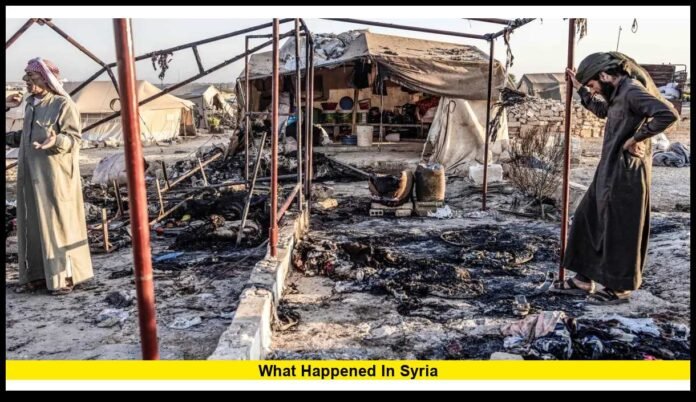

What happened in Syria is a question that continues to concern the world as the nation struggles through its fifteenth year of turmoil. As of December 2025, Syria remains a country divided — scarred by years of war, crippled by economic collapse, and facing one of the world’s worst humanitarian crises.
Although large-scale fighting has slowed compared to the early years of the civil war, tensions, airstrikes, and political struggles continue to shape daily life. For millions of Syrians, the conflict has not ended — it has simply changed form.
How the War in Syria Began
The conflict in Syria started in March 2011, during the wave of Arab Spring uprisings across the Middle East. What began as peaceful protests demanding reforms from President Bashar al-Assad quickly escalated into a brutal civil war.
Over the years, many forces became involved:
- Government troops loyal to Assad.
- Opposition groups fighting for political change.
- Kurdish fighters in the north seeking self-rule.
- ISIS and other extremist groups exploiting the chaos.
Foreign powers deepened the conflict. Russia and Iran supported Assad’s government, while the United States and Western allies targeted ISIS and provided limited support to rebel groups.
By 2025, Syria has seen over 500,000 deaths, the destruction of major cities, and the displacement of millions of people both inside and outside the country.
The Situation in Syria Now (December 2025)
1. Violence Still Persists in Northern Syria
Although the full-scale war has ended, fighting continues in northern Syria, especially near the Turkish border.
Recent reports show:
- Turkish airstrikes on Kurdish-held towns like Ain Issa and Qamishli.
- Kurdish retaliation attacks targeting Turkish military posts.
- Syrian government forces carrying out raids in the provinces of Idlib and Daraa against remaining rebel groups.
These clashes show that Syria remains far from peaceful. The struggle for control, particularly in oil-rich and agricultural areas, keeps tensions high.
2. ISIS Activity Resurfaces in the Desert
Although ISIS lost its territory in 2019, the group has not vanished. Its fighters now operate from the desert regions of Deir ez-Zor and Homs, carrying out surprise attacks.
In recent months, ISIS has:
- Ambushed Syrian soldiers and allied militias.
- Attacked oil pipelines and checkpoints.
- Clashed with U.S.-backed forces in eastern Syria.
The U.S. military, with around 900 troops still stationed in the northeast, continues to work with Kurdish-led Syrian Democratic Forces (SDF) to contain ISIS remnants.
3. Humanitarian Crisis at Its Worst Point Yet
Syria’s humanitarian situation remains catastrophic. The war has left behind widespread destruction, and the country’s economy has completely collapsed.
Here are some of the staggering figures:
- 6.8 million Syrians have fled the country as refugees.
- 7 million people are displaced inside Syria.
- 90% of the population lives below the poverty line.
- Over 12 million people face food insecurity.
Winter conditions are making things worse. Displaced families living in makeshift camps face freezing nights with little access to heat, clean water, or medicine. Aid agencies are warning that without additional international funding, millions could be at risk.
4. A Broken Economy and Harsh Sanctions
The Syrian economy is in ruins. The national currency, the Syrian pound, has lost almost all its value, and inflation is out of control. Everyday essentials — bread, rice, cooking oil, and fuel — are unaffordable for most families.
The U.S. continues to enforce the Caesar Act sanctions, which target individuals and businesses that fund or profit from the Assad regime. While intended to pressure the government, the sanctions have also made recovery harder for ordinary Syrians.
Key problems in 2025 include:
- Power outages lasting up to 20 hours a day.
- Long fuel lines in major cities like Damascus and Homs.
- Rising unemployment and corruption.
Rebuilding Syria will require billions of dollars, but international investors remain hesitant due to ongoing instability and sanctions.
5. Diplomatic Shifts in the Arab World
After years of isolation, Syria is slowly returning to the regional stage.
- The Arab League readmitted Syria in 2023, signaling growing acceptance of Assad’s rule.
- Saudi Arabia, Egypt, and Jordan have reopened diplomatic relations with Damascus.
- Talks on reconstruction and counterterrorism are underway, but progress remains slow.
However, Turkey continues to occupy parts of northern Syria and views Kurdish forces as a security threat. Meetings between Syrian and Turkish officials have not yet led to a breakthrough, and border tensions remain high.
6. U.S. and Russian Troops Remain Active
Both the United States and Russia maintain a military presence in Syria, often operating in the same regions but for different reasons.
- U.S. forces are focused on preventing ISIS from regrouping.
- Russian troops are stationed at key bases such as Hmeimim Air Base in Latakia, supporting the Assad government.
While both sides avoid direct confrontation, their patrols sometimes cross paths, leading to tense stand-offs in the desert.
This uneasy balance reflects how foreign powers still shape Syria’s fate, even after years of war.
7. Idlib: The Last Rebel Stronghold
The northwestern province of Idlib remains under the control of Hay’at Tahrir al-Sham (HTS), an extremist group once linked to al-Qaeda.
In recent weeks, Idlib has seen:
- Airstrikes by Syrian and Russian jets targeting HTS positions.
- Civilian casualties in crowded refugee zones.
- A growing humanitarian crisis as aid deliveries struggle to reach the area.
Cease-fire agreements between Russia and Turkey exist but are frequently broken. Idlib’s future remains one of the biggest obstacles to a complete resolution of the conflict.
The Human Cost of 14 Years of War
The toll of the Syrian conflict is staggering:
- Over half a million people have been killed.
- Entire cities, including Aleppo, Homs, and Raqqa, are still in ruins.
- Children have lost an entire generation of education, with more than 2.5 million out of school.
- In refugee camps, early marriage, child labor, and malnutrition have become alarmingly common.
Despite these hardships, Syrians continue to show remarkable resilience. Families rebuild homes from rubble, children attend makeshift schools, and communities find ways to survive amid adversity.
The Role of International Aid
Humanitarian organizations remain active, though funding is shrinking as global attention shifts to other crises.
Efforts in 2025 focus on:
- Providing food aid and winter supplies to displaced families.
- Rebuilding basic infrastructure, like schools and clinics.
- Supporting mental health and trauma recovery programs.
Aid agencies stress that without long-term solutions — including peace, political reform, and reconstruction — short-term assistance can only go so far.
What Comes Next for Syria?
Syria’s future remains uncertain. The country is no longer at war in the traditional sense, but it is not at peace either.
Three main factors will determine what happens next:
- Political Reconciliation: Progress toward an inclusive government that represents all Syrians.
- Economic Recovery: Lifting sanctions and rebuilding infrastructure to restore livelihoods.
- Security and Stability: Preventing ISIS and extremist groups from regaining power.
Without these steps, millions of Syrians risk remaining trapped in poverty and displacement for years to come.
The question of what happened in Syria is one of tragedy, endurance, and hope. Fourteen years after the war began, the country is still fighting for stability — but the determination of its people continues to shine through.