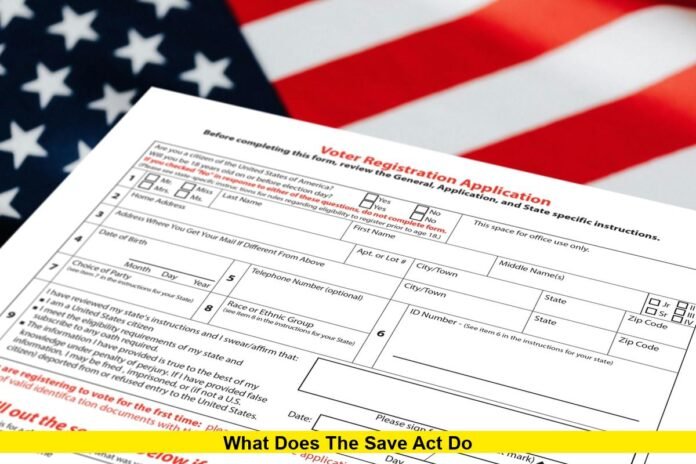

The question what does the SAVE Act do is now at the center of U.S. political debate as the Republican-led House of Representatives passed a major elections bill this week that would reshape voter registration and ballot access in federal elections. The legislation, called the SAVE America Act and closely tied to the original SAVE Act proposal, imposes new proof-of-citizenship and photo ID requirements that supporters say will protect election integrity and critics warn could make it harder for millions of Americans to cast ballots in November and future elections.
If you want to understand the potential impact on your voting rights and how elections are run in the U.S., read on.
Stay informed about how changes in election law may affect your right to vote and civic participation.
What the SAVE Act Is and Where It Comes From
The name “SAVE Act” refers to the Safeguard American Voter Eligibility Act, a bill originally introduced in the 119th U.S. Congress to amend the National Voter Registration Act of 1993. Its purpose was simple on paper: require documentary proof of U.S. citizenship for anyone registering to vote in federal elections. Previously, Americans could register simply by attesting under oath that they are U.S. citizens. Under the SAVE Act proposal, that would no longer be enough.
The House passed an updated version this week known as the SAVE America Act, which broadens that approach and adds other voting-related requirements. This new bill passed with a narrow 218-213 vote, with only one Democrat joining all House Republicans in support. It now awaits consideration in the Senate, where its future is uncertain due to procedural hurdles and bipartisan opposition.
Key Requirements the SAVE Act Would Implement
At its core, the SAVE Act and the related SAVE America Act focus on tightening rules around voter registration and ballot access. Here’s what they do:
1. Proof of U.S. Citizenship to Register
Under current federal law, U.S. citizens attest to citizenship on voter registration forms. The SAVE Act would change that standard by requiring documentary evidence such as:
- A U.S. passport,
- A birth certificate,
- A government-issued photo ID showing citizenship status, or
- Other government documentation that verifies citizenship.
States would have to refuse registration without this documentation.
2. Photo ID to Cast Ballots
The SAVE America Act adds a nationwide photo ID requirement for voting, meaning individuals would need to present acceptable government-issued photo identification at the polls. This goes beyond many existing state voter ID laws by specifying stricter criteria and excluding some commonly accepted IDs such as student cards.
3. Changes to Mail-In and Online Registration
According to legislative summaries, the SAVE Act could effectively eliminate mail-in and online voter registration as convenient options by requiring in-person submission of citizenship documentation for mail or online applications to be valid.
4. Voter Roll Purges and Data Sharing
The SAVE America Act would also direct states to share voter registration lists with federal agencies like the Department of Homeland Security for citizenship verification. This has raised privacy and election-administration concerns, as sensitive personal information could be collected and used for frequent voter purges.
5. Penalties for Election Officials
Under the most detailed drafts, state and local election officials who fail to enforce the documentary requirements could face fines or even criminal penalties, a move critics say would deter election administrators from accommodating voters with incomplete documentation.
Supporters Say It Protects Election Integrity
Republican lawmakers, including bill sponsor Rep. Chip Roy, argue the SAVE Act strengthens confidence in U.S. elections by ensuring that only eligible citizens participate. House Speaker Mike Johnson and other GOP leaders frame it as a common-sense update that modernizes federal election law and combats perceived vulnerabilities in the registration process.
Proponents also cite public opinion polls showing broad support among Americans for requiring proof of citizenship at registration and photo ID at the polls, although how those polls were conducted and interpreted varies by source.
Supporters view the bill as a response to concerns about noncitizen voting, even though such occurrences are rare. They argue that documentary verification reduces ambiguity and protects the legal right of citizens to decide federal elections.
Critics Warn of Barriers to Voting
Opponents — including Democrats and voting rights advocates — contend the SAVE Act’s requirements would create unnecessary hurdles that could disproportionately affect certain groups of eligible voters. They point to data showing many U.S. adults lack ready access to passports or birth certificates, especially low-income individuals, people of color, the elderly, and young voters.
Critics also argue the legislation could shrink voter participation by making registration more difficult, undermining long-standing, accessible registration methods such as online and mail-in systems.
Organizations focused on civil rights emphasize that citizenship is already a legal requirement to vote and that criminal penalties for noncitizen voting are severe. They see the SAVE Act’s added documentation demands as unnecessary and exclusionary.
Many voting rights groups describe the bill as part of a broader effort to restrict ballot access, rather than a targeted solution to a problem that election officials say rarely occurs.
What It Means for Voters Ahead of 2026 Midterms
Because the House passed the SAVE America Act this week, the bill now moves to the Senate. For it to become law, Senate leaders would need to find a path around procedural obstacles like the 60-vote filibuster threshold, which requires at least some bipartisan support. Without it, the bill may stall or be modified before a final vote.
Even if the Senate doesn’t act, the debate highlights a deep partisan divide over how elections in the United States should be run and who should determine voter eligibility standards. Changes proposed by the SAVE Act and its siblings could shape federal election administration for years to come, affecting how Americans register and cast their ballots.
Let us know what you think about these changes and how they could impact voter access in the United States. Share your thoughts or stay tuned for further developments.