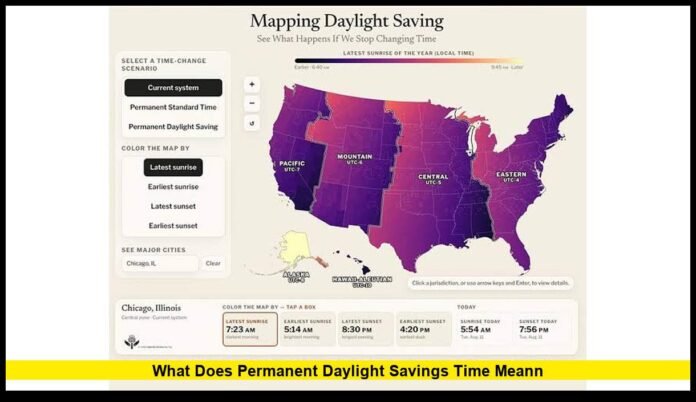

If you have been wondering what does permanent daylight savings time mean, the basic idea is simple: the United States would stop moving clocks backward in the fall and instead keep the clock one hour ahead of standard time throughout the entire year. The proposal has gained renewed attention after the U.S. House of Representatives passed the Sunshine Protection Act of 2025 in July 2026, but the change has not yet become federal law.
For most Americans, the current system remains unchanged for now. Daylight saving time continues during the spring, summer and early fall, followed by a return to standard time in November. Whether that system will eventually be replaced remains dependent on congressional action.
What Is Permanent Daylight Saving Time?
Permanent daylight saving time would make the clock setting currently used during the warmer months the year-round standard for most parts of the country.
Under the existing system, clocks are moved forward one hour in March. This is commonly called “spring forward.” In November, clocks are moved back one hour to standard time, often called “fall back.”
A permanent daylight saving system would eliminate that second adjustment.
Instead of moving clocks back in November, Americans in participating states would leave them on the daylight-saving setting. The result would be later clock times for both sunrise and sunset compared with permanent standard time.
The proposal does not create additional sunlight. The Sun would continue following the same astronomical cycle. What changes is the way society labels daylight hours on the clock.
For example, if the Sun would rise at 7 a.m. under standard time, it could rise at 8 a.m. under permanent daylight saving time. A sunset that would occur at 5 p.m. could instead appear at 6 p.m. on the clock.
The exact times would vary depending on location and season.
Is Permanent Daylight Saving Time Law in the U.S.?
No. Permanent daylight saving time is not currently the nationwide rule in the United States.
The House passed H.R. 139, the Sunshine Protection Act of 2025, on July 14, 2026. The final House vote was 308-117.
The legislation then moved to the Senate, where it was referred to the Senate Committee on Commerce, Science, and Transportation. It therefore still requires additional congressional action before it could become law.
Until that happens, most states remain subject to the existing federal daylight saving time schedule.
The 2026 schedule calls for daylight saving time to end on November 1, meaning clocks in participating areas are currently scheduled to move back one hour under the existing law.
This is important because congressional consideration of a bill does not automatically change the nation’s clocks. Americans should continue following the existing schedule unless federal law is changed.
What Is the Sunshine Protection Act?
The Sunshine Protection Act is federal legislation designed to eliminate the seasonal clock change by making daylight saving time permanent.
The legislation has been introduced in multiple congressional sessions. The current version, H.R. 139, received House approval in July 2026.
The measure would generally keep participating states on the time setting used during daylight saving time instead of returning to standard time every November.
The legislation also addresses jurisdictions that already have different time arrangements. Hawaii and most of Arizona, for example, do not observe daylight saving time under the current system.
Because timekeeping is governed by federal law, states cannot simply decide independently to adopt permanent daylight saving time under the existing rules. Federal legislation would be necessary to authorize such a nationwide change.
Why Does Permanent Daylight Saving Time Matter?
The debate is largely about where Americans want daylight to appear on the clock.
Permanent daylight saving time would shift an hour of daylight toward the evening compared with standard time.
That means people could have more daylight after a traditional work or school day during the winter.
However, the trade-off would be darker mornings.
This distinction becomes particularly important in northern states, where winter sunrise already occurs relatively late.
A worker who normally leaves home shortly after sunrise could instead begin a commute while it is still dark. Children heading to school early in the morning could also spend more time traveling before sunrise.
At the same time, the evening would remain lighter for an additional hour by the clock.
The policy therefore involves a fundamental choice about how daylight is distributed across people’s daily schedules.
How Would Winter Mornings Change?
Winter is where the effects of year-round daylight saving time would become most noticeable.
During winter, the Northern Hemisphere receives fewer hours of daylight because of Earth’s tilt. Permanent daylight saving time would not change that.
Instead, it would shift the clock one hour forward compared with standard time.
Consider a hypothetical city where the Sun rises at 7:30 a.m. under standard time. Under permanent daylight saving time, the same sunrise would occur at approximately 8:30 a.m. on the clock.
Sunset would also appear one hour later.
For someone working from 9 a.m. to 5 p.m., that could mean arriving at work before sunrise but leaving with more daylight remaining.
The impact would differ significantly between states and even between cities in the same time zone. Locations near the western edge of a time zone generally experience later sunrise and sunset times than locations farther east.
Northern communities can also experience much larger seasonal changes in daylight than areas closer to the equator.
Would Permanent Daylight Saving Time Mean More Sunlight?
No.
This is one of the most important points to understand.
Changing the clock does not change the amount of sunlight available. It only changes the time displayed on the clock when sunrise and sunset occur.
Permanent daylight saving time would give people later clock-time sunsets compared with standard time. It would not extend the actual length of daylight.
For instance, if a location receives 10 hours of daylight on a particular winter day, it would still receive approximately 10 hours regardless of whether the clock is on standard time or daylight saving time.
The difference would be when those 10 hours appear on the clock.
Why Do Supporters Want the Change?
Supporters of permanent daylight saving time generally focus on ending the twice-yearly clock adjustment and keeping more daylight in the evening.
The current system requires most Americans to adjust clocks twice each year. Modern smartphones and computers usually update automatically, but people can still experience disruption to sleep schedules and daily routines.
Permanent daylight saving time would remove the need for the November rollback.
Supporters also argue that later evening daylight can benefit outdoor activities, recreation, shopping, dining and other activities that are easier to conduct when there is more daylight after work and school.
Some proponents have also associated year-round daylight saving time with potential public-safety and quality-of-life benefits.
These arguments remain part of a broader debate because the effects of the policy can differ depending on location, season and individual schedules.
Why Do Some Experts Prefer Permanent Standard Time?
Ending the clock changes and deciding which time system should remain are two separate issues.
Some sleep and circadian-rhythm researchers have supported permanent standard time rather than permanent daylight saving time.
The reason is that morning light plays an important role in regulating the body’s internal clock.
Keeping daylight saving time throughout the winter would delay sunrise by one hour on the clock. In some locations, this could result in substantial periods of darkness during the morning commute or school day.
Permanent standard time would have the opposite effect. Sunrise would occur earlier by the clock, but sunset would also occur earlier.
That means the central disagreement is not necessarily whether seasonal clock changes should continue. It is also about which clock setting should remain if the changes are eliminated.
What Happened With Year-Round Daylight Saving Time in 1974?
The United States has experimented with year-round daylight saving time before.
In 1974, the country temporarily adopted year-round daylight saving time during an energy-related effort.
The experiment did not last. Public concerns about dark winter mornings contributed to the decision to return to the previous system.
The 1974 experience is frequently cited in today’s debate because it demonstrates that permanent daylight saving time is not a completely new concept in the United States.
However, conditions have changed substantially since the 1970s. Modern work schedules, technology, transportation patterns and energy consumption are different, meaning historical experience does not provide a simple answer to today’s policy debate.
What States Already Stay on Standard Time?
Most of the United States participates in daylight saving time, but there are notable exceptions.
Hawaii does not observe daylight saving time. Most of Arizona also remains on standard time throughout the year.
The Navajo Nation observes daylight saving time, creating a distinctive situation within Arizona.
U.S. territories including Puerto Rico and Guam also have their own timekeeping arrangements and do not generally participate in the seasonal daylight saving system.
Any federal legislation changing the national system would therefore need to account for jurisdictions that already operate differently.
Could States Choose Permanent Daylight Saving Time on Their Own?
Under current federal law, states cannot independently establish permanent daylight saving time.
States can choose not to observe daylight saving time and remain on standard time throughout the year. However, states that participate in daylight saving time must follow federally established start and end dates.
This means a state legislature cannot simply decide to remain on daylight saving time permanently under current federal rules.
A change in federal law would be necessary for states to adopt permanent daylight saving time.
That is why congressional action remains central to the current debate.
What Would Happen to the November Clock Change?
If the Sunshine Protection Act becomes law in its current form, participating areas would no longer move their clocks backward in November.
The November transition from daylight saving time to standard time would disappear.
That would mean Americans would not have to make the familiar one-hour adjustment associated with the fall transition.
However, the change would not necessarily affect every U.S. jurisdiction in exactly the same way. Existing exemptions and provisions in federal law would remain relevant.
Until new legislation is enacted, the November clock change remains scheduled under current law.
What Would Happen to the March Clock Change?
The spring transition would also disappear under a permanent daylight saving system.
Currently, most Americans move clocks forward one hour in March.
If daylight saving time became permanent, there would be no need to make that annual adjustment because the country would already be using the daylight-saving clock setting.
This would create a single year-round clock setting for participating locations.
The major difference would become the relationship between that clock setting and seasonal sunrise and sunset times.
What Does Permanent Daylight Savings Time Mean for Everyday Life?
For everyday Americans, the biggest practical difference would be the timing of daylight.
A person leaving work at 5 p.m. during winter could have more daylight remaining than under standard time.
A student beginning school early in the morning could face a darker commute.
A family planning an outdoor activity after dinner could benefit from the later sunset.
A morning runner, construction worker, delivery driver or early-shift employee could experience the opposite effect.
These differences explain why the debate has continued for decades. The same policy can produce different experiences depending on when someone works, attends school, travels or spends time outdoors.
What Should Americans Expect in 2026?
For now, Americans should expect the existing system to continue.
The House has passed the Sunshine Protection Act, but the Senate has not completed the legislative process needed to send the measure to the president.
Consequently, the current federal time rules remain in effect.
Most Americans should continue to expect daylight saving time to end on November 1, 2026, with clocks moving back one hour.
That could change if Congress passes new legislation before the scheduled transition, but no nationwide permanent change has taken effect as of the latest update.
The Difference Between Permanent DST and Ending Daylight Saving Time
Another common source of confusion is the phrase “ending daylight saving time.”
Ending the twice-yearly clock change does not automatically mean permanent daylight saving time.
There are two principal year-round alternatives.
Under permanent daylight saving time, clocks remain one hour ahead of standard time, producing later sunrise and sunset times by the clock.
Under permanent standard time, clocks remain on the standard setting, producing earlier sunrise and sunset times.
Both approaches would eliminate the twice-yearly clock change.
The current congressional legislation favors the first option: permanent daylight saving time.
Final Takeaway
The latest U.S. debate over year-round daylight saving time is focused on whether Americans should continue changing clocks twice a year or keep the daylight-saving clock setting throughout the entire year.
The House’s passage of the Sunshine Protection Act in July 2026 represents a significant step in the current legislative effort, but it does not by itself change the nation’s time system.
For now, the existing schedule remains in place. Most Americans will continue observing daylight saving time during the spring and summer and return to standard time in November.
If Congress ultimately approves permanent daylight saving time, the most visible changes would be later clock-time sunsets throughout the year and later winter sunrises. The amount of sunlight would not change, but its position on the clock would.
For anyone still asking what does permanent daylight savings time mean, the answer ultimately comes down to keeping the “spring forward” clock setting year-round rather than “falling back” each November. The policy would eliminate seasonal clock changes while moving one hour of daylight from the morning toward the evening on the clock.
Key Points Summary
╔════════════════════════════════════════════════════════════════════╗
║ – Permanent daylight saving time would keep clocks one hour ahead of standard time throughout the year. ║
║ – The U.S. House passed the Sunshine Protection Act of 2025 by a 308-117 vote in July 2026. ║
║ – The legislation still requires Senate action before it could become federal law. ║
║ – Year-round daylight saving time would mean later clock-time sunsets but later winter sunrises. ║
║ – Most Americans should continue following the existing seasonal clock schedule unless Congress changes federal law. ║
╚════════════════════════════════════════════════════════════════════╝