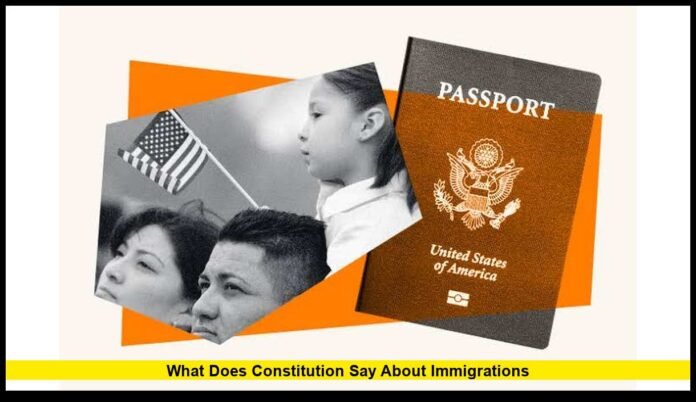

The question what does constitution say about immigration highlights an important part of American law: the relationship between national border control, individual rights, and the federal government’s responsibilities. The U.S. Constitution does not establish a complete immigration system, but it provides the legal foundation for federal immigration authority. It also protects certain rights for people living in the country, regardless of citizenship or immigration status.
Immigration policy involves several branches of government. Congress establishes federal laws, the president oversees their implementation, and the judicial system determines whether government actions comply with constitutional requirements. This division of authority shapes how the United States handles border security, visas, asylum applications, citizenship, and deportation.
The Constitution’s Role in American Immigration Policy
The Constitution does not specifically outline modern visa categories, border inspection procedures, or deportation requirements. Instead, it establishes governmental powers that Congress and federal agencies use to administer immigration policy.
Article I, Section 8, gives Congress authority to establish a uniform rule of naturalization. This provision allows lawmakers to determine the legal requirements for foreign nationals seeking American citizenship.
Congress also relies on its authority over foreign commerce and the Necessary and Proper Clause when developing immigration-related legislation.
These constitutional provisions support federal laws governing:
- Admission of foreign nationals.
- Temporary and permanent immigration.
- Employment-based immigration.
- Family-sponsored immigration.
- Naturalization and citizenship.
- Deportation and removal procedures.
- Refugee protection and asylum eligibility.
The Immigration and Nationality Act remains the central federal statute governing these matters.
Why Immigration Is Primarily a Federal Responsibility
The United States operates under a federal system in which national and state governments have different responsibilities.
Immigration is primarily a federal responsibility because decisions about foreign nationals entering or remaining in the country affect national security, international relations, and the country’s overall immigration system.
The Supremacy Clause, found in Article VI, establishes that valid federal laws take precedence over conflicting state laws.
This principle prevents individual states from creating independent immigration systems that undermine national policy.
The Supreme Court addressed this issue in Arizona v. United States in 2012. The ruling limited several provisions of an Arizona immigration enforcement law because they conflicted with federal authority.
States can still perform legitimate law enforcement functions. However, they cannot independently replace the federal government’s immigration framework.
How the President Influences Immigration Decisions
Although Congress creates immigration legislation, the president plays a significant role in administering it.
Article II gives the president executive responsibilities, including ensuring that federal laws are faithfully executed.
Presidential administrations can establish enforcement priorities, direct executive agencies, and introduce policies within the authority provided by federal law.
The Department of Homeland Security oversees several important immigration agencies:
- U.S. Citizenship and Immigration Services: Processes immigration applications, naturalization requests, and other immigration benefits.
- Immigration and Customs Enforcement: Handles immigration enforcement and removal responsibilities.
- Customs and Border Protection: Conducts border inspections and enforces laws governing entry into the United States.
Presidential authority nevertheless has limits. An executive order cannot independently amend the Constitution or disregard a federal statute.
The Fourteenth Amendment and Birthright Citizenship
The Fourteenth Amendment is central to American citizenship law.
Its Citizenship Clause establishes citizenship for people born or naturalized in the United States who are subject to its jurisdiction.
This constitutional language provides the foundation for birthright citizenship.
The amendment also contains due process and equal protection provisions, which influence how governments treat people within their jurisdiction.
Birthright citizenship does not mean every immigrant automatically becomes an American citizen. A foreign national must meet applicable naturalization requirements unless citizenship is acquired through another legally recognized route.
Major Supreme Court Development on Birthright Citizenship
The constitutional debate over birthright citizenship received renewed attention following President Donald Trump’s January 20, 2025, executive order seeking to restrict citizenship recognition for certain children born in the United States.
The dispute reached the Supreme Court in Trump v. Barbara.
On June 30, 2026, the Supreme Court ruled 6–3 that children born in the United States to parents who are unlawfully or temporarily present qualify for citizenship at birth under the Fourteenth Amendment.
Chief Justice John Roberts wrote the majority opinion.
The decision rejected the administration’s effort to narrow birthright citizenship through the executive order.
The ruling is significant because it demonstrates that presidential immigration policies must comply with constitutional requirements. The executive branch cannot independently redefine constitutional citizenship in a way that conflicts with the Court’s interpretation.
Do Undocumented Immigrants Have Constitutional Protections?
Immigration status does not automatically eliminate constitutional protections.
The Fifth Amendment protects persons against deprivation of life, liberty, or property without due process of law by the federal government.
The Fourteenth Amendment provides due process and equal protection guarantees against state government action.
These protections can apply to undocumented immigrants physically present in the United States.
However, constitutional protections do not give undocumented immigrants the same legal status or benefits as American citizens.
In Plyler v. Doe (1982), the Supreme Court ruled that Texas could not deny undocumented children access to public education under the circumstances considered in that case.
The decision recognized that undocumented children are persons protected by the Fourteenth Amendment’s Equal Protection Clause.
It remains an important example of how constitutional protections can apply independently of immigration status.
What Protection Does the Fourth Amendment Provide?
The Fourth Amendment protects people against unreasonable searches and seizures.
This provision is relevant when immigration officers conduct searches, vehicle stops, or arrests.
Federal officers must follow applicable constitutional and statutory requirements when exercising enforcement powers.
Border inspections involve special legal rules. The government has broader authority to conduct certain searches at international borders than during ordinary domestic law enforcement.
Nevertheless, that authority is not unlimited.
In United States v. Brignoni-Ponce (1975), the Supreme Court ruled that apparent Mexican ancestry alone could not justify a roving Border Patrol stop.
The decision illustrates that immigration enforcement remains subject to constitutional restrictions.
Can the Government Deport Someone Without Violating the Constitution?
Federal law permits the government to remove certain noncitizens who violate immigration requirements or fall within other statutory removal categories.
Potential grounds include visa overstays, unlawful presence under applicable provisions, certain criminal convictions, and immigration fraud.
However, deportation must follow the procedures established by federal immigration law.
Depending on the circumstances, individuals may receive immigration court proceedings and opportunities to challenge allegations or seek available forms of relief.
Removal proceedings are generally civil rather than criminal. Therefore, the Sixth Amendment does not create an automatic right to government-funded legal representation in ordinary immigration court cases.
The Fifth Amendment’s due process protections remain relevant to applicable immigration proceedings.
Does the Constitution Guarantee Asylum or Entry Into America?
The Constitution does not establish an unlimited right for foreign nationals to enter the United States.
Federal law determines admission requirements, visa eligibility, and the circumstances under which foreign nationals may remain in the country.
Asylum is also primarily governed by federal immigration legislation rather than an express constitutional guarantee.
Eligible individuals may request asylum if they meet the statutory requirements involving persecution or a well-founded fear of persecution based on protected grounds.
Submitting an application does not guarantee approval. Applicants must establish eligibility through the applicable legal process.
Why Constitutional Limits Matter in Immigration Enforcement
Immigration enforcement involves balancing the government’s authority to control national borders with legal protections for individuals.
Congress can establish admission and removal requirements. The executive branch can enforce those requirements. However, neither branch has unlimited power.
Federal courts can review constitutional disputes involving detention, citizenship, equal protection, searches, and government authority.
The constitutional framework also prevents states from creating conflicting immigration systems.
These safeguards help maintain the distinction between lawful immigration enforcement and government action that exceeds legal authority.
Final Thoughts on Immigration and the U.S. Constitution
American immigration law rests on a combination of constitutional authority, congressional legislation, executive enforcement, and judicial interpretation. The Constitution gives the federal government substantial control over immigration while protecting certain individual rights.
The Fourteenth Amendment remains particularly important for citizenship and equal protection, while the Fifth and Fourth Amendments establish additional safeguards. The Supreme Court’s 2026 birthright citizenship ruling further demonstrates that immigration policies must remain consistent with constitutional requirements.
Understanding these constitutional principles is essential to following America’s immigration debate. Share your opinion about federal immigration authority and constitutional rights in the comments.