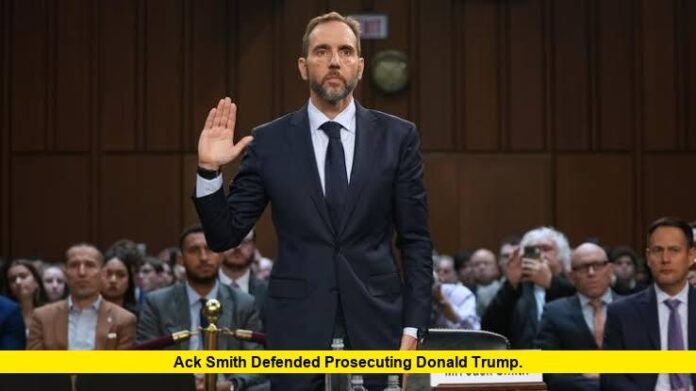

What did the former special counsel say during the Senate testimony about prosecuting Donald Trump? Jack Smith said he stands by his decision to charge Trump and would pursue the same case against a former president regardless of political party.
Smith appeared before the Senate Judiciary Committee on September 29, 2026, for a closely watched hearing about his investigations into Trump. His testimony focused heavily on why he brought two federal criminal cases, whether politics influenced his decisions, and how his office handled sensitive investigative steps.
The former special counsel gave senators a direct answer on the central question surrounding his prosecution of Trump. Smith said the decision was based on evidence and law rather than Trump’s political identity or his campaign for the presidency.
Jack Smith Said He Still Stands by Charging Trump
Smith’s most important statement came in his opening testimony.
He said he stood by his decisions as special counsel, including his decision to bring criminal charges against Trump. He also stressed that Trump’s political affiliation, beliefs and 2024 presidential campaign did not influence those decisions.
Smith went further when discussing whether he would make the same decision again.
He told senators that if he were asked to prosecute a former president today based on the same facts, he would do so whether that president were a Republican or a Democrat.
That statement directly addressed one of the central criticisms raised by Republican senators. They argued that Smith’s investigations were politically motivated and improperly targeted Trump.
Smith rejected that characterization.
His testimony presented the prosecutions as the result of evidence developed by investigators and presented to grand juries rather than as a decision driven by Trump’s political status.
Smith Said Investigators Developed Evidence Supporting Criminal Charges
Smith also described the evidence gathered during his investigations in unusually strong terms.
He said the investigation developed proof beyond a reasonable doubt that Trump had engaged in serious crimes against the United States.
That statement was significant because neither of Smith’s federal cases reached a trial against Trump. The election case was dismissed after Trump won the 2024 presidential election, while the classified-documents prosecution had already been dismissed by a federal judge in Florida.
Therefore, Smith’s comments represented his assessment of what prosecutors believed the evidence would establish in court.
He emphasized that grand juries in two federal districts had returned indictments based on the allegations presented to them.
The two investigations involved separate areas of conduct.
One focused on Trump’s efforts to overturn his defeat in the 2020 presidential election and prevent the lawful transfer of presidential power. The other concerned Trump’s retention of classified documents after leaving the White House and allegations that he obstructed efforts to recover them.
Why Smith Said He Would Prosecute Trump Again
The question of whether Smith would make the same decision under identical circumstances was particularly important during the Senate hearing.
Smith’s answer was yes.
His position was not that every former president should automatically face prosecution. Instead, he framed the issue around the facts of the particular investigation.
If the same evidence existed and the same conduct had occurred, Smith said he would prosecute regardless of whether the former president belonged to the Republican or Democratic Party.
That distinction was central to his defense.
Smith argued that prosecutors are supposed to apply federal criminal law without considering a defendant’s political affiliation. He maintained that this principle guided his work as special counsel.
He also said the charges resulted from evidence rather than Trump’s candidacy for another term.
The 2020 Election Case Was One of Two Federal Prosecutions
Smith’s Senate testimony covered the federal investigation into Trump’s actions surrounding the 2020 election.
A federal grand jury indicted Trump in 2023 on four criminal counts related to efforts to overturn the election results. A superseding indictment was later issued after the Supreme Court’s ruling on presidential immunity.
The case involved allegations concerning Trump’s efforts to retain power after losing the election, including efforts connected to the certification of the electoral vote.
Smith described the investigation as uncovering a criminal scheme designed to overturn the election results and prevent the lawful transfer of power.
The prosecution never reached trial.
After Trump won the 2024 presidential election, Smith’s team moved to dismiss the federal election case. Prosecutors cited the Justice Department’s longstanding position that a sitting president cannot be federally prosecuted.
The court subsequently dismissed the case.
Smith’s Senate testimony therefore did not announce a new prosecution. Instead, he was defending the original decision to bring the case and explaining why he continued to believe the evidence supported it.
The Classified Documents Case Had a Different Ending
Smith also led the federal investigation involving classified documents retained by Trump after his first presidency.
The investigation resulted in a federal indictment alleging that Trump unlawfully retained highly classified government documents at Mar-a-Lago and repeatedly obstructed efforts to recover them.
Smith told senators that investigators developed powerful evidence concerning the retention of classified material.
The case, however, did not proceed to trial.
U.S. District Judge Aileen Cannon dismissed the prosecution in July 2024 after ruling that Smith’s appointment as special counsel was unlawful. The Justice Department appealed the decision, but after Trump won the 2024 election, prosecutors moved to end the remaining proceedings against him.
The classified-documents case ultimately did not produce a criminal verdict against Trump.
That distinction is important when evaluating Smith’s Senate testimony. His statement about evidence supporting prosecution reflects the former special counsel’s position about the investigations and indictments. It does not represent a criminal conviction.
Smith Rejected Claims That Politics Drove the Prosecutions
Republican senators repeatedly questioned Smith about whether political considerations influenced his investigations.
Smith rejected that accusation.
He pointed to his long career as a prosecutor and said he approached the special counsel position as a nonpartisan law-enforcement assignment.
During the hearing, he emphasized that he would have handled the matter in the same way regardless of whether he personally belonged to one political party or another.
Smith had previously served in federal and international prosecutorial roles, including work involving war crimes. He also previously served as acting U.S. attorney in Tennessee during the Trump administration’s first term.
His response was designed to counter arguments that his appointment under Attorney General Merrick Garland automatically made the investigations part of a partisan effort against Trump.
Republican Senators Challenged Smith’s Investigative Methods
Much of the Senate hearing focused on more than the charges themselves.
Republican senators questioned Smith about his office’s investigative methods, particularly its acquisition of telephone toll records involving Republican members of Congress.
Toll records generally show information such as the numbers involved in calls, the timing and duration of calls, rather than the content of conversations.
Smith defended the investigative step.
He said his investigators were examining potential contacts involving Trump’s allies and lawmakers during the period surrounding January 6, 2021.
Republican senators argued that the collection of lawmakers’ records raised serious constitutional and investigative concerns.
Smith rejected claims that his office had improperly spied on members of Congress.
The dispute became one of the most contentious parts of the hearing because it shifted the discussion from the evidence against Trump to the methods used by investigators to gather information.
The Senate Hearing Became Highly Confrontational
The hearing featured repeated clashes between Smith and Republican senators.
Sen. Ted Cruz accused Smith of abusing prosecutorial authority and questioned the investigation’s treatment of Republican lawmakers.
Sen. John Kennedy also challenged Smith over investigative records and raised questions about political influences surrounding the investigation.
Sen. Eric Schmitt went further, accusing Smith of dishonesty during an exchange concerning Smith’s whereabouts at a basketball game in February 2024.
That confrontation became a major moment from the hearing.
Schmitt appeared to be referring to an Atlanta Hawks game and suggested Smith’s presence could help support allegations involving Fulton County District Attorney Fani Willis. Smith disputed the premise.
The exchange ultimately centered on a confusion between the Atlanta Hawks and the Iowa Hawkeyes. Smith had attended a women’s college basketball game involving Iowa in Maryland rather than an Atlanta Hawks NBA game.
The incident became one of the most widely discussed moments from the hearing, but it did not change Smith’s central testimony about the Trump prosecutions.
Smith Also Addressed Threats of Prosecution
Another major theme was Smith’s response to calls for investigations or prosecution of people involved in the Trump cases.
Smith said he would not be silenced by threats of prosecution.
He described the rule of law as facing serious challenges and argued that prosecutors and investigators should not be threatened because of the cases they pursue.
That portion of his testimony was broader than the original Trump indictments. Smith was also defending the independence of federal law enforcement and the ability of prosecutors to investigate politically powerful individuals.
He maintained that prosecutors must follow evidence and the law even when their decisions involve presidents or other high-profile political figures.
What Smith’s Senate Testimony Means for the Trump Cases
Smith’s testimony did not reopen either federal criminal case against Trump.
Both federal prosecutions remain dismissed.
The Senate hearing instead provided Smith with an opportunity to publicly defend the decisions that produced those cases and explain why he believed the evidence justified criminal charges.
His central position was straightforward: he believed the investigations produced evidence sufficient to support prosecution, and he said the same conduct would have warranted prosecution regardless of the defendant’s political party.
That position was challenged throughout the hearing by Republican senators, who argued that Smith’s investigations were politically motivated and that his investigative methods crossed legal or constitutional boundaries.
Democratic senators defended Smith and argued that the hearing was being used to revisit investigations that had already been dismissed.
The competing arguments made clear that the Senate hearing was as much about the Justice Department’s investigative powers and prosecutorial independence as it was about Trump’s two federal cases.
What Happened to Jack Smith After the Trump Cases Ended
Smith resigned from the Justice Department in January 2025 after completing his work as special counsel.
Before leaving, he submitted a final report covering his investigations.
The report’s election-related volume was released publicly in January 2025. The volume concerning the classified-documents investigation has remained subject to legal restrictions, and a federal judge later blocked its public release.
The continuing dispute over that material helped keep Smith’s investigations in the political spotlight even after the criminal cases themselves ended.
By September 2026, Smith was no longer prosecuting Trump. Instead, he was appearing before senators to explain and defend the decisions he made while serving as special counsel.
The Main Point From Smith’s Senate Testimony
The clearest answer to the question of what the former special counsel said during the Senate testimony about prosecuting Donald Trump is that Smith did not retreat from his decision.
He said he stood by bringing the charges.
He said the investigations produced evidence that he believed met the criminal standard required for prosecution.
He said political affiliation did not determine his decisions.
And he said that, if presented with the same facts involving a former president today, he would pursue prosecution regardless of whether that president were a Republican or Democrat.
At the same time, the testimony did not establish a criminal conviction against Trump. The federal cases ended without trials against him, and Smith’s statements about the evidence represented the conclusions of his prosecutorial team rather than a verdict by a jury.
The September 29 Senate hearing therefore became a public examination of why Smith prosecuted Trump, how his investigators operated and whether political considerations influenced those decisions.
Smith’s testimony has now put his position on the Trump prosecutions clearly on the public record, making the Senate hearing an important reference point in the continuing debate over the cases and the Justice Department’s role.