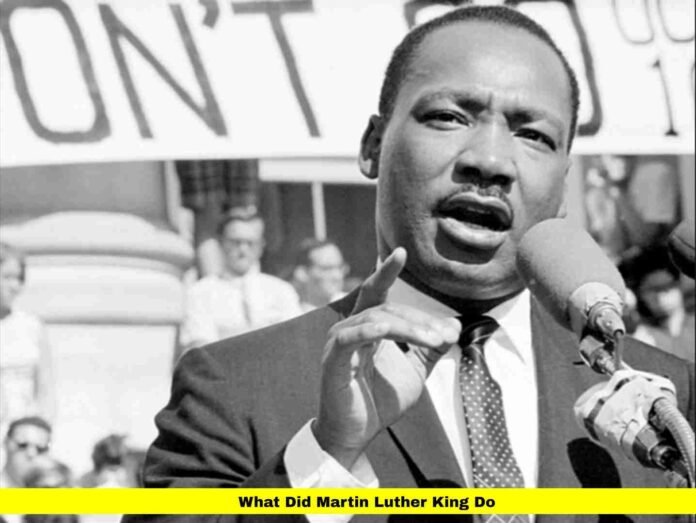

Martin Luther King Jr. led organized, nonviolent campaigns that challenged segregation, protected voting rights, and pushed the nation toward equal treatment under the law.
His leadership helped drive major civil rights legislation and expanded democratic participation across the United States.
Through action, discipline, and moral clarity, he reshaped American society and left a lasting legacy of justice and civic responsibility.
What did Martin Luther King do is a question that captures the essence of one of the most transformative figures in American history. From his early activism to his leadership in the civil rights movement, his role changed the legal and social landscape of the United States. His actions were rooted in nonviolence and moral purpose, and they helped dismantle institutional racism while inspiring generations to continue the pursuit of justice and equality.
This comprehensive article outlines his major activities, the historical context around them, and the lasting impact of his life’s work.
Early Life and Path to Activism
Martin Luther King Jr. was born on January 15, 1929, in Atlanta, Georgia, into a family deeply involved in church leadership and community affairs. Early experiences with racial discrimination shaped his view of American society and fueled his commitment to change.
King’s upbringing emphasized education and moral responsibility. He attended Morehouse College and later earned a divinity degree. These years strengthened his philosophical foundation, combining Christian theology with the principles of nonviolence he later adopted from leaders like Mahatma Gandhi. This blending of spiritual commitment with social activism became the core of his approach to organizing and protest.
From his earliest years as a pastor and civil rights advocate, he worked to address systemic injustices in a way that sought lasting change through peaceful means.
Montgomery Bus Boycott and National Emergence
One of the first major examples of what he did was his leadership in the Montgomery Bus Boycott, which began in December 1955 after Rosa Parks refused to give up her seat on a city bus. King helped organize the boycott and was elected president of the Montgomery Improvement Association, which coordinated the massive protest.
For more than a year, Black residents refused to ride segregated buses, relying on carpools and other means of transportation. This sustained protest led to a federal court decision that declared bus segregation unconstitutional. King’s leadership during this period transformed him from a local pastor into a national figure in the fight against segregation. This boycott marked the beginning of a nationwide movement that used nonviolent resistance as its strategy.
Founding and Leading the Southern Christian Leadership Conference
In 1957, King and other civil rights leaders established the Southern Christian Leadership Conference (SCLC). The organization coordinated nonviolent protests across the Southern United States and became a central institution in the movement.
Through the SCLC, King worked with churches, civil rights groups, and communities to mount strategic campaigns addressing segregation, discrimination, and voter disenfranchisement. The SCLC’s activities expanded beyond specific protests to become a sustained national effort to apply moral and political pressure on institutions that upheld discrimination.
This organizational leadership helped unify disparate local efforts into a cohesive national push for civil rights reform, ensuring that protests had both strategic focus and broad participation.
Early National Advocacy and the Prayer Pilgrimage for Freedom
In May 1957, King delivered one of his early major public addresses at the Prayer Pilgrimage for Freedom on the Washington Mall. In this speech, he demanded that Black Americans be granted the vote and equal participation in the political system.
This moment marked a transition from local activism to national advocacy. He articulated a clear vision for full citizenship rights, laying the groundwork for future campaigns that directly challenged discriminatory laws and practices. His words at this event amplified his voice and connected the struggles of Southern Black communities with a broader call for nationwide justice and equality.
Birmingham Campaign and Address from Jail
King’s work in Birmingham, Alabama, in 1963 demonstrated his commitment to confronting segregation head-on. Birmingham was one of the most segregated cities in the South, and the campaign there involved sit-ins, marches, and boycotts aimed at ending segregation in public spaces and hiring practices.
During the protests, police responded with fire hoses and dogs, images of which were broadcast widely and stirred national outrage. While jailed during the campaign, King wrote a powerful letter defending nonviolent resistance and arguing that waiting for change was no longer acceptable. His argument emphasized moral urgency and helped solidify public support for the movement.
These actions in Birmingham helped shift national sentiment and increased pressure on lawmakers to act.
The March on Washington and the “I Have a Dream” Speech
In August 1963, King joined with other civil rights leaders to organize a massive demonstration in Washington, D.C. More than 200,000 people gathered near the Lincoln Memorial for the March on Washington for Jobs and Freedom. Here, King delivered his now-iconic “I Have a Dream” speech, imagining a future where all Americans would enjoy equality and justice.
This event was one of the largest peaceful demonstrations in U.S. history and significantly influenced public opinion and political will. It became a defining moment in the civil rights movement, symbolizing both the moral strength of the movement and its broad appeal across racial and social lines. The clarity and passion of King’s message helped accelerate support for sweeping civil rights reforms.
Civil Rights and Voting Rights Legislation
One of the most measurable aspects of what he did was his influence on landmark federal legislation. King’s leadership helped build momentum for the Civil Rights Act of 1964, which outlawed segregation in public places and prohibited discrimination in employment.
His actions also contributed to the passage of the Voting Rights Act of 1965. King and other activists organized and led the Selma to Montgomery marches, a series of demonstrations advocating for voting rights protections. The violent response to protesters on “Bloody Sunday” captured national attention and increased bipartisan support for federal legislation to protect voting rights.
These laws reshaped American civil rights policy and expanded legal protections for millions of citizens who had been denied equal treatment for generations.
Chicago Freedom Movement and Broader Campaigns
By the mid-1960s, King began addressing racial discrimination beyond the South. In Chicago, he led efforts to challenge segregation in housing and employment. The Chicago Freedom Movement confronted discriminatory practices in northern cities where segregation and inequality persisted.
King’s leadership drew attention to the fact that racial injustice was not confined to Southern states. He sought to bring national focus to housing discrimination and economic inequality, arguing that civil rights reforms must address structural disparities across the country.
These efforts extended the movement’s reach and demonstrated that the struggle for equality was a nationwide challenge.
Opposition to the Vietnam War and Wider Focus
In the late 1960s, King expanded his activism to include opposition to the Vietnam War. He argued that the war diverted resources from anti-poverty programs and disproportionately harmed poor and minority communities. He also spoke out on economic justice, labor rights, and broader social issues.
This shift reflected his belief that true equality could not be achieved without addressing economic and social structures that perpetuated injustice. While this broadened agenda drew criticism from some political leaders and allies, it underscored his commitment to universal fairness and human dignity.
Final Campaign in Memphis
In 1968, King traveled to Memphis, Tennessee, to support striking sanitation workers who were seeking fair wages and safer working conditions. These workers faced dangerous conditions and low pay, and a growing strike brought attention to labor rights as part of the broader civil rights movement.
King saw the sanitation workers’ struggle as integral to the fight for economic justice and racial equality. His work in Memphis brought national attention to the strike and highlighted the pressing need for reforms that would improve working conditions for all Americans.
Tragically, while in Memphis, King was assassinated on April 4, 1968. His death was a profound loss for the movement and the nation, but his actions that led up to this moment were a culmination of his lifelong dedication to justice.
Posthumous Legacy and Legislative Change
The national outpouring of grief after his death led Congress to pass the Fair Housing Act of 1968. This law made it illegal to refuse to sell, rent, or finance housing based on race or other protected characteristics. It was a direct extension of the civil rights reforms King had championed.
Beyond legislation, his legacy lives on in educational curricula, public commemorations, and a federal holiday established in his honor. Each year, the third Monday in January is set aside for Americans to reflect on his work and consider ongoing efforts toward equality.
Commemorations and Continued Relevance
Across the United States, communities commemorate his life through events, speeches, and educational programs. Museums, memorials, and academic research continue to highlight his contributions to civil rights and social justice.
In recent years, renewed focus on racial equity has prompted public discussions about how his actions remain relevant to contemporary movements for justice and equality. Annual celebrations often emphasize the need to carry forward his principles of nonviolence and civic engagement.
Summary of Key Actions
To understand what he did, it helps to view his work through specific actions that shaped U.S.
Early Leadership in Nonviolence
From organizing boycotts to founding influential groups, his early leadership created a model of peaceful protest.
Major Demonstrations and Speeches
His commands during marches and speeches helped unify the movement and broaden national support.
Legislative Impact and National Change
His influence on major civil rights laws reshaped American legal protections.
Expansion of Social and Economic Justice Focus
Later work addressed poverty, war, labor rights, and systemic inequality.
These efforts combined moral leadership with sustained activism that permanently altered how American society understands race, justice, and equality.
Understanding His Legacy Today
His legacy remains central to discussions about fairness, voting rights, economic opportunity, and peaceful protest. Modern movements often reference his methods and moral clarity, even as they adapt strategies for new challenges.
Public officials, educators, and community leaders continue to draw on his words and actions to inspire civic engagement. His influence extends into debates about equity, policing, voting access, and public education reform.
The question of what he did is not merely historical. It is a living dialogue about who we want to be as a nation and how we pursue justice.
How do you see his legacy influencing today’s efforts for justice and equality? Share your thoughts and stay part of the ongoing conversation.