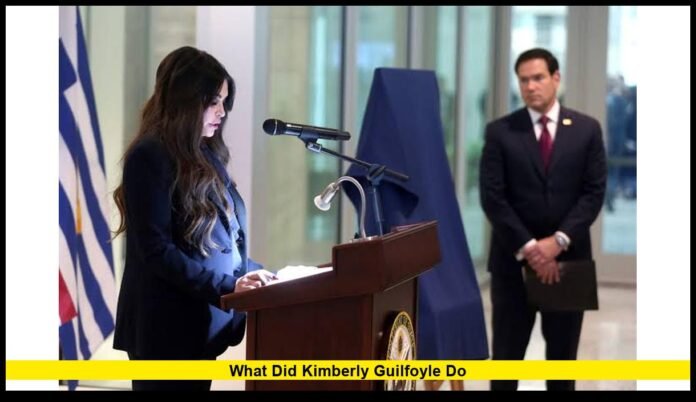

What did Kimberly Guilfoyle do to attract national attention in October 2026? The U.S. ambassador to Greece faced mounting scrutiny after a political donor alleged that she asked him to pay a $100,000 American Express bill shortly before her Senate confirmation hearing. The controversy intensified when President Donald Trump said he was considering her removal. On October 13, the White House confirmed that it had asked Guilfoyle to resign, marking a major development in the dispute over her financial dealings and diplomatic conduct.
The allegations have placed Guilfoyle’s professional relationships, financial arrangements, and responsibilities as an American diplomat under renewed scrutiny. Her legal team has disputed important parts of the accusations and maintains that a financial disagreement lies behind the claims.
The controversy extends beyond the alleged credit card payment. Separate reports have raised questions about her interactions with private business interests in Greece, gifts and travel, and the involvement of a lobbyist in diplomatic settings.
Here is what is known about the allegations, Guilfoyle’s response, her career, and the latest developments surrounding her position as ambassador.
Why Is Kimberly Guilfoyle in the News?
Kimberly Guilfoyle became the focus of intense political attention after reports detailed an alleged request for a $100,000 payment from Republican donor Eric Deters.
Deters said Guilfoyle contacted him in July 2025, shortly before her Senate confirmation hearing, and asked him to pay her American Express bill. He also alleged that she offered assistance involving influential officials in the Trump administration.
The timing raised questions because Guilfoyle was preparing to serve as a U.S. ambassador. Critics questioned whether her reported financial dealings with a political donor created an ethical concern.
The controversy became more serious on October 12, 2026, when Trump told reporters that his administration was considering whether to fire Guilfoyle. He expressed dissatisfaction with the situation but did not publicly explain every concern.
On October 13, White House press secretary Katie Zacharia confirmed that the administration had asked Guilfoyle to resign.
The announcement followed several days of growing attention to the allegations. It also came amid scrutiny of other reported aspects of her conduct in Greece.
The resignation request is an established development. However, it does not mean that every accusation has been proven or that a court has found Guilfoyle guilty of a crime.
The $100,000 American Express Allegation
The alleged credit card payment sits at the center of the controversy.
Deters said Guilfoyle asked him to transfer money directly to American Express to cover a bill totaling approximately $100,000. He provided purported text messages documenting their exchanges.
The reported messages allegedly date to July 2025, just days before Guilfoyle’s confirmation hearing. Deters said she wanted the payment handled in a way that would not appear as a direct transfer to her.
The timing attracted attention because financial disclosures and ethical considerations can be particularly important when a nominee prepares to assume a senior government position.
Deters characterized the request as an attempt to exchange financial support for political access. He said he expected help with matters involving administration officials.
However, Deters said he did not make the requested $100,000 payment.
Guilfoyle’s attorney, Jesse Binnall, challenged the authenticity of the messages. Her legal team has also argued that Deters owed money for earlier speaking engagements and consulting services.
That disagreement is central to understanding the allegations. A request to settle a legitimate business debt would differ substantially from a request for personal money in exchange for government assistance.
The available accounts present competing explanations. Deters describes the request as improper, while Guilfoyle’s representatives dispute his interpretation and challenge the communications.
The allegations have contributed to pressure on Guilfoyle, but they should not be treated as a final legal finding.
Who Is Eric Deters?
Eric Deters is a Republican donor, businessman, former lawyer, and political figure who has publicly discussed his dealings with Guilfoyle.
He said he had paid Guilfoyle approximately $300,000 over time for professional appearances. He also described efforts to obtain assistance with personal and legal matters through his connections to the Trump political network.
Deters has claimed that the alleged $100,000 request was part of a broader arrangement in which he expected help from influential officials. He said he did not receive the assistance he wanted.
His allegations became more widely known after he provided purported messages and other records to journalists.
Guilfoyle’s legal team disputes his account. Her attorneys argue that the financial dispute involves unpaid compensation for professional services, rather than an exchange of money for government action.
The disagreement raises several important questions. What services did Deters purchase? What payments were made? Were additional fees outstanding? Did either party connect a payment to a specific official decision?
Those questions require evidence from communications, financial records, contracts, and other relevant documents.
The existence of a dispute between a donor and a political figure does not automatically establish corruption. Likewise, a denial does not independently resolve every factual question.
The competing accounts remain important to the broader controversy because they offer different explanations for the alleged request.
Did Kimberly Guilfoyle Offer Political Favors?
Deters alleged that Guilfoyle offered to use her connections to help him reach senior government officials.
The reported matters included tax-related concerns and a legal issue involving an extradition request. Deters interpreted the alleged offers as part of a financial arrangement rather than ordinary political networking.
He said he expected assistance after providing financial support to people connected to the Trump political circle.
Guilfoyle’s legal team has rejected the suggestion that she sought money in exchange for official action. Her representatives have argued that the disputed communications concerned professional fees.
The distinction matters because political access and government authority are not the same thing. A person may introduce a contact to an official without promising a particular outcome. However, using public office to secure a personal financial benefit can raise serious ethical and legal concerns.
Establishing an improper exchange would require evidence connecting a payment or requested benefit to an official act or promise.
The public allegations have prompted scrutiny, but they do not independently establish that a criminal exchange occurred.
The controversy also demonstrates why the financial arrangements of senior public officials can attract attention. Diplomats represent the United States and must maintain public confidence in their ability to perform their duties without improper personal influence.
Questions About Kimberly Guilfoyle’s Conduct in Greece
The donor dispute was not the only issue that attracted scrutiny during Guilfoyle’s tenure as ambassador.
Separate reports raised concerns about her interactions with business figures, alleged comments about political developments in Europe, and the presence of a lobbyist at diplomatic meetings.
These matters are distinct from the American Express allegation, although they contributed to the broader examination of her conduct.
Allegations About Political Influence
Reports in September 2026 raised questions about comments Guilfoyle allegedly made during a dinner attended by Greek and American officials.
The reported remarks concerned political developments in Romania and the possibility of similar changes elsewhere, including Greece.
Critics questioned whether the comments suggested that the United States might use its influence to affect the domestic politics of another country.
The issue drew attention because Greece is a NATO ally and an important U.S. partner in Europe. Relations between the two countries involve defense cooperation, regional security, trade, and energy policy.
Representative Gregory Meeks, the senior Democrat on the House Foreign Affairs Committee, sought answers from Secretary of State Marco Rubio about reports concerning Guilfoyle’s conduct.
The allegations raised questions about diplomatic judgment and the language American representatives use when discussing another country’s political system.
However, reports about controversial remarks do not establish that the United States carried out an effort to remove or undermine the Greek government.
Questions About Aktor Group
Another area of scrutiny involved Aktor Group, a Greek construction and energy company.
Reports raised questions about whether Guilfoyle promoted the company’s commercial interests during official diplomatic engagements.
The controversy also involved Christos Marafatsos, a registered lobbyist associated with Aktor. Reports indicated that he accompanied Guilfoyle to meetings involving senior officials.
Critics questioned whether his presence gave a private business interest access to diplomatic settings that required greater transparency.
Ambassadors routinely engage with businesses when commercial cooperation advances legitimate American interests. Such activity can support investment, trade, infrastructure development, and energy security.
The ethical concern arises when official access appears to favor a private company without a clear public-interest justification.
The reported meetings have prompted questions about the boundaries between diplomacy and private commercial advocacy. The existence of those questions, however, does not establish that Guilfoyle violated a particular law or regulation.
Questions About Gifts and Travel
Separate reporting also raised concerns about gifts, hospitality, and private travel involving wealthy Greek business figures.
Such matters can be relevant because federal officials must follow applicable rules governing gifts, travel arrangements, and potential conflicts of interest.
The circumstances surrounding any benefit matter. Investigators would need to establish who provided it, its value, whether it related to official duties, and whether the appropriate approval process applied.
Guilfoyle’s legal team has disputed allegations of improper conduct and maintained that relevant arrangements complied with applicable requirements.
These claims remain separate from the donor’s allegations concerning the credit card bill. Each matter requires its own evidence and assessment.
Did the State Department Investigate Kimberly Guilfoyle?
Reports in October 2026 indicated that the State Department’s Office of Inspector General was examining allegations involving Guilfoyle.
The reported scrutiny concerned possible ethics issues connected to her financial dealings and conduct while serving as ambassador.
An inspector general can examine allegations involving government employees, review relevant records, and determine whether additional action is warranted. Such reviews may involve interviews, documents, financial information, and other evidence.
The existence of an investigation does not establish that a person committed misconduct. It indicates that allegations are receiving scrutiny.
As of October 13, the public information available did not establish a final investigative finding proving that Guilfoyle had committed a crime.
The White House’s request for her resignation represents a separate development. Presidential appointees can face personnel decisions based on administrative concerns or loss of confidence, even when no criminal conviction exists.
This distinction is important when assessing the controversy. The donor’s allegations, the reported government review, and the resignation request are related developments, but they do not carry the same meaning.
Any final determination about potential violations would depend on the relevant evidence and the outcome of appropriate proceedings.
Kimberly Guilfoyle’s Response to the Allegations
Guilfoyle’s legal representatives have challenged the accusations and disputed the authenticity of the messages presented by Deters.
Her attorneys have argued that the dispute concerns professional compensation for speaking engagements and consulting services. They have rejected the claim that the financial request represented a corrupt exchange for political assistance.
Her legal team has also addressed concerns about gifts and travel, maintaining that relevant arrangements complied with applicable State Department requirements.
These responses offer a different account from Deters’s allegations.
The central dispute involves the nature of their financial relationship, the authenticity of the reported communications, and whether any payment was connected to official government action.
The public release of purported messages does not automatically resolve those questions. Their context, authenticity, and relationship to any professional agreements remain important.
Similarly, a legal denial does not itself establish that every allegation is unfounded.
Readers should distinguish between claims made by an accuser, responses from the accused person’s representatives, and conclusions established through independent evidence.
The White House’s resignation request has changed Guilfoyle’s immediate professional situation, but it does not resolve the factual disputes surrounding the allegations.
Kimberly Guilfoyle’s Career Before Becoming Ambassador
Guilfoyle built her public career through law, television, and Republican politics.
She worked as a prosecutor in California, including in San Francisco and Los Angeles. Her legal career gave her experience with criminal cases and public institutions before she moved into television.
In 2006, she joined Fox News and became a familiar face in American political commentary. She appeared on programs including The Five and developed a national profile through political discussions and interviews.
Guilfoyle later became closely associated with Republican campaigning and fundraising. She supported Trump and served as a prominent political surrogate during his campaigns.
Her relationship with Donald Trump Jr. also brought her into the public spotlight. The couple became engaged but later ended their engagement.
In December 2024, Trump announced her nomination to serve as U.S. ambassador to Greece. The appointment represented a move from political advocacy and media work into formal diplomatic service.
The Senate confirmed her nomination in September 2025, and she subsequently served in Athens.
Her role involved representing American interests and maintaining relations with the Greek government. U.S.-Greek cooperation includes NATO security, regional stability, trade, and energy matters.
The controversy surrounding her conduct has now placed that diplomatic role under intense scrutiny.
Why Did Donald Trump Ask Guilfoyle to Resign?
Trump’s public comments on October 12 indicated that he was considering Guilfoyle’s future as ambassador.
The next day, the White House confirmed that the administration had asked her to resign. Press secretary Katie Zacharia announced the decision during a briefing but did not provide a detailed explanation of every factor behind it.
The announcement followed allegations that raised questions about Guilfoyle’s financial dealings and her conduct in Greece.
The controversy created several challenges for the administration. It brought attention to the relationship between political donors and public officials, raised concerns about diplomatic ethics, and generated questions about the ambassador’s ability to continue representing the United States effectively.
Ambassadors rely on credibility and professional judgment. Persistent allegations can complicate diplomatic work even when the claims remain disputed.
The resignation request was therefore a significant personnel decision. It showed that the administration was no longer merely considering the controversy publicly but had taken a concrete step concerning Guilfoyle’s position.
However, the request should not be interpreted as a judicial finding that she committed a crime.
What Happens Next for Kimberly Guilfoyle?
The next developments concern Guilfoyle’s departure from the ambassadorial position and any further findings arising from the reported scrutiny.
As of October 13, 2026, the White House had confirmed its request for her resignation. The announcement did not establish a specific departure date or identify a successor.
The status of the State Department’s reported review also remains important. Any official findings could clarify whether the allegations warrant administrative action or further investigation.
Congressional questions about her conduct may also remain part of the public debate.
Key developments to watch include:
- Confirmation of Guilfoyle’s formal departure from the position.
- An announcement naming a successor or interim arrangement.
- Any official findings from the relevant oversight process.
- Further evidence concerning the disputed financial communications.
- Additional official responses addressing diplomatic meetings, gifts, travel, and business relationships.
Until reliable new information becomes available, conclusions about criminal liability or specific ethics violations should remain grounded in established evidence.
The clearest current development is the White House’s request that Guilfoyle resign. The allegations and the competing explanations remain matters that must be assessed separately.
Frequently Asked Questions
What did Kimberly Guilfoyle do?
Guilfoyle faced allegations that she asked Republican donor Eric Deters to pay a $100,000 American Express bill and offered political assistance in return. Separate reports raised questions about her diplomatic conduct in Greece. Her legal team disputes key allegations.
Why did Donald Trump ask Kimberly Guilfoyle to resign?
The request followed mounting scrutiny of her financial dealings and conduct as ambassador to Greece. Trump said on October 12, 2026, that he was considering her removal. The White House confirmed the resignation request on October 13.
Who is Eric Deters?
Eric Deters is a Republican donor, businessman, and former lawyer. He alleged that Guilfoyle asked him to pay her credit card bill shortly before her confirmation hearing and connected the request to political assistance.
Did Eric Deters pay Kimberly Guilfoyle $100,000?
Deters said he did not make the requested payment. The allegation concerns a request to pay an American Express bill, not a completed $100,000 transfer.
Has Kimberly Guilfoyle denied the allegations?
Her legal representatives have disputed the authenticity of the reported messages and rejected the suggestion that the financial discussions involved an improper exchange. They have described the disagreement as involving professional fees and other financial matters.
Was Kimberly Guilfoyle investigated by the State Department?
October 2026 reports indicated that the State Department’s Office of Inspector General was examining allegations involving Guilfoyle. A review does not itself establish that misconduct occurred.
What controversies surrounded Guilfoyle in Greece?
Reports raised questions about alleged political remarks, business interests involving Aktor Group, a lobbyist’s participation in diplomatic meetings, and gifts or travel arrangements. These matters require separate assessment and should not automatically be treated as proven violations.
When did Kimberly Guilfoyle become ambassador to Greece?
Trump nominated Guilfoyle in December 2024. The Senate confirmed her nomination in September 2025, and she subsequently served as U.S. ambassador to Greece.
Is Kimberly Guilfoyle leaving her ambassador position?
The White House confirmed on October 13, 2026, that it had asked her to resign. The announcement did not specify the effective date of her departure.
Final Thoughts
The controversy surrounding Kimberly Guilfoyle involves a disputed financial request, questions about political access, and allegations concerning her conduct as a U.S. diplomat. The White House’s request for her resignation marks a significant development, but the allegations must remain distinct from proven findings. Further verified information will determine how the remaining questions are resolved.
What is your view of the latest developments involving Kimberly Guilfoyle? Share your thoughts in the comments and follow future updates as more confirmed information becomes available.