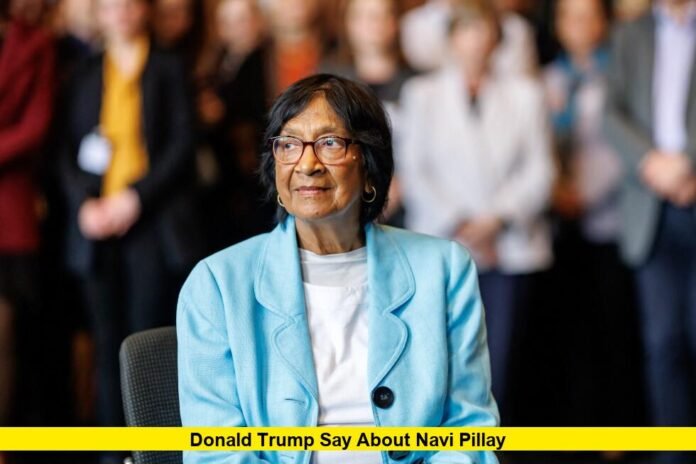

What did Donald Trump say about Navi Pillay winning the Nobel Peace Prize? President Donald Trump criticized the decision to award the 2026 Nobel Peace Prize to South African jurist Navi Pillay, questioned her achievements, and argued that he deserved the honor for his diplomatic efforts. Following the October 9 announcement, Trump called the decision an “indelible stain” on Norway and claimed that the Nobel Peace Prize had been discredited. His comments sparked international debate about the award, Pillay’s career in international justice, and Trump’s repeated claims that his efforts to resolve international conflicts deserved recognition.
What Did Donald Trump Say About Navi Pillay?
Trump responded angrily after learning that Navi Pillay had won the 2026 Nobel Peace Prize. During a rally in Syracuse, New York, and in a subsequent Truth Social post, he questioned her international reputation and criticized the committee responsible for selecting the winner.
Trump described Pillay as a person he had never heard of and suggested that few people knew her. In his online statement, he wrote, “I know nothing about this woman, and neither does anyone else!” He also accused her of opposing Israel and questioned what she had accomplished.
His comments focused on two issues: his belief that he deserved the Nobel Peace Prize and his disagreement with the committee’s decision to recognize Pillay.
Trump also directed criticism toward Norway, where the Nobel Peace Prize is awarded. He described the decision as an “indelible stain” on the country and said the award had been discredited by what he called radical ideologues.
The remarks quickly became a major part of the discussion surrounding Pillay’s victory. Rather than congratulating the winner without qualification, Trump used the occasion to challenge the award and promote his own record.
Trump Claims He Deserved the Nobel Peace Prize
A central theme of Trump’s reaction was his assertion that his diplomatic achievements made him more deserving of the award.
Trump claimed that he had settled eight wars and argued that each resolution should have earned him a Nobel Peace Prize. He also referred to additional international conflicts that he said he was working to resolve.
In his Truth Social post, Trump listed several accomplishments, including diplomatic efforts involving Israel and the release of hostages. He maintained that his administration’s work had contributed significantly to international peace.
However, Trump’s claims about ending eight wars require important context. The conflicts he cites vary considerably, and some have continued despite diplomatic agreements or temporary reductions in fighting. Other outcomes involved the work of multiple governments and international actors.
His assertion that he deserved eight Nobel Peace Prizes represents his own assessment of his record, not an official finding by the Nobel Committee.
The committee does not award prizes based simply on the number of conflicts a leader claims to have resolved. Its decision reflects its assessment of a nominee’s contribution to peace in accordance with the criteria governing the award.
Why Did Trump Call the Decision an Indelible Stain on Norway?
Trump’s criticism extended beyond Navi Pillay to the country associated with the Nobel Peace Prize.
During his Syracuse rally on October 9, he argued that the United States, represented by him as president, should have received the award. He described the committee’s decision as disgraceful and embarrassing and warned that Norway would be remembered for the outcome.
His comments reflected longstanding frustration over not receiving the Nobel Peace Prize. Trump has repeatedly argued that his diplomatic efforts and involvement in international negotiations merit recognition.
Although the Norwegian Nobel Committee awards the prize, the Norwegian government does not directly select the recipient. The committee operates independently under the terms of Alfred Nobel’s will.
That distinction is important when evaluating Trump’s criticism of Norway. His remarks targeted the decision-making process associated with the award, but they do not establish that the Norwegian government personally chose Pillay over him.
The committee’s decision remains in effect, and Trump’s public objections do not change Pillay’s status as the 2026 laureate.
Who Is Navi Pillay, the 2026 Nobel Peace Prize Winner?
Navanethem “Navi” Pillay is a South African jurist and former United Nations High Commissioner for Human Rights. Born in Durban in 1941, she built an international career focused on human rights, legal accountability, and international criminal justice.
Pillay began her legal career during South Africa’s apartheid era. She defended people facing political persecution and challenged discriminatory practices under the country’s racial segregation system.
Her career later expanded into international judicial institutions. She served as a judge at South Africa’s High Court and became president of the International Criminal Tribunal for Rwanda. She subsequently served as a judge at the International Criminal Court and held senior responsibilities within the United Nations.
From 2008 to 2014, Pillay served as the United Nations High Commissioner for Human Rights. During that period, she advocated for the protection of fundamental rights and emphasized the importance of holding perpetrators of serious abuses accountable.
Her professional background provides important context for the Nobel Committee’s decision. The award recognized her efforts to promote peace and international law, particularly through the development and enforcement of legal standards intended to prevent impunity for serious international crimes.
Why Did Navi Pillay Win the Nobel Peace Prize?
The Norwegian Nobel Committee announced Pillay as the 2026 Nobel Peace Prize recipient on October 9. It recognized her contributions to international law and efforts to strengthen accountability for war crimes, crimes against humanity, and genocide.
The committee emphasized the importance of legal institutions in preventing violence and supporting lasting peace. Its decision reflected the view that justice and accountability can contribute to a more stable international order.
Pillay’s career includes work at several institutions involved in investigating or prosecuting serious international crimes. These experiences have made her a prominent figure in debates about the responsibilities of governments and the role of international courts.
Her selection also highlighted the continuing disagreements between some governments and international justice institutions. Those disagreements have become particularly pronounced in debates involving Israel, Gaza, and the authority of international courts.
The Nobel Committee’s stated rationale centered on Pillay’s work promoting peace and international law. Trump’s criticism of her reputation did not alter that explanation.
What Is the Connection Between Navi Pillay and Israel?
One of the clearest elements of Trump’s criticism concerned Pillay’s work related to Israel and the Palestinian territories.
Pillay chaired a United Nations commission of inquiry that investigated events in the occupied Palestinian territory and Israel. In September 2025, the commission concluded that Israel had committed genocide in Gaza and that Israeli authorities had acted with the specific intent required under its assessment.
Israel has strongly rejected allegations of genocide and criticized the commission’s conclusions.
The findings became a major source of international controversy. Supporters of the commission emphasized its investigation and legal conclusions, while Israel and its supporters disputed its methodology and findings.
Trump referred to Pillay’s position on Israel when questioning her qualifications for the Nobel Peace Prize. His comments presented her criticism of Israeli actions as a reason to doubt her standing.
However, the existence of this political controversy does not fully explain the Nobel Committee’s decision. The committee cited her wider career in international justice and her work to promote international law.
Understanding this distinction helps separate Trump’s political characterization of Pillay from the stated reasons for her selection.
How Did Navi Pillay Respond to Winning the Award?
Pillay’s immediate response included a lighthearted reference to Trump’s desire to receive the Nobel Peace Prize.
After learning that she had won, she addressed an audience at an international law gathering in Nuremberg, Germany. As attendees applauded, she joked that she might share the prize with Trump if they continued clapping.
The remark attracted attention because Trump has repeatedly expressed his belief that he deserves the award.
Pillay also emphasized the importance of protecting human rights and preserving international legal institutions. Her comments reflected her longstanding position that governments and political leaders should remain accountable under international law.
Her response contrasted with Trump’s criticism. While he focused on his own diplomatic record and the decision not to recognize it, Pillay highlighted the broader principles behind her work.
The exchange became one of the most widely discussed moments surrounding the 2026 Nobel Peace Prize announcement.
Does Donald Trump Have Any Authority Over the Nobel Peace Prize?
No. The American president has no authority to select or remove a Nobel Peace Prize recipient.
The Norwegian Nobel Committee independently evaluates nominations and chooses the winner according to the rules governing the award. Political leaders can express support for candidates or criticize the committee, but they cannot dictate its decision.
Trump’s objections therefore do not change the result. Pillay remains the 2026 Nobel Peace Prize laureate.
The award also cannot be transferred to another person simply because a recipient offers to share recognition or gives someone a medal. The distinction between possessing a medal and holding the official title of Nobel laureate remains important.
Trump’s previous expressions of interest in the prize have generated considerable public discussion, but the committee’s selection process remains separate from his political ambitions.
What Happens Next After Trump’s Reaction?
As of October 12, 2026, the main development remains Trump’s public criticism of Pillay’s selection and his renewed argument that his diplomatic efforts merited the award.
Pillay is expected to receive the Nobel Peace Prize at the ceremony in Oslo on December 10, the anniversary of Alfred Nobel’s death.
The controversy has brought renewed attention to competing approaches to peace. Trump’s argument emphasizes diplomatic agreements and his claimed role in preventing or ending conflicts. The Nobel Committee’s decision highlights international law, accountability, and the institutions designed to address serious crimes.
The disagreement also demonstrates how international awards can become part of wider political debates. Trump’s reaction has drawn attention to Pillay’s career, but the committee’s stated reasons for recognizing her remain focused on international justice.
For readers following the story, the key distinction is between Trump’s personal assessment of his achievements and the independent committee’s explanation of why it selected Pillay.
Conclusion
Donald Trump criticized Navi Pillay’s 2026 Nobel Peace Prize win, questioned her accomplishments, and argued that his own diplomatic efforts made him more deserving of the award. He called the decision an “indelible stain” on Norway and challenged the credibility of the Nobel Committee.
Pillay received the award for her work promoting peace, human rights, and international law. Her decades-long career in South African and international legal institutions formed the basis of the committee’s decision.
The controversy reflects a wider disagreement over how the international community should recognize contributions to peace and justice.
What do you think about Donald Trump’s reaction to Navi Pillay winning the Nobel Peace Prize? Share your thoughts in the comments and follow the latest verified developments.