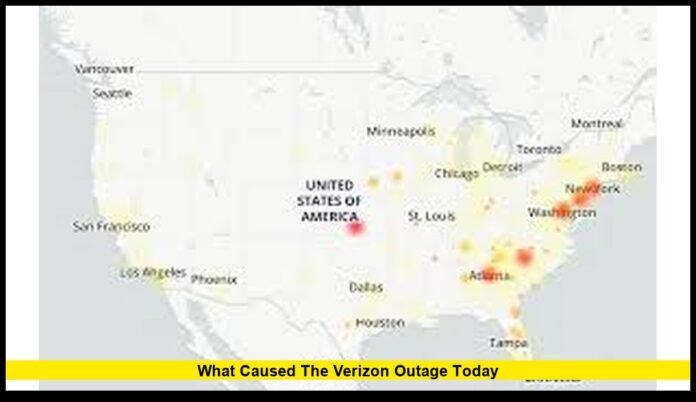

What caused the Verizon outage today became a top question across the United States after millions of customers suddenly lost mobile service, saw their phones switch to SOS mode, and experienced failed calls and data interruptions. The disruption affected both urban and rural regions, cutting across state lines and impacting essential communications during normal business hours.
The incident unfolded as a large-scale failure within Verizon’s wireless network, triggering widespread loss of connectivity for voice, text, and mobile internet. Engineering teams worked throughout the day and overnight to stabilize systems and restore full service. While most customers are now back online, the event exposed how a single network disruption can ripple across the nation in minutes.
When the Outage Began and How It Spread
The first signs of trouble appeared during the early afternoon when customers in multiple states noticed their signal bars vanish. Within minutes, phones began displaying “SOS” or “Emergency Calls Only,” indicating that devices could no longer authenticate with Verizon’s core network.
The outage did not remain isolated. Reports came in from:
- The Northeast, including major East Coast cities
- The Midwest, where both suburban and rural areas lost service
- The South, with disruptions in several large population centers
- The West Coast, including parts of California and the Pacific Northwest
The pattern showed that the problem was not tied to a single region or weather system. Instead, it pointed to a centralized network issue affecting nationwide operations.
Service Impact on Customers
The disruption affected multiple layers of communication:
- Voice calls: Many calls failed to connect or dropped immediately.
- Text messaging: SMS and MMS delivery was delayed or blocked.
- Mobile data: Internet access over cellular networks became unavailable or unstable.
- Emergency access: Some users could only place emergency calls, not standard calls.
For businesses, delivery drivers, healthcare providers, and remote workers, the outage caused significant delays and communication gaps. For families, it meant hours without reliable contact.
What the “SOS” Display Signaled
When a phone shows “SOS,” it means:
- The device is powered and functioning.
- Nearby cell towers may still be active.
- The phone cannot complete normal registration with its carrier’s core systems.
- Only emergency routing through any available compatible network is allowed.
This status usually appears when authentication servers or network signaling systems experience widespread failure. In this case, the scale of the SOS reports across the country confirmed that the issue was not limited to tower damage or local congestion.
Verified Facts About the Cause
Based on confirmed information available as of today, the following points are established:
- The outage was the result of an internal network failure.
- It affected Verizon’s nationwide wireless infrastructure.
- The disruption involved core systems that manage call routing and subscriber authentication.
- Customer devices and SIM cards were not the source of the problem.
- There is no verified evidence linking the incident to hacking or physical sabotage.
- No severe weather events were responsible for the nationwide scope.
The precise technical fault has not yet been publicly detailed. However, all verified indicators show that the disruption originated within the carrier’s centralized network control environment rather than from localized hardware damage.
How Verizon Responded
Once the outage was confirmed, Verizon initiated several response steps:
- Network Diagnostics
Engineers began tracing signaling failures and traffic bottlenecks within the core network. - Traffic Rerouting
Systems were adjusted to shift loads away from affected nodes and re-establish stable call paths. - Progressive Restoration
Service returned in stages, region by region, as network synchronization was re-established. - Ongoing Monitoring
Even after most customers regained service, teams continued monitoring for residual instability.
The restoration process reflected the complexity of modern mobile networks, where millions of simultaneous connections rely on continuous coordination between switching centers, databases, and routing platforms.
Why the Outage Was So Widespread
Nationwide wireless systems depend on:
- Centralized subscriber databases
- Authentication and encryption servers
- Real-time call routing controllers
- Data session management platforms
- Inter-carrier handoff systems
If a disruption occurs in these shared components, the effects can cascade instantly across states. Even though local towers may still transmit radio signals, phones cannot complete normal communication without access to these central systems.
Emergency Communications and Public Safety
During the outage window, some local authorities advised residents to use alternative methods for critical calls. While emergency call routing remained available in many areas, congestion and partial routing failures created uncertainty for users relying on mobile phones for urgent contact.
This aspect of the incident has drawn regulatory attention, as maintaining reliable emergency access is a core requirement for national carriers.
Current Network Status
As of today:
- Most affected customers have regained full voice and data service.
- Network stability has significantly improved compared to the peak outage period.
- Some users may experience brief reconnection delays as systems fully normalize.
- Core monitoring remains active to ensure continued reliability.
Residual effects, such as delayed voicemail notifications or message syncing, may occur temporarily but are expected to resolve as background processes complete.
Customer Steps If Issues Persist
For users still seeing instability:
- Power cycle the device to refresh network registration.
- Enable airplane mode for 30 seconds, then disable it.
- Ensure the phone’s carrier settings are up to date.
- Contact Verizon support if SOS mode or call failures continue.
These steps help devices re-establish secure authentication with restored network servers.
Broader Implications for U.S. Wireless Infrastructure
The outage highlighted several realities of modern telecommunications:
- Centralization improves efficiency but increases the impact of single-point failures.
- Software-driven networks require constant synchronization across regions.
- Redundancy planning is essential for maintaining nationwide reliability.
- Transparent post-incident reporting builds public trust and regulatory confidence.
Large carriers continuously invest in backup routing, geographic diversity, and automated failover systems to reduce the risk of similar events.
What Caused the Verizon Outage Today: Key Points Summarized
- A nationwide internal network disruption interrupted voice and data services.
- The failure affected core systems responsible for authentication and routing.
- Millions of devices entered SOS mode due to loss of normal network registration.
- Service was restored in stages as engineers stabilized infrastructure.
- The exact technical trigger has not yet been publicly detailed.
- There is no verified link to cyberattacks, weather damage, or user equipment.
What Customers Can Expect Next
In the coming days, Verizon is expected to:
- Complete a full technical review of the incident.
- File regulatory reports detailing system performance.
- Evaluate redundancy and failover mechanisms.
- Implement adjustments to prevent recurrence.
- Communicate any customer service remedies or billing considerations if applicable.
Such reviews are standard after nationwide outages and are essential for strengthening network resilience.
What caused the Verizon outage today remains under formal technical review, but confirmed facts show it stemmed from a large-scale internal network disruption that has now been largely resolved. Share your experience below and stay connected for verified updates as more details emerge.