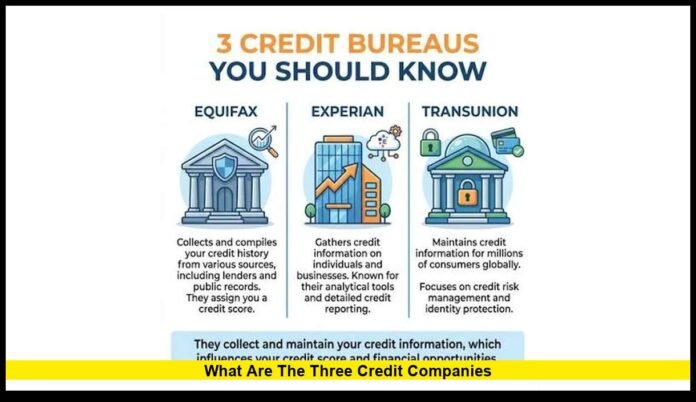

What are the three credit companies that influence how Americans access loans, credit cards, and other financial products? The three major credit reporting companies are Equifax, Experian, and TransUnion. These independent businesses collect and maintain information about consumers’ credit histories, helping lenders evaluate applications and understand borrowers’ financial obligations.
Although the companies perform similar functions, they do not maintain identical records for every consumer. One bureau might receive an updated account balance before another, while a creditor might report information to only two of the three companies. These differences can affect the credit reports lenders review and the scores calculated from those reports.
For American consumers, understanding the three credit companies is an important part of managing personal finances. Reviewing all three reports can help identify inaccurate information, recognize possible identity theft, and understand what lenders may see when evaluating a credit application.
What Are the Three Credit Companies?
The three major credit reporting companies in the United States are Equifax, Experian, and TransUnion. They are also known as credit bureaus or consumer reporting agencies.
Their primary responsibility is to collect credit-related information from participating lenders and other data providers. Each company organizes the information into individual credit reports that describe a consumer’s borrowing and repayment history.
Credit reports may contain information about:
- Credit cards and revolving credit accounts.
- Mortgages, auto loans, and personal loans.
- Reported payment history and late payments.
- Account balances and credit limits.
- Account opening dates and current statuses.
- Certain collection accounts.
- Credit inquiries and applications.
- Personal identifying information.
The exact details depend on a consumer’s financial history and the information each bureau receives.
Equifax, Experian, and TransUnion operate independently. They do not automatically maintain identical information, even when they report on the same person.
For this reason, reviewing just one credit report may not reveal every account or discrepancy recorded across the three companies.
1. Equifax: Understanding Your Credit History
Equifax is one of the largest credit reporting companies serving consumers and businesses in the United States. It maintains credit information that lenders may use when assessing applications for mortgages, credit cards, auto loans, and other financial products.
Equifax gathers information from participating creditors and organizes it into consumer credit files.
What Does Equifax Include in a Credit Report?
An Equifax report can show the credit accounts associated with a consumer, including their reported balances, credit limits, payment records, and account status.
For example, someone with two credit cards and an auto loan may see information about all three accounts if the respective creditors report them to Equifax.
The report may also contain collection information and records of credit inquiries. However, not every creditor reports to every bureau, so some accounts may be missing from a particular report.
Why Do Lenders Check Equifax?
Lenders use credit information to evaluate how applicants have managed their financial obligations.
A history of timely payments may demonstrate responsible credit management. Conversely, high reported balances, recent delinquencies, or other negative information may affect a lender’s assessment.
Equifax does not make every lending decision. Banks and other financial institutions establish their own approval requirements and may consider income, debt-to-income ratios, employment information, and other relevant factors.
How Can Consumers Check Equifax Reports?
Consumers can request their Equifax credit reports through the authorized free-report service available in the United States.
After obtaining a report, check whether the listed accounts belong to you. Verify payment records, balances, account statuses, and personal information.
If you identify an error, you can dispute the information with Equifax and provide documentation that supports your claim.
2. Experian: A Major Source of Credit Reporting Information
Experian is another major credit reporting company in the United States. It maintains consumer credit information and provides reports to lenders and other businesses for legally permitted purposes.
Like Equifax, Experian collects information from participating creditors. However, it operates a separate reporting system, so its records may not match those of the other two bureaus.
What Information Does Experian Report?
Depending on the information available, an Experian credit report may include credit card accounts, mortgages, auto loans, personal loans, payment histories, balances, and credit limits.
It may also contain collection accounts and credit inquiries.
These records help create a picture of a consumer’s borrowing history. However, the report reflects the information Experian receives and maintains, rather than every financial activity a person has ever undertaken.
For instance, a newly opened credit card might not appear immediately if the issuer has not yet reported the account.
How Does Experian Influence Credit Decisions?
A lender may examine an Experian report when reviewing a consumer’s application for a loan or credit card.
The lender could consider payment consistency, outstanding debt, account age, and other information relevant to the application.
Experian supplies the credit report, but the lender determines how to use that information. Different lenders may apply different approval standards or use different credit scoring models.
How to Review Your Experian Credit Report
Consumers can access their Experian credit reports through the authorized free-report service.
Review every account and investigate unfamiliar activity. Compare reported balances with recent statements and check whether payment statuses accurately reflect your history.
If the report contains an error, submit a dispute through Experian’s official process. You can also contact the creditor responsible for providing the information.
3. TransUnion: The Third Major Credit Bureau
TransUnion is the third major credit reporting company in the United States. It collects consumer credit information, maintains credit files, and supplies reports to authorized businesses.
Its role is similar to that of Equifax and Experian, but its database operates independently.
Consequently, TransUnion may show different account details or reporting dates from the other bureaus.
What Appears on a TransUnion Credit Report?
A TransUnion report may include credit card accounts, installment loans, mortgage information, reported payment histories, credit limits, and outstanding balances.
Depending on the records available, it may also contain collection information, credit inquiries, and personal identifying details.
Consumers should examine these entries carefully because incorrect information can create confusion when applying for credit.
Why Do Financial Institutions Use TransUnion?
Lenders may use TransUnion reports to assess applicants’ credit histories and outstanding financial obligations.
For example, an auto lender may review a consumer’s reported loan payments and existing balances before evaluating an application for vehicle financing.
A mortgage lender may consider similar information when assessing an applicant’s overall credit profile.
TransUnion does not guarantee that a consumer will receive approval. The lender makes that decision using its own underwriting policies and relevant financial information.
Checking Your TransUnion Report
Consumers can request TransUnion credit reports through the authorized free-report service.
Look for accounts you do not recognize, inaccurate balances, incorrect payment statuses, and personal information that needs correction.
If you find a problem, submit a dispute with supporting documents. When the same error appears on multiple reports, contact each bureau that displays the inaccurate entry.
Why Are There Three Credit Companies Instead of One?
Equifax, Experian, and TransUnion developed as separate businesses with independent reporting systems, data sources, and relationships with creditors.
Because they maintain separate databases, each company depends on the information supplied to it. A bank may report a credit card to all three bureaus, while another lender may report only to selected companies.
Different reporting schedules can also create temporary inconsistencies. One bureau might show a recently reduced balance while another still displays the previous amount.
Errors may contribute to differences as well. If a creditor corrects a payment record with one bureau, the same correction may not appear simultaneously in the other reports.
These differences do not automatically indicate a reporting violation. However, they explain why consumers benefit from checking all three credit reports.
Reviewing Equifax, Experian, and TransUnion gives consumers a broader view of their credit information and makes it easier to identify discrepancies.
What Is the Difference Between a Credit Bureau and a Credit Score?
A credit bureau maintains credit information, while a credit score summarizes credit risk using a scoring model.
Equifax, Experian, and TransUnion supply credit reports. Credit scoring models evaluate information from those reports according to their own criteria.
FICO and VantageScore are examples of credit scoring systems used in the United States. Different models can produce different scores even when they evaluate similar information.
Scoring models commonly consider factors such as payment history, credit utilization, the length of credit history, and recent credit activity. The exact calculations depend on the model and version.
A bureau does not determine every score that lenders use. A lender may obtain a report from one bureau and use a particular scoring model to assess the information.
Consumers should therefore distinguish between the company supplying a report and the scoring system calculating a number.
When comparing scores, consider which bureau supplied the information, which scoring model generated the score, and when the calculation occurred.
Can Your Credit Score Differ Across the Three Companies?
Yes. Consumers can receive different credit scores depending on the credit information and scoring models involved.
Several factors can explain these differences.
Different account records: A creditor may report an account to one bureau but not the others. The resulting reports may contain different information.
Different update schedules: Creditors provide updates periodically, so one bureau may display a newer account balance than another.
Different scoring models: FICO and VantageScore models may evaluate the same credit history differently.
Different reporting dates: A score calculated before a payment or account update may differ from one calculated afterward.
A difference between credit scores does not automatically mean that a bureau made an error.
Consumers should compare the reports themselves to identify whether the underlying account information differs. If a report contains inaccurate information, disputing the error can help correct the record.
How to Get Free Credit Reports From All Three Companies
American consumers can request credit reports from Equifax, Experian, and TransUnion through AnnualCreditReport.com, the federally authorized service for free reports from the three major credit reporting companies.
Checking these reports helps consumers understand their credit histories without necessarily purchasing a paid monitoring service.
Follow these steps:
- Visit AnnualCreditReport.com.
- Complete the required identity verification.
- Select Equifax, Experian, and TransUnion.
- Review each report separately.
- Save copies when the service permits.
- Record errors or unfamiliar activity that needs investigation.
The authorized service has offered free weekly online credit reports as an ongoing arrangement. Consumers should check the service for current availability and request options.
Remember that a credit report and a credit score are different products. A report contains the underlying credit information, while a score represents an assessment generated by a scoring model.
You can review account details and identify many reporting errors without buying a credit score.
How to Dispute Errors With Equifax, Experian, and TransUnion
If a credit report contains inaccurate information, consumers can dispute the entry with the relevant credit reporting company.
The Fair Credit Reporting Act establishes important consumer protections and responsibilities for credit reporting agencies. Generally, a bureau must investigate a qualifying dispute unless an applicable exception allows it to treat the dispute as frivolous or irrelevant.
Step 1: Identify the Error
Locate the incorrect entry and identify the problem. It could involve an unfamiliar account, an inaccurate balance, a payment reported late by mistake, or incorrect personal information.
Step 2: Gather Supporting Evidence
Collect documents that help establish the correct information. These might include account statements, bank records, payment confirmations, correspondence, or identity theft documentation.
Step 3: File a Dispute
Submit your dispute through the relevant bureau’s official process. Clearly explain what information is incorrect and what correction you are requesting.
If the same error appears in all three reports, consider submitting separate disputes to each bureau.
Step 4: Contact the Creditor
You can also contact the lender, collector, or company that furnished the inaccurate information.
Disputing the information with the original provider may help address the problem at its source.
Step 5: Review the Investigation Results
Credit reporting companies generally have 30 days to investigate qualifying disputes. Certain circumstances can extend that period.
After the investigation, review the results and check whether the information has been corrected.
If the issue remains unresolved, consider the available complaint procedures and provide additional evidence when appropriate.
A dispute does not guarantee the removal of negative information. Accurate information that remains legally reportable generally does not have to be deleted simply because it affects a credit score.
How Long Does Information Stay on Your Credit Reports?
Credit reporting periods depend on the type of information and the rules that apply.
Most late payments generally remain on credit reports for up to seven years. Many other negative entries also follow reporting periods of approximately seven years, although specific rules vary.
Bankruptcy reporting periods differ according to the circumstances. Some bankruptcy records may remain for up to ten years under federal law.
Consumers should distinguish between accurate negative information and entries that are incorrect, outdated, or otherwise not legally reportable.
If a record appears to exceed the applicable reporting period, review it carefully and dispute it when appropriate.
How the Three Credit Companies Help Consumers Address Identity Theft
Credit reports can help consumers detect signs of possible identity theft.
An unfamiliar account, an unexpected credit inquiry, or a new debt you did not authorize may indicate suspicious activity. Reviewing all three reports can reveal information that appears in only one company’s database.
Consumers can also use fraud alerts and security freezes to help protect their credit files.
A fraud alert asks businesses to take additional steps to verify identity before extending credit. An initial fraud alert generally lasts one year, while eligible identity theft victims can qualify for an extended alert that generally lasts seven years.
A security freeze restricts access to a credit report for many new-credit purposes, subject to applicable exceptions. Federal law allows consumers to place and lift security freezes without charge.
Because the three companies maintain separate credit files, consumers generally need to contact each bureau to freeze all three reports.
A freeze does not erase existing accounts or correct inaccurate information. It can help limit certain attempts to open new credit accounts using stolen personal information.
Which of the Three Credit Companies Is Best?
No single credit bureau is the best choice for every consumer or lending situation.
Some lenders use Equifax reports, others use Experian, and others rely on TransUnion. Certain lenders may obtain information from multiple bureaus.
Consumers generally cannot control which bureau a lender selects. That decision depends on the lender’s policies, the type of credit requested, and its underwriting process.
The most practical approach is to maintain accurate credit information across all three companies.
Pay bills on time, monitor reported balances, review your reports regularly, and dispute inaccurate entries. These habits can help you maintain a reliable credit history regardless of which bureau a lender consults.
Frequently Asked Questions
1. What are the three credit companies in America?
The three major credit companies are Equifax, Experian, and TransUnion. They maintain consumer credit reports used for legally permitted purposes.
2. Are Equifax, Experian, and TransUnion government agencies?
No. They are private companies that operate under applicable federal and state laws governing consumer reporting.
3. Can I check all three credit reports for free?
Yes. Consumers can request free credit reports from all three companies through AnnualCreditReport.com.
4. Why are my credit scores different?
Different account information, reporting dates, and scoring models can produce different credit scores.
5. Which credit bureau do lenders use most often?
There is no universal answer. Lenders choose the credit reporting companies and scoring models that fit their policies and lending products.
6. Does checking my own credit report lower my credit score?
No. Checking your own credit report is considered a soft inquiry and does not lower your score.
7. Can I correct errors on all three credit reports?
Yes. You can dispute inaccurate information with each bureau that reports the error. You may also contact the company that supplied the information.
8. How long do late payments remain on a credit report?
Most late payments generally remain for up to seven years, subject to applicable reporting requirements.
9. Can I freeze my credit with all three companies?
Yes. You can place a security freeze with Equifax, Experian, and TransUnion without charge. You generally must contact each company separately.
10. Do the three credit companies calculate every credit score?
No. The bureaus maintain credit reports, while scoring models evaluate credit information and generate scores.
Final Thoughts
Equifax, Experian, and TransUnion are the three major credit reporting companies in the United States. Although they perform similar functions, each maintains an independent database that may contain different information about the same consumer.
Understanding these differences can help you recognize why credit scores vary, identify errors, and prepare for future credit applications. Regularly reviewing all three reports is a practical way to monitor your credit history and protect your financial information.
Have you checked your Equifax, Experian, and TransUnion reports recently? Share your experience in the comments and stay informed about the factors that can affect your credit.