
The question that haunted Austin, Texas, for over three decades — were the yogurt shop murders ever solved — has finally been answered. In September 2025, Austin police publicly named a deceased serial killer as the man responsible for one of the most disturbing crimes in Texas history. What took investigators so long, and how did they ultimately crack the case? The answers involve wrongful accusations, a dangerous predator who slipped through the cracks, and a forensic breakthrough that would not have been possible until just recently.
If this case has touched you or someone you know, consider speaking with a counselor or victim advocacy resource in your area.
The Night That Changed Austin Forever
On the evening of December 6, 1991, four teenage girls were closing up the “I Can’t Believe It’s Yogurt” shop on West Anderson Lane in Austin. Jennifer Harbison, 17, and her sister Sarah, 15, worked at the shop. Their friends Eliza Thomas, 17, and Amy Ayers, 13, had stopped by so they could all head home together for a planned sleepover. None of them made it home.
Just before midnight, an Austin police officer reported a fire at the shop. When first responders arrived, they discovered a scene that stunned an entire city. All four girls had been herded to the back of the store, bound, gagged, and shot execution-style. Their bodies were found amid severe fire and water damage. Evidence at the scene also indicated sexual assault. The fire had destroyed much of the physical evidence, leaving investigators with very little to work with.
Austin Police Chief Lisa Davis would later call it “one of the most devastating and haunting cases in the city’s history.” That description barely does justice to the grief that consumed Austin in the weeks and months that followed.
Thousands of Leads, No Answers
The investigation immediately became one of the largest in Texas history. The Austin Police Department formed a dedicated task force, and the FBI was called in to assist. Families of the victims posted billboards offering reward money. A tip line was established. More than a thousand leads were chased down over the years. None of them held up.
The case went cold. Then, in 1999, nearly eight years after the murders, investigators arrested four young men — Robert Springsteen, Michael Scott, Maurice Pierce, and Forrest Welborn. These men had actually been questioned days after the murders when one of them was found near the yogurt shop with a .22 caliber gun. Police had dismissed them at the time due to a complete lack of physical evidence.
This time around, however, Springsteen and Scott gave confessions — confessions they would later recant. Charges were dropped against Pierce and Welborn due to insufficient evidence. Springsteen and Scott went to trial and were both convicted of capital murder. It appeared, at least on the surface, that justice had finally been served.
It had not.
Convictions Overturned, Men Set Free
The convictions of Springsteen and Scott were overturned on constitutional grounds years later. The Sixth Amendment guarantees defendants the right to confront their accusers. In both trials, the men’s confessions had been used against each other, but neither was allowed to cross-examine the other in court. This legal error voided the convictions.
By 2009, with DNA testing failing to link any of the four accused men to the scene — and in fact pointing to an unknown male — prosecutors dropped all charges. Springsteen and Scott walked free after nearly a decade behind bars. They were released, but not formally exonerated — meaning the possibility of a future prosecution remained open, an injustice that would linger for years.
All four men had effectively lost their reputations and years of their lives to a crime they did not commit.
The DNA That Refused to Give Up
What investigators did have from the crime scene was a Y-STR DNA profile — genetic material pulled from under Amy Ayers’ fingernails, evidence of her fight against her attacker. This profile belonged to an unidentified male. For years, it sat as an open mystery, compared against database after database with no match.
In 2017, an Austin investigator searched a public DNA database used for population studies and found what looked like a promising lead — but it couldn’t be fully pursued at the time. The technology hadn’t caught up yet.
Detective Dan Jackson took over the yogurt shop case in 2022 and refused to let it die. He resubmitted a spent .380 shell casing found in a floor drain at the scene into the National Integrated Ballistic Information Network (NIBIN), a federal database that links firearms to crimes. In July 2025, he got a hit: the same gun appeared to have been used in an unsolved murder in Kentucky. The cases shared similar details in method and approach.
Jackson then reached out to forensic labs across the country, asking each one to manually search the unknown Y-STR profile against their databases. Only one lab responded with a match — the South Carolina State Lab, in August 2025. The profile matched DNA collected from a 1990 rape and murder in Greenville, South Carolina.
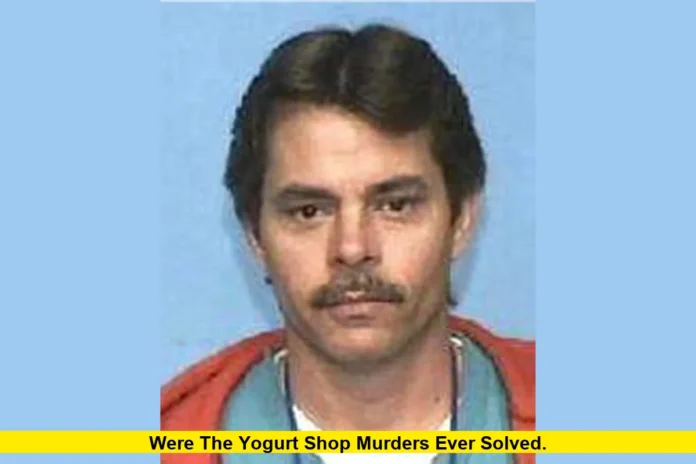
The name attached to that profile was Robert Eugene Brashers.
Who Was Robert Eugene Brashers?
Robert Eugene Brashers was born in 1958 in Newport News, Virginia. Investigators and court records describe him as intelligent, manipulative, and skilled with weapons. His violent history began in 1985 in Florida, where he shot a woman. He was convicted of attempted second-degree murder and sentenced to 12 years in prison, but was released on parole in 1989 after serving only three years.
What followed was a trail of violence across the country. DNA evidence later linked him to the 1990 rape and murder of a woman in Greenville, South Carolina; the 1997 rape of a 14-year-old girl in Memphis, Tennessee; and the 1998 rape and murder of a mother and her 12-year-old daughter in Portageville, Missouri.
Two days after the yogurt shop murders in December 1991, Brashers was stopped at a border checkpoint near El Paso. In his stolen car was a pistol matching the caliber used to kill one of the girls. At the time, investigators had no reason to connect him to Austin.
On January 13, 1999, police tracked Brashers to a motel in Kennett, Missouri, where he was hiding with his family. After a standoff, he released his wife and children — and then shot himself in the head. He died at 40. He never faced a trial for the Austin murders or the other crimes later linked to him by DNA.
The Announcement and the Exonerations
On September 29, 2025, Austin police held a press conference and formally named Robert Eugene Brashers as the suspect in the yogurt shop murders. The DNA from Amy Ayers’ fingernails had been retested and directly compared to Brashers’ profile. The results showed a 2.5 million to one likelihood that the DNA was his.
Austin Mayor Kirk Watson told the city that “this day has been a long time coming.” The announcement brought an emotional wave of grief, relief, and anger to families who had spent 34 years waiting for answers.
Then, in a separate but deeply meaningful development, a Texas judge formally declared all four of the wrongfully accused men — Springsteen, Scott, Pierce, and Welborn — innocent. Standing in a packed courtroom, state District Judge Dayna Blazey looked at the men and their families and said simply: “You are innocent.” Prosecutors told the judge that the four men had lived for decades under the shadow of a crime they did not commit.
Detective Jackson, reflecting on the breakthrough, put it plainly: “This is something that could not have happened until 2025. I’m sorry that it took 34 years to get here, but we’re here now. Amy’s final moments on this earth were to solve this case for us. It’s because of her fighting back.”
A Case That Lives On in Public Memory
The case gained renewed national attention in 2025 with the release of an HBO documentary miniseries also titled The Yogurt Shop Murders, which premiered at South by Southwest in March 2025 and aired on HBO beginning in August. Produced by A24 and executive produced by Emma Stone and Dave McCary, the four-part series explored the grief of the victims’ families and the decades-long investigation. ABC’s 20/20 also aired a special episode on the case in February 2026, featuring interviews with families of both the victims and the wrongfully accused.
The case stands today as a powerful, painful story about what DNA technology can accomplish when it is applied with patience and determination — and a cautionary tale about the dangers of coerced confessions and convictions built on no physical evidence.
Whether you’ve followed this case for years or just learned about it today, share your thoughts below — and stay with us as this story continues to unfold.