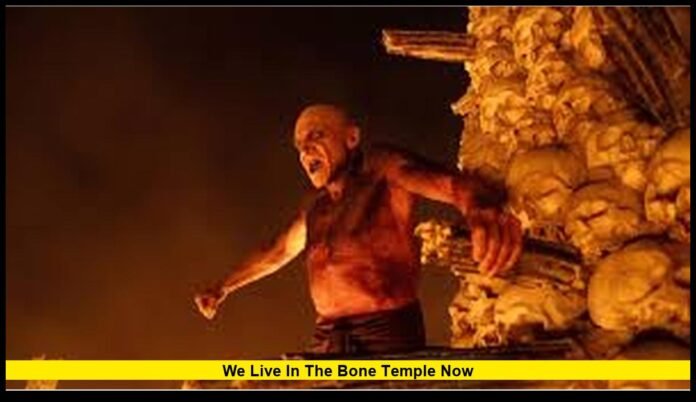

We Live In The Bone Temple Now is a phrase that has quickly taken hold among horror fans as the latest chapter in the legendary infected saga reaches U.S. theaters. The line captures the mood, the symbolism, and the unsettling worldview of “28 Years Later: The Bone Temple,” the newest continuation of the story that began with 28 Days Later and reshaped modern apocalyptic cinema.
This film does more than extend a timeline. It reframes the entire emotional and philosophical core of the franchise. Instead of focusing solely on the chaos of infection, it turns its attention to what humanity becomes after decades of survival, fear, and loss.
A World No Longer Defined Only by the Infected
The earlier films in the series centered on speed, panic, and the shock of collapse. Society fell fast, and the rage virus was the dominant force. In 28 Years Later: The Bone Temple, the world has had time to settle into a new, terrifying normal.
The infected still exist, but they are no longer the only monsters. Communities have formed, belief systems have hardened, and power structures have emerged in the vacuum left by the old world. Survival is no longer just about running and hiding. It is about choosing who to follow, what to believe, and what kind of person to become when laws, governments, and shared morality have disappeared.
This shift in focus gives the film a heavier psychological weight. Fear does not only come from what lurks in the shadows, but from what people are willing to do in the light.
The Meaning of the Bone Temple
The “Bone Temple” is both a physical location and a powerful symbol. Built as a monument to the countless dead, it stands as a reminder that this world is constructed on loss. Every structure, every community, and every fragile sense of order rests on the remains of those who did not survive.
In a literal sense, the temple is an ossuary-like complex, a place where bones are arranged with ritualistic purpose. In a deeper sense, it represents how memory, grief, and violence have become the foundation of civilization itself. The survivors do not simply live in ruins. They live in a culture shaped by death, reverence, and fear.
That is why the phrase We Live In The Bone Temple Now resonates so strongly. It suggests that humanity is no longer merely rebuilding. It is redefining existence around what was lost and what was learned through suffering.
Human Threats Take Center Stage
One of the most striking developments in this installment is the rise of organized human antagonists. A cult-like group known as The Fingers emerges as a central force of terror. Their leader, a charismatic and brutal figure, commands loyalty through fear, ritual, and a distorted sense of destiny.
These followers are not driven by infection. They are driven by ideology. They wear symbols, follow strict hierarchies, and justify extreme violence as necessary for order and purification. Their presence shows how, in the absence of stable institutions, belief can become as dangerous as any virus.
The film uses this group to explore how quickly people can surrender autonomy in exchange for protection and purpose. It is a chilling reminder that the collapse of society does not only unleash chaos. It also creates the conditions for authoritarian control and cult devotion.
Science, Survival, and the Question of Hope
Alongside the rise of cult power, the story introduces a scientific thread that reshapes long-held assumptions about the infected. A reclusive doctor studies the virus in isolation, observing long-term changes that suggest it may not be as static or unstoppable as once believed.
This research hints at evolution, adaptation, and even the possibility of partial recovery in certain cases. The infected are no longer portrayed as a uniform, eternal threat. They are changing, just as humanity is changing.
This development does not offer easy optimism. Instead, it raises complex ethical questions. If the virus can change, what responsibility do survivors have toward those who are infected? Are they still monsters, or are they victims of a condition that might one day be understood or treated?
The film never provides simple answers. It allows uncertainty to linger, reinforcing the idea that in this world, every step toward hope is shadowed by moral risk.
A New Generation in a Broken World
At the emotional center of the story is a young survivor who has never known the world before the outbreak. For him, the ruins, the rituals, and the constant danger are normal. He does not remember cities full of life, open highways, or societies built on trust rather than fear.
Through his eyes, the audience sees how trauma becomes inherited. The values of the new world are not learned from history books but from survival rules: stay quiet, stay loyal to your group, and never assume safety. His journey forces viewers to confront how childhood, identity, and morality are shaped when violence is the backdrop of everyday life.
The contrast between older survivors, who remember what was lost, and younger ones, who only know what is, gives the film much of its emotional power.
Visual Storytelling and Atmosphere
Visually, The Bone Temple moves away from the frantic handheld energy of earlier entries and adopts a more deliberate, haunting style. Wide shots of abandoned landscapes emphasize isolation, while the interiors of cult spaces and the temple itself are filled with shadow, firelight, and ritualistic design.
The bones are not merely props. They are arranged with care, forming patterns that suggest worship, warning, and memory all at once. This visual language reinforces the film’s central theme: civilization has rebuilt itself using the remnants of the dead as both foundation and symbol.
Sound design and music further heighten the tension, often favoring silence over constant noise, allowing dread to build slowly rather than explode suddenly.
What This Chapter Means for the Franchise
For long-time fans, this film marks a clear evolution. The series is no longer only about how fast the infected run or how society collapses in the first days of an outbreak. It is about what happens decades later, when survival has turned into culture, and fear has turned into belief systems.
The ending leaves the door open for continuation. It suggests that the world of 28 Years Later is entering a new phase, one where the lines between human, monster, victim, and savior are increasingly blurred. The foundations for future stories are laid not through cliffhangers, but through unresolved questions about power, healing, and the cost of endurance.
Why the Phrase Endures
The power of the phrase We Live In The Bone Temple Now lies in its universality. It is not only about a building in a film. It is about a state of existence where the past is inescapable, where every structure is built on memory, and where progress carries the weight of countless losses.
It encapsulates the idea that humanity moves forward, but never without carrying the physical and emotional remains of what came before. In the world of the film, bones are bricks, and remembrance is architecture.
That haunting concept is what lingers long after the credits roll.
What did this new chapter make you feel about the future of the franchise and the world it portrays? Share your thoughts and stay tuned as this dark universe continues to evolve.