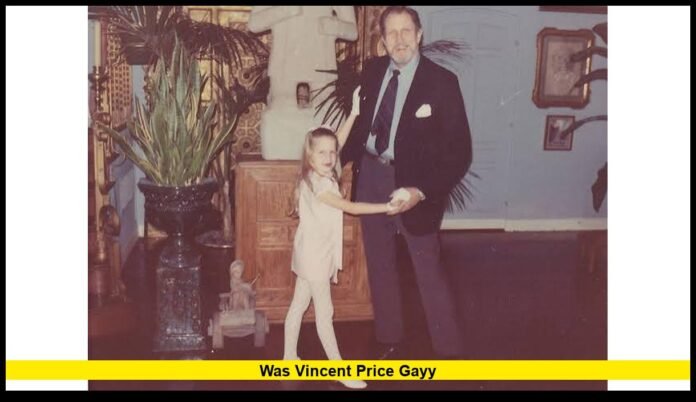

The question was Vincent Price gay continues to generate curiosity among classic Hollywood fans, particularly as renewed interest in entertainment history encourages audiences to look beyond familiar screen roles. Price, celebrated for his commanding voice and unforgettable performances in horror films, maintained a public career spanning several decades. Although his marriages and family life are documented, questions about his sexuality require a careful distinction between established facts and interpretations of his private relationships.
Price died in 1993, leaving behind a legacy that reaches far beyond the horror genre. His personal life remains a subject of interest, but the available public record does not establish a definitive sexual identity beyond what he personally disclosed.
Vincent Price’s Life Beyond the Horror Genre
Born in St. Louis, Missouri, on May 27, 1911, Vincent Leonard Price Jr. developed interests in literature, theater, and art before becoming a familiar presence on American screens.
He attended Yale University and subsequently pursued further studies in London, where his interest in acting developed into a professional career. His early theatrical experience helped him cultivate the polished delivery and expressive performance style that later became his trademark.
Price appeared in a variety of productions before gaining lasting recognition for horror and suspense films. His credits included House of Wax, The Fly, The House on Haunted Hill, and The Masque of the Red Death. He became particularly associated with stories featuring mysterious characters, elaborate settings, and psychological tension.
His career was not confined to frightening audiences. Price also worked in television, theater, comedy, and art education. His interest in visual art was a substantial part of his life, helping establish a public identity that extended beyond his acting work.
Understanding this broader background provides useful context when considering the questions that continue to surround his private life.
What Is Known About His Sexual Orientation?
There is no widely documented public declaration in which Price explicitly identified himself as gay. That distinction is important because discussions about his sexuality sometimes present speculation as though it were a settled biographical fact.
Accounts and interpretations concerning his personal relationships have prompted questions about whether his private experiences may have been more complex than the relationships widely recorded in his public biography. Some discussions have also raised the possibility of bisexuality.
However, a suggestion about someone’s intimate experiences does not automatically establish their sexual orientation. A person’s relationships, personal identity, and the terms they might use to describe themselves are separate matters.
The most responsible conclusion is that Price’s sexuality cannot be definitively classified from the publicly established information. Claims that go beyond that evidence should be presented as unconfirmed rather than as established history.
Three Marriages Shaped His Family History
Price married three times during his life. These relationships are important parts of his biography, although they do not independently answer every question about his sexuality.
His first marriage was to actress Edith Barrett in 1938. The couple had a son, Vincent Barrett Price, before their marriage ended in divorce in 1948.
In 1949, Price married Mary Grant, an artist and costume designer. Their daughter, Victoria Price, later became an author and public speaker. The marriage lasted until 1973.
Price’s third marriage was to Australian actress Coral Browne in 1974. Their relationship continued until Browne died in 1991.
These marriages were part of Price’s documented life, but marital history alone cannot establish the full nature of someone’s sexual identity. People can have complicated personal histories, and historical records do not always capture every dimension of private relationships.
For that reason, his marriages should be acknowledged as established facts without treating them as conclusive evidence for or against a particular label.
Why His Daughter’s Recollections Attract Attention
Victoria Price’s reflections on her father have contributed to public interest in aspects of his life outside the movie industry. Her perspective offers a family member’s view of a performer whose professional image was familiar to millions.
Some accounts and interpretations associated with discussions of his private life have prompted questions about whether Price may have experienced relationships that were not part of his public narrative. These discussions have encouraged speculation about his sexuality.
Still, recollections must be understood in context. A report about a possible relationship is not necessarily proof of a person’s identity, and interpretations made by others should not be confused with an explicit declaration by the individual concerned.
This distinction matters when discussing historical figures who can no longer clarify their experiences. It is possible to examine the available information without claiming certainty where the evidence remains incomplete.
Price lived during a period when public discussion of homosexuality was often shaped by social stigma and professional concerns. That historical context helps explain why some entertainers guarded their personal lives. It does not prove that Price concealed a particular identity or relationship.
His Screen Image Is Not Evidence of Sexuality
Price’s distinctive acting style has become one of the most recognizable features of classic horror cinema. His refined manner, expressive voice, and theatrical performances made him especially effective in portraying sophisticated and unsettling characters.
Those qualities have also become part of the cultural image associated with him. Modern audiences sometimes revisit older performances through contemporary discussions about gender expression, identity, and sexuality.
However, the personality an actor presents on screen is not a reliable guide to private identity. Acting involves interpretation, costume, direction, and deliberate performance choices. A dramatic manner or an unusual screen presence cannot establish whether someone was gay, bisexual, or heterosexual.
Price’s horror roles explain much of his lasting fame, but they should not be used as evidence about his intimate life.
A Legacy That Extends Beyond Personal Speculation
Price’s cultural contributions remain an important part of his story. In addition to acting, he supported public engagement with art and worked to make cultural education accessible to broader audiences.
His enthusiasm for painting, collecting, literature, and food reflected interests that reached beyond the film sets where he became famous. These pursuits demonstrated a multifaceted personality that cannot be reduced to a single question about his private life.
Price died on October 25, 1993, at age 82. His performances continue to attract viewers, and his influence remains visible in the popularity of classic horror movies.
Interest in his relationships and sexuality is understandable, but those questions should be approached with the same care applied to other aspects of historical biography. Respecting uncertainty is not a failure to investigate; it is part of reporting responsibly.
What Can Be Concluded About Vincent Price?
The available public record confirms that Price married three times, had two children, and maintained a long career in entertainment and the arts. It does not provide a definitive public declaration establishing that he identified as gay.
The question was Vincent Price gay therefore remains difficult to answer with certainty. Discussions of possible same-sex experiences or bisexuality should not be presented as proven facts without clear supporting evidence.
Ultimately, Price’s life encompasses far more than speculation about his sexuality. His work helped define an era of horror filmmaking, while his artistic interests and public contributions revealed dimensions of his life that audiences may not immediately associate with his famous screen persona.
A balanced account recognizes the documented facts, acknowledges the questions that remain, and avoids assigning an identity that the available evidence cannot conclusively establish.