
Who Is Greg Abel? Meet Warren Buffett’s Hand-Picked Successor
For decades, the burning question in investing circles was simple: Who comes after Warren Buffett?
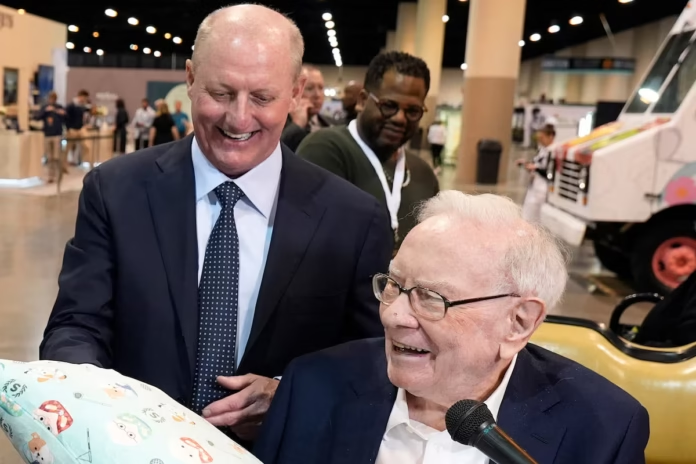
The answer, confirmed at Berkshire Hathaway’s Annual Shareholders Meeting on May 3, 2025, turned out to be Greg Abel — a 63-year-old Canadian businessman who spent more than a quarter century quietly proving himself inside one of the world’s most complex corporations.
Born on June 1, 1962, in Edmonton, Alberta, Abel’s rise was anything but silver-spoon. He famously started his entrepreneurial journey collecting and reselling empty soda bottles as a child. That working-class hustle translated into a business career defined by discipline, deep operational knowledge, and an unwavering focus on value.
Abel joined the Berkshire ecosystem through its energy operations. He served as CEO and Executive Chairman of Berkshire Hathaway Energy from 2008 to 2018 before being elevated to Vice Chairman of Non-Insurance Operations — a role that put him at the right hand of Buffett himself.
On January 1, 2025, Greg Abel officially became President and CEO of Berkshire Hathaway, ending Warren Buffett’s six-decade reign as chief executive. Buffett, 95, remains Chairman of the Board.
Buffett’s Blessing: “Greg Will Be the Decider”
Warren Buffett has never been shy about his confidence in his successor. In his final shareholder letter, Buffett wrote that Abel “has more than met the high expectations I had for him when I first thought he should be Berkshire’s next CEO,” adding that he “understands many of our businesses and personnel far better than I now do, and he is a very fast learner.”
The praise didn’t stop there. Buffett has publicly stated, “Greg will be the decider,” and declared, “I’d rather have Greg handling my money than any of the top investment advisors or any of the top CEOs in the United States.”
For investors worried about a post-Buffett Berkshire, that kind of endorsement carries enormous weight — though as Abel’s early moves make clear, this is already a different company.
The Biggest Story Right Now: Is Greg Abel Dumping Bank of America?
The most closely watched investment storyline surrounding Abel involves Berkshire’s former No. 2 holding: Bank of America (NYSE: BAC).
The signs are unmistakable. Between July 17, 2024, and the end of Buffett’s tenure, Berkshire reduced its Bank of America stake by nearly 515.6 million shares — roughly 50% of a position that once topped 1.03 billion shares. That selling occurred across six consecutive quarters, all while Buffett was still at the helm.
Now, under Abel’s leadership, BofA is conspicuously absent from Berkshire’s list of core, long-term holdings. Abel’s first shareholder letter outlined nine “forever” positions — companies identified as indefinite or compound-type investments. Bank of America was not among them.
The core holdings Abel explicitly named include Apple, American Express, Coca-Cola, and Moody’s — companies he described as “positioned to compound value over decades.”
Why might BofA be on the chopping block?
The math on valuation tells most of the story. When Buffett originally invested in Bank of America preferred stock in August 2011, BofA’s common shares were trading at a 62% discount to book value — a classic Buffett bargain. By the start of this year, those same shares were changing hands at a 43% premium to book value.
For a value investor like Abel, who has made clear he will not compromise on price, that premium makes BofA far less compelling. Halving more than a billion-share position in just 18 months sends a loud signal: Bank of America is no longer viewed as a forever holding.
Formal 13F filings — which disclose institutional holdings with a lag — will ultimately confirm the extent of any additional selling. But the trajectory is hard to ignore.
Abel’s Global Pivot: “Not Betting on America”
Perhaps the most striking departure from the Buffett playbook comes in where Abel is choosing to deploy Berkshire’s legendary war chest.
Warren Buffett famously and repeatedly told investors to “never bet against America.” His successor, it turns out, is betting heavily on Japan.
According to regulatory filings, Abel has directed more than $43 billion of Berkshire’s assets into Japanese stocks as of mid-April — and the number continues to grow. His moves have centered on Japan’s powerful trading conglomerates, known as the sogo shosha:
- Mitsubishi — $13.27 billion
- Mitsui
- Itochu
- Marubeni
- Sumitomo
In mid-March, Abel also added to Berkshire’s existing stakes in Itochu, Marubeni, and Sumitomo, before opening a fresh $1.8 billion position in Tokio Marine — a major Japanese insurer. That move marked a significant milestone: Berkshire entering the Japanese insurance market in a meaningful way.
Abel was actually one of the original champions of the sogo shosha strategy when Berkshire first entered the sector in 2019. His enthusiasm for these businesses is rooted in classic value principles: Japan’s trading houses have historically traded at high-single-digit to low-double-digit price-to-earnings ratios — valuations almost impossible to find among large U.S. companies right now. The U.S. stock market, by contrast, entered this year near its second-priciest valuation over the past 155 years.
Additionally, the sogo shosha and Tokio Marine all pay dividends and are known for shareholder-friendly management — another hallmark of the Berkshire investment DNA.
Abel Goes Where Buffett Never Went
Beyond stocks, Abel has made at least one genuinely unprecedented move. Berkshire has joined a U.S. government-backed insurance syndicate covering ships transiting the Strait of Hormuz — one of the world’s most strategically sensitive and currently dangerous shipping corridors.
Buffett never entered territory quite like this. The move underscores that Abel is, as one analyst put it, “not managing for caution — he is managing for growth,” using Berkshire’s unmatched balance sheet to underwrite risks few other institutions on earth can absorb.
Abel also restarted share buybacks early in his tenure and invested his entire salary in company stock — a personal signal of alignment with shareholders.
Berkshire’s Portfolio Today: What Abel Is Keeping
While the changes are real, so is the continuity. Abel has been clear that the backbone of Berkshire’s equity portfolio will remain intact.
As of his first shareholder letter, nine positions form the core of Berkshire’s strategy, collectively representing approximately 60% of the $320 billion stock portfolio:
- Apple — still the largest single holding
- American Express
- Coca-Cola
- Moody’s
- Mitsubishi (Japan)
- Mitsui (Japan)
- Itochu (Japan)
- Marubeni (Japan)
- Sumitomo (Japan)
The Japanese trading houses alone have delivered extraordinary returns. Shares of Mitsubishi and Sumitomo have approximately doubled over the past year; Mitsui is up roughly 138% and Marubeni up around 173%.
Meanwhile, Berkshire also still sits on a record $381.6 billion in cash — a formidable reserve that gives Abel unmatched flexibility for future acquisitions or market dislocations.
The New Berkshire Leadership Team
The transition extends beyond Abel. Several other key changes have taken shape at Berkshire:
- Charles C. Chang will become Senior Vice President and CFO effective June 1, succeeding the outgoing CFO. Chang currently serves in the same role at Berkshire Hathaway Energy and brings over three decades of financial reporting and M&A experience from PricewaterhouseCoopers.
- Michael J. O’Sullivan has been appointed Senior Vice President and General Counsel — a newly created position at a company that historically relied on external legal counsel.
- Nancy L. Pierce has been named CEO of GEICO.
- Todd Combs, a longtime Berkshire investment manager, has departed to join JPMorgan Chase. Abel is reportedly unlikely to bring on a replacement, signaling he intends to manage the portfolio more directly himself.
What This Means for Berkshire Hathaway Investors
The transition from Buffett to Abel is the most consequential leadership change in Berkshire’s modern history. A few key takeaways for investors:
Value investing lives on. Abel and Buffett share a fundamental philosophy: you don’t pay up for assets that don’t justify the price. Where they differ is in where they are finding value right now — and Abel is finding it overseas.
Bank of America’s exit appears increasingly likely. Sustained selling, valuation concerns, and BofA’s absence from Abel’s list of core compounders all point in one direction. The next 13F filings will be closely watched.
Japan is Abel’s top conviction bet. With over $43 billion deployed in Japanese equities and more on the way, the sogo shosha have become the defining trade of the Abel era.
Berkshire is evolving, not abandoning its roots. The core holdings of Apple, American Express, and Coca-Cola remain cornerstones. The philosophy of buying quality businesses at fair prices hasn’t changed. The execution, however, is distinctly Abel’s.
The Bottom Line
Greg Abel has moved quickly and decisively since taking the reins. He is trimming Buffett-era positions that no longer offer compelling value, building a major international footprint in Japan, and stepping into risk categories Buffett never pursued — all while maintaining the discipline and long-term orientation that made Berkshire Hathaway legendary.
This is not your grandfather’s Berkshire Hathaway. But judging by Abel’s early moves, it remains a company that takes investing seriously — on its own terms, and on its own timeline.
Investors and market watchers should pay close attention to every 13F filing and shareholder communication from here on out. The Greg Abel era is just beginning, and it already looks anything but ordinary.
Last updated: April 28, 2025. All information is based on publicly available regulatory filings, shareholder letters, and news reports.