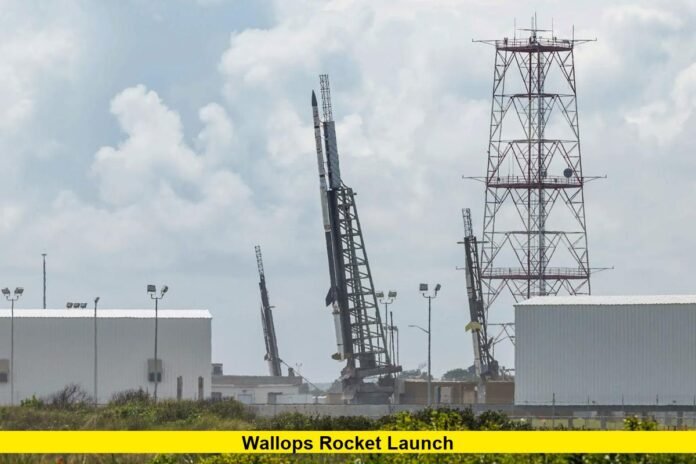

The wallops rocket launch has captured the attention of space enthusiasts as NASA prepares to send three sounding rockets into the upper atmosphere. The launch window opened on August 25 at 10 p.m. EDT and extends until 3 a.m., with backup opportunities available on subsequent nights through September 3. The event is taking place from the Wallops Flight Facility in Virginia and is expected to be visible across large portions of the mid-Atlantic region.
Mission Overview
The mission, called TOMEX+ (Turbulent Oxygen Mixing Experiment Plus), involves three different sounding rockets: two Terrier-Improved Orion rockets and one Black Brant IX. Each vehicle is equipped with advanced instruments designed to measure turbulence and chemical mixing in the upper atmosphere, particularly in the mesopause region.
This part of the atmosphere sits between 53 and 65 miles above Earth, an area too high for balloons and too low for satellites. Sounding rockets provide a unique opportunity to gather direct data from this region, which plays a key role in radio signal transmission, satellite drag, and the overall dynamics of space weather.
Key Points Summary
⭐ Mission name: TOMEX+ (Turbulent Oxygen Mixing Experiment Plus)
⭐ Launch site: Wallops Flight Facility, Virginia
⭐ Vehicles: Two Terrier-Improved Orion rockets + one Black Brant IX
⭐ Launch window: August 25, 10 p.m.–3 a.m. EDT, with nightly attempts through September 3
⭐ Purpose: Study turbulence in the upper atmosphere
⭐ Visibility: Expected to be seen across the mid-Atlantic within 30 seconds of liftoff
⭐ Viewing options: Visible to the naked eye and available via livestream
What to Watch For
The wallops rocket launch is designed not just for scientific exploration but also for public engagement. Viewers in Virginia, Maryland, Delaware, Pennsylvania, and New Jersey may spot the glowing trail in the sky shortly after ignition. The rockets will climb rapidly into the upper atmosphere, with visibility lasting only a brief time, making timing essential for those watching from the ground.
If weather conditions interfere with the attempt, the backup schedule allows NASA to try again each night until early September. These flexible opportunities maximize the chances of a successful mission while giving the public multiple opportunities to witness the event.
Why It Matters
The TOMEX+ mission will help scientists better understand how turbulence in the upper atmosphere affects oxygen mixing. These processes are critical to predicting how energy and particles move between different layers of Earth’s atmosphere. Improved knowledge can lead to more accurate space weather forecasting, which directly impacts satellite operations, GPS navigation, and communication systems.
In addition, the research provides valuable insights into how the atmosphere reacts to solar storms and other cosmic influences. By focusing on an area of the sky that remains largely inaccessible to other types of missions, the sounding rockets serve as powerful tools to bridge gaps in scientific knowledge.
Viewing Opportunities
For those hoping to see the launch, the best chances are in areas with clear skies and low light pollution. Observers should look toward the southeast horizon within 10 to 30 seconds of the launch window opening. Even at great distances, the bright plume of the rockets can sometimes be visible as they ascend rapidly into the night sky.
For those unable to view in person, NASA is providing a livestream beginning a few minutes before each launch attempt. Social media updates will also notify followers of countdowns, weather delays, and successful liftoffs.
Looking Ahead
If successful, the TOMEX+ mission will contribute significantly to atmospheric science while also providing the public with a rare opportunity to witness a rocket launch from the East Coast. Wallops Flight Facility has long served as a hub for scientific missions of this type, and each launch adds to its legacy as a critical site for space exploration.
By combining public visibility with cutting-edge science, the wallops rocket launch underscores the importance of continued investment in research that directly impacts daily life on Earth. Whether you are a dedicated space enthusiast or a casual skywatcher, this mission is a reminder of how exploration connects us all to the universe above.
The wallops rocket launch offers both an exciting viewing event and meaningful scientific advancement. If you catch a glimpse in the night sky, share your experience and join the conversation about this fascinating mission.