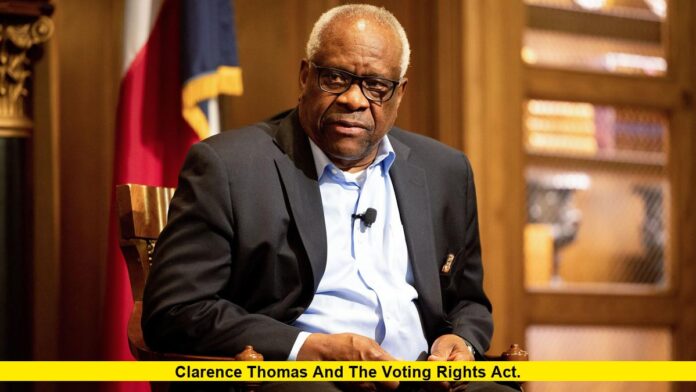

For years, Supreme Court Justice Clarence Thomas has voiced his disapproval of the Voting Rights Act, believing it has outlived its necessity. Once seen as a lone dissenter, Thomas now finds himself in a powerful position. With a solid conservative majority on the Court, he may finally have the votes to reshape—or severely restrict—the landmark law that once transformed America’s electoral landscape.
The Voting Rights Act: Why It Still Matters
Enacted in 1965, the Voting Rights Act was a game-changer in U.S. history. Its primary goal was to end racial discrimination in voting, especially in Southern states where voter suppression was rampant. The law banned literacy tests, poll taxes, and other tactics designed to keep Black Americans from casting ballots. Over the years, it has been amended and challenged, but its core mission remains crucial: protecting every citizen’s right to vote.
Clarence Thomas: A Longtime Critic
Justice Thomas has long argued that parts of the Voting Rights Act—especially the provisions that gave the federal government oversight over state election laws—are no longer necessary. In his view, America has changed enough that these protections are outdated.
He has stated, both in rulings and writings, that laws like Section 5 (which required some states to get federal approval before changing voting rules) are unconstitutional. He believes such sections place unfair burdens on states and no longer reflect modern-day realities.
Turning Point: Shelby County v. Holder
In 2013, the Court decided Shelby County v. Holder, a case that significantly weakened the Voting Rights Act. The justices struck down the formula that determined which states had to get pre-approval before making voting changes. While Chief Justice John Roberts wrote the majority opinion, Clarence Thomas went further—he wanted the entire preclearance section removed.
This decision opened the door for several states to pass stricter voting laws, many of which critics say unfairly impact minority voters.
The Numbers Game: Why Now Is Different
Back then, Thomas’s opinions didn’t carry the weight to rewrite the law. But things have changed. Today’s Supreme Court leans heavily conservative. Justices Gorsuch, Kavanaugh, and Barrett have joined the bench, all appointed by Republican presidents. With this new makeup, Clarence Thomas may finally have the numbers to carry out what he has advocated for decades: a major rollback of the Voting Rights Act.
Recent Cases Reflect the Shift
One major signal came in Brnovich v. DNC (2021), where the Court made it harder to challenge state voting laws under Section 2 of the Act. This section is supposed to stop rules that result in racial discrimination, even if discrimination isn’t the law’s intent. But with the Court’s new interpretation, proving harm has become much tougher.
Thomas supported this direction and continues to argue that states should have broader control over how they run elections.
What Could Be Next?
If the current Supreme Court majority agrees with Thomas in upcoming cases, we could see:
- Further weakening of Section 2, making it harder to challenge voter suppression tactics.
- Total removal of Section 5, even in theory.
- Expanded power for states to decide voting rules with less federal oversight.
- A rise in new voter restrictions, especially in battleground or conservative-leaning states.
In essence, what remains of the Voting Rights Act could be gutted.
Critics Warn of Backsliding
Civil rights groups are deeply concerned. They argue that voting discrimination hasn’t vanished—it has simply changed form. While we no longer see poll taxes or literacy tests, we do see strict voter ID laws, reduced early voting windows, and mass purging of voter rolls. These newer tactics still affect voters of color, especially in states with a history of discrimination.
For them, Clarence Thomas’s long-held views are dangerous—not just for minority voters but for democracy itself.
A Divided Nation on Voting Rights
The public is split. Some believe tighter laws are needed to prevent fraud, even though voter fraud remains rare. Others believe voter access should be expanded, not restricted. Congress has attempted to respond with legislation like the John Lewis Voting Rights Advancement Act, but political gridlock continues.
Meanwhile, the courts—especially the Supreme Court—are taking the lead. And Justice Thomas may finally be in control of the direction.
Final Thoughts: Democracy at a Crossroads
The Voting Rights Act was born from protest, sacrifice, and a desire for justice. It helped millions gain a voice in shaping the country’s future. Now, with Clarence Thomas and a conservative Supreme Court majority at the helm, the law’s power is hanging in the balance.
Whether the Act will be revived, redefined, or dismantled remains to be seen—but the decisions made in the coming months could echo for decades.