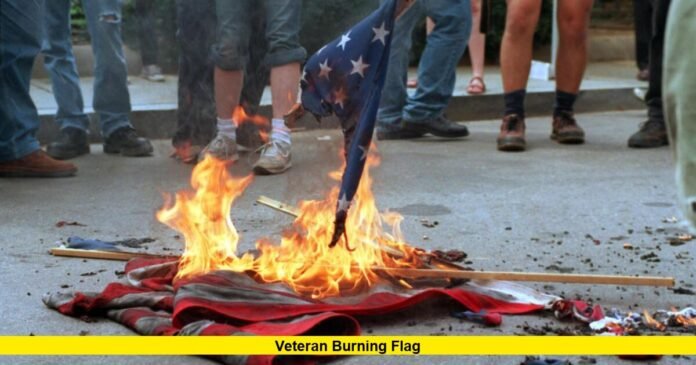

A veteran burning flag outside the White House this week has ignited a national debate, pitting long-standing Supreme Court precedent against a newly issued executive order. The act, carried out by Jay Carey, a retired U.S. Army combat veteran, has become the most visible flashpoint in America’s ongoing struggle over free speech, patriotism, and the limits of government power.
Carey, who served multiple tours overseas and earned a Bronze Star, deliberately set fire to the American flag in Lafayette Square on August 25, 2025. He described the act not as an attack on the country, but as an expression of protest against policies he believes undermine the Constitution. Park Police quickly detained him, though officials clarified that his arrest was based on safety violations for igniting a fire on federal grounds rather than for the symbolic act of burning the flag itself. Carey was released after several hours but now awaits a court summons.
Executive Order Sparks Controversy
Just hours before Carey’s protest, President Trump signed an executive order directing the Justice Department to aggressively pursue prosecutions against individuals who burn the flag. The order calls for mandatory minimum jail time and urges the Attorney General to bring the matter back before the Supreme Court. The move has energized supporters who believe the American flag should be legally protected from desecration, but it has also triggered immediate backlash from free speech advocates.
Critics argue that the president’s action directly challenges decades of settled law. Civil liberties groups have called it unconstitutional, noting that no executive order can override the Supreme Court’s interpretation of the First Amendment. Even some conservative commentators have voiced concerns, warning that restricting political expression through executive power sets a dangerous precedent.
Supreme Court Rulings on Flag Burning
The Supreme Court has twice ruled that burning the American flag is a form of symbolic speech protected by the Constitution.
- Texas v. Johnson (1989): The Court ruled 5–4 that flag burning is expressive conduct covered under the First Amendment, striking down state laws that criminalized it.
- United States v. Eichman (1990): The Court reaffirmed its position, invalidating federal laws aimed at punishing flag desecration.
These rulings established that even offensive or unpopular forms of expression cannot be prohibited by government, so long as they do not incite imminent violence or lawless action.
Divisions Within Politics
What makes this moment unique is the divide not only between political parties but also within conservative circles themselves. Some leaders argue that the flag, as a symbol of national sacrifice, deserves special legal protection. Others, however, point out that once exceptions to free speech are made, it opens the door to broader government restrictions.
Vice President J.D. Vance added fuel to the fire by declaring that Justice Antonin Scalia, who sided with the majority in 1989 to protect flag burning as free speech, had been “wrong.” This sharp break from one of conservatism’s most influential legal thinkers reflects the intensity of the debate and signals that the administration is prepared to challenge established doctrine at the highest level.
Veteran’s Protest Becomes a Legal Test
Carey’s protest has quickly shifted from a solitary act of defiance to a national legal test case. His willingness to risk arrest underscores his position that the Constitution is worth defending, even through controversial methods. Many veterans’ groups remain divided: some view flag burning by a former soldier as a betrayal, while others emphasize that the freedoms they fought for include the right to dissent.
What Comes Next
The Department of Justice is expected to explore ways to bring the issue before the Supreme Court, potentially setting the stage for a major constitutional showdown. However, legal scholars caution that overturning past rulings would require more than political will—it would demand a fundamental rethinking of free speech protections.
For now, the debate rests at the crossroads of law, politics, and patriotism. The image of a veteran burning flag near the seat of American government will remain a powerful symbol in the unfolding battle over the boundaries of free expression.
Closing Thought
The clash between executive power and Supreme Court precedent over something as symbolic as the flag raises urgent questions about the balance between liberty and authority. Whether one sees flag burning as an intolerable insult or as a constitutional right, the nation now finds itself confronting one of its most defining debates once again. Share your perspective below—should the act remain protected, or should the law change?