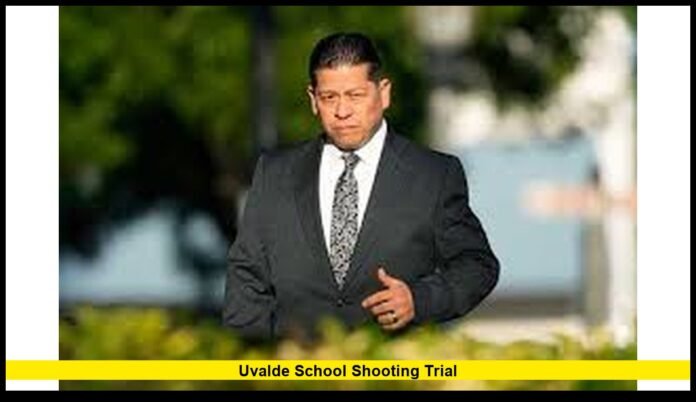

The Uvalde school shooting trial centers on whether former school police officer Adrian Gonzales is criminally responsible for failing to act during the 2022 Robb Elementary massacre.
The uvalde school shooting trial has become one of the most closely watched criminal proceedings in modern American history, shifting national attention from the gunman to the actions of law enforcement during the deadliest school shooting in Texas. As courtroom proceedings unfold, the case is forcing jurors, families, and the broader public to confront difficult questions about duty, responsibility, and the limits of criminal law in moments of crisis.
More than three years after the May 24, 2022, massacre at Robb Elementary School, the trial represents a rare attempt to assign criminal accountability to a police officer for decisions made during a mass shooting response. The outcome could influence how future tragedies are investigated, prosecuted, and judged in courts across the United States.
Where the Trial Stands Now
The trial is taking place outside Uvalde after the court approved a change of venue, citing the intense emotional and community impact of the shooting. Jurors were selected after an extensive screening process designed to ensure fairness despite widespread public knowledge of the case.
At the center of the proceedings is Adrian Gonzales, a former Uvalde Consolidated Independent School District police officer who responded to Robb Elementary on the day of the attack. Prosecutors allege Gonzales failed to act when children were in imminent danger, violating both his training and his legal duty as a peace officer.
Gonzales has pleaded not guilty. His defense argues that the circumstances were chaotic, information was incomplete, and responsibility for the overall response cannot be placed on one individual.
Why This Trial Is Unusual
Criminal cases against law enforcement officers for response failures during mass shootings are extremely rare. Most accountability efforts in similar tragedies have taken the form of internal discipline, policy reviews, or civil lawsuits rather than felony prosecutions.
This case stands apart because it asks jurors to decide whether inaction during an emergency can constitute criminal conduct under Texas law. The trial does not accuse Gonzales of causing the shooting. Instead, it focuses on whether his decisions, or lack of action, knowingly placed children in danger.
That distinction makes the trial legally complex and nationally significant.
The Robb Elementary Shooting: A Brief Recap
On May 24, 2022, an 18-year-old gunman entered Robb Elementary School armed with a semi-automatic rifle. He made his way into two connected fourth-grade classrooms.
By the end of the attack:
- 19 students were killed
- 2 teachers were killed
- Numerous children were wounded
Law enforcement officers from multiple agencies arrived quickly. However, officers did not breach the classroom where the shooter was located for more than an hour. That delay became the central focus of multiple investigations and now lies at the heart of the criminal trial.
Charges Filed Against Adrian Gonzales
Prosecutors charged Gonzales with 29 counts of child abandonment or endangerment, one count for each child who was killed or injured inside the classrooms. Under Texas law, each count is a state jail felony and carries a potential sentence of up to two years.
To secure a conviction, prosecutors must prove that Gonzales:
- Had a legal duty to act
- Was aware children faced imminent danger
- Knowingly failed to take reasonable action to reduce that danger
The jury must consider each count separately, and any verdict must be unanimous.
What Prosecutors Are Arguing
The prosecution’s case centers on timeline, training, and awareness. Prosecutors argue that Gonzales knew the shooter was inside a classroom with children and failed to confront the threat or relay critical information to other officers positioned nearby.
According to prosecutors, active-shooter training requires immediate action when a threat is ongoing. They contend that every minute of delay increased the risk to children and that Gonzales had both the authority and obligation to act.
The state has emphasized that this case is not about hindsight. Instead, prosecutors argue it is about what Gonzales knew in real time and how a trained officer was expected to respond under those conditions.
The Defense’s Core Arguments
The defense paints a very different picture. Attorneys argue that:
- Information at the scene was fragmented and often incorrect
- Officers believed the shooter may have been barricaded
- Command authority rested elsewhere
Defense lawyers stress that chaotic emergencies rarely align with training scenarios and that mistakes, even tragic ones, are not crimes. They also argue that focusing criminal blame on one officer ignores broader systemic failures involving multiple agencies.
Throughout the trial, the defense is expected to challenge how prosecutors interpret training standards and to highlight uncertainty faced by officers during the response.
The Role of Other Officers
Gonzales is not the only officer charged in connection with the Uvalde response. Pete Arredondo, the former school district police chief who served as incident commander, has also been indicted on child endangerment charges. His case is proceeding separately and has not yet gone to trial.
The existence of multiple indictments underscores prosecutors’ position that accountability may extend beyond a single individual, even as each case is evaluated independently.
Key Evidence the Jury Will See
Jurors are expected to review a large volume of evidence intended to reconstruct the response minute by minute. This includes:
- Body-camera footage showing officer movement and positioning
- Surveillance video from inside and outside the school
- Radio communications between officers and dispatch
- Emergency calls placed from inside the classrooms
- Training materials outlining active-shooter protocols
The prosecution and defense will offer sharply different interpretations of the same evidence, particularly regarding what Gonzales knew and what actions were reasonable at the time.
Active-Shooter Training Under Scrutiny
One of the most consequential aspects of the uvalde school shooting trial is its focus on law enforcement training. Modern active-shooter doctrine emphasizes rapid engagement to stop the threat as quickly as possible.
Prosecutors argue Gonzales failed to follow those principles. The defense counters that training allows discretion and must be applied based on real-world conditions, including officer safety and incomplete information.
How jurors interpret the purpose and flexibility of training guidelines may play a decisive role in the verdict.
Impact on Families and Survivors
For families who lost children, the trial represents a painful but necessary step toward accountability. Many have attended court proceedings quietly, choosing to let the evidence speak for itself.
Survivors of the shooting, now older students, continue to live with the trauma of that day. The trial has reopened difficult memories while also offering a public examination of decisions that shaped their survival.
Families have consistently emphasized that no verdict can undo their loss, but many hope the process leads to meaningful change.
National Attention and Broader Consequences
Legal experts across the country are closely watching the case. The verdict could influence how prosecutors evaluate similar incidents in the future and whether criminal statutes are used to address law enforcement response failures.
A conviction could signal a new willingness to pursue criminal accountability. An acquittal could reinforce the high legal bar required to prove criminal liability in emergency situations.
Beyond the courtroom, the trial is shaping public expectations about transparency, accountability, and the responsibilities of officers tasked with protecting children.
What the Jury Must Decide
Jurors in the uvalde school shooting trial are tasked with resolving some of the most challenging legal questions a criminal court can present. Their role is not to assess public outrage or the scale of the tragedy, but to determine whether the prosecution has met the strict burden required for criminal conviction under Texas law.
First, jurors must decide whether Adrian Gonzales had a clear legal duty to act at the moment children were in danger inside Robb Elementary. Prosecutors argue that his role as a sworn and trained officer created an obligation to intervene or take steps to reduce the threat once he became aware of the shooter’s presence.
Next, the jury must evaluate whether Gonzales’s alleged inaction satisfies the legal definition of child abandonment or endangerment. This requires more than identifying mistakes or poor judgment. Jurors must determine whether the evidence shows a knowing failure to act that placed children at risk, as defined by statute.
Finally, jurors must assess whether the evidence proves beyond a reasonable doubt that Gonzales understood the immediacy of the danger and still failed to take reasonable action. This involves weighing real-time information, communications, training standards, and the conditions officers faced during the response.
Their verdict must be unanimous on each count. Jurors are instructed to base their decision solely on the testimony, exhibits, and legal instructions presented in court — not on public emotion, media coverage, or outside commentary.
What Happens After the Trial
Once all testimony has concluded and both sides deliver closing arguments, the jury will begin deliberations in private. Jurors must review the evidence count by count and reach a unanimous decision on each charge. If unanimity cannot be achieved, the court may declare a mistrial on some or all counts.
If Adrian Gonzales is convicted on any charge, sentencing would take place during a separate court phase. Under Texas law, sentencing in this case would be determined by the judge and could involve confinement, supervision, or other penalties permitted by statute. If Gonzales is acquitted, he would be cleared of the criminal charges tied to this trial.
Beyond this courtroom, additional legal proceedings remain unresolved. Separate criminal cases involving other former officers, including Pete Arredondo, are still pending and will follow their own legal timelines. These cases are independent and will be evaluated on their individual facts and evidence.
Civil lawsuits filed by families of victims and survivors are also moving forward through the court system. Those cases focus on liability and damages rather than criminal guilt and are not influenced by the outcome of this trial, though factual findings may overlap.
Regardless of the verdict, the case is expected to influence how future school safety failures are examined, how law enforcement actions are scrutinized after mass casualty events, and how accountability is pursued when institutional responses fall short during moments of profound crisis.
Why This Case Matters
The uvalde school shooting trial extends far beyond the actions of a single officer or the events of one horrific day. At its core, the case forces the justice system to confront how responsibility is defined when institutions entrusted with public safety fail during moments of extreme danger. The courtroom questions are legal, but the implications are deeply societal.
This trial asks whether existing laws are capable of addressing inaction during emergencies where seconds can determine survival. It challenges long-standing assumptions about discretion, command structure, and accountability in high-risk policing situations. For many Americans, the proceedings represent a test of whether legal standards keep pace with modern expectations of school safety and law enforcement response.
As testimony unfolds and jurors examine evidence, the case continues to influence a broader national discussion. It intersects with debates over police training, emergency preparedness, transparency, and trust between communities and institutions meant to protect them. Regardless of the verdict, the trial is shaping how future tragedies may be evaluated — not only in courtrooms, but in policy decisions, training reforms, and public understanding of justice after unimaginable loss.
As the trial continues, its outcome may redefine expectations for accountability when lives are on the line — and many Americans are watching closely.