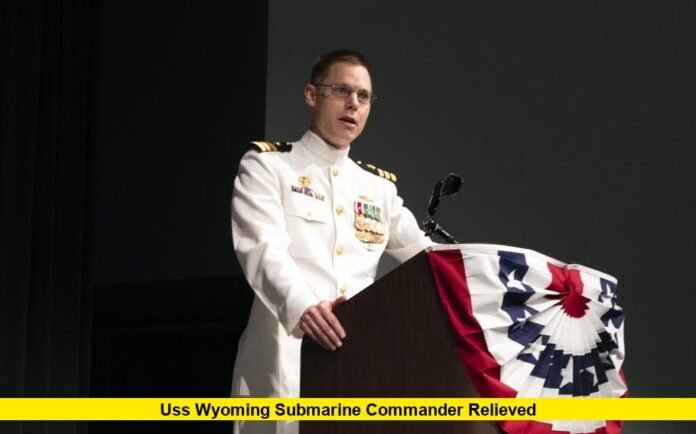

The USS Wyoming submarine commander relieved of duty this week has drawn national attention, underscoring the Navy’s high leadership standards within its strategic deterrent fleet. On October 8, 2025, the Navy announced that Commander Robert Moreno, commanding officer of the Blue Crew of USS Wyoming (SSBN-743), was removed from his position due to a “loss of confidence” in his ability to lead.
This decisive action highlights how critical leadership is in the nation’s nuclear submarine force — a community tasked with operating some of the most powerful weapons systems in the world.
A Rare and Significant Decision
Relieving a commanding officer from a nuclear ballistic missile submarine is uncommon. These decisions are not made lightly, as they involve the highest levels of Navy leadership and affect strategically important vessels.
Commander Moreno’s relief was ordered by Rear Admiral Bob Wirth, commander of Submarine Group Ten. The decision followed an internal assessment of leadership effectiveness, trust, and performance. The Navy emphasized that this action was taken because of diminished confidence, not because of a single operational failure or external incident.
By taking swift action, the Navy aimed to ensure that the USS Wyoming remains under stable and trusted leadership as it undergoes maintenance at its homeport in Kings Bay, Georgia.
USS Wyoming: A Pillar of U.S. Strategic Deterrence
The Submarine’s Mission
USS Wyoming (SSBN-743) is an Ohio-class ballistic missile submarine, one of the cornerstone platforms of the U.S. strategic deterrent triad. Its primary mission is to provide an undetectable second-strike capability, ensuring that the United States can respond decisively to any nuclear attack.
Equipped with submarine-launched ballistic missiles (SLBMs), Wyoming operates silently beneath the ocean’s surface for extended patrols. These missions are critical to national security and require flawless leadership, technical precision, and crew discipline.
The Dual-Crew System
Like all Ohio-class submarines, USS Wyoming operates with a Blue Crew and a Gold Crew. These two crews rotate between deployments and maintenance cycles to maximize operational availability while maintaining readiness and training standards.
Commander Moreno led the Blue Crew, responsible for training, daily operations, personnel management, and ensuring the submarine was fully mission-ready. Commanding one of these crews is considered one of the most demanding and prestigious positions in the Navy.
Commander Robert Moreno’s Background
Commander Moreno assumed command of the Blue Crew in May 2024 after a lengthy submarine career. He had served in multiple leadership positions, progressing through the ranks over two decades of service. Taking command of a ballistic missile submarine represents the culmination of years of rigorous evaluation, operational experience, and leadership training.
His relief after only about a year and a half in command underscores how swiftly the Navy moves when doubts about leadership capability arise. The “loss of confidence” standard is intentionally broad, allowing senior commanders to act quickly to protect the integrity of the force.
Understanding “Loss of Confidence”
The phrase “loss of confidence” is a formal term in Navy culture that carries significant weight. It reflects a determination by higher leadership that a commanding officer no longer meets the trust, judgment, or leadership standards required for their position.
Key Factors Often Considered Include:
- Leadership Judgment: Whether decisions consistently reflect sound judgment under pressure.
- Crew Climate: Morale, discipline, and overall health of the command environment.
- Operational Competence: The commander’s ability to maintain readiness, safety, and mission execution.
- Accountability: Personal conduct and the capacity to set a strong example for officers and enlisted personnel.
Unlike disciplinary removals that follow misconduct investigations, loss-of-confidence reliefs can happen quickly. This ensures that no gap in leadership jeopardizes operational effectiveness or strategic trust.
Interim Leadership and Transition
Following Moreno’s removal, Captain David Burke, the deputy for training at Submarine Squadron 20, was appointed as the temporary commanding officer of the Blue Crew. This ensures seamless leadership during the maintenance phase of the submarine’s operational cycle.
The Navy has initiated a formal selection process to appoint a new permanent commander. This process typically involves reviewing senior submarine officers with strong track records, leadership experience, and exemplary evaluations. The timeline for this replacement is usually expedited for strategic units like ballistic missile submarines.
Strategic Importance of Command Integrity
Commanding officers of strategic submarines carry immense responsibility. These vessels operate in a domain where mistakes can have geopolitical consequences. A single leadership failure could ripple through the chain of command, impacting operational effectiveness, crew safety, and deterrence credibility.
By removing the USS Wyoming submarine commander, the Navy demonstrated that no position is too critical to escape scrutiny. The decision protects the integrity of the submarine force and reinforces expectations across the fleet.
Broader Trends in Command Reliefs
While rare, leadership reliefs in the Navy have occurred in various contexts in recent years — from ship collisions to command climate issues. In the submarine force, these removals are particularly notable because submarine operations depend on a tight-knit crew structure, technical mastery, and absolute trust in command.
Typical Reasons Commanders Are Relieved
- Command Climate Failures: Toxic leadership or poor crew morale.
- Operational Incidents: Collisions, navigational errors, or safety violations.
- Personal Conduct: Misconduct on or off duty that undermines trust.
- Leadership Deficiencies: Poor decision-making, failure to enforce standards, or loss of respect among subordinates.
The relief of a ballistic missile submarine commander stands apart because of the strategic implications. It sends a clear signal to other commanders about the Navy’s expectations.
Timeline of Key Events
| Date | Event |
|---|---|
| May 2024 | Commander Robert Moreno assumes command of USS Wyoming Blue Crew |
| October 8, 2025 | Moreno is relieved of command due to loss of confidence |
| October 2025 | Captain David Burke assumes interim command |
| Coming months | Navy expected to name permanent new commander |
Impact on Operations
USS Wyoming is currently in a maintenance period, which means the leadership transition is unlikely to disrupt deployments or strategic deterrence missions. However, these kinds of changes can affect internal crew dynamics, training rhythms, and overall command culture.
The Navy typically uses such periods to conduct thorough leadership transitions, reinforce crew standards, and prepare for the next operational patrol. New leadership often brings renewed emphasis on training, procedural adherence, and crew cohesion.
Cultural and Institutional Implications
The relief of the USS Wyoming commander also resonates throughout the broader submarine community. It serves as both a reminder and a reinforcement of the Navy’s core leadership principles.
Submarine commanders are selected through years of intense vetting. Their careers are closely monitored for indicators of leadership ability, operational skill, and personal integrity. When one is relieved, it often leads to renewed focus on:
- Mentorship Programs for prospective commanding officers.
- Command Climate Assessments to identify issues early.
- Leadership Training Enhancements to address evolving challenges.
- Peer Accountability across the command structure.
This incident underscores that even among elite ranks, accountability remains constant.
Why This Matters Beyond the Navy
Strategic ballistic missile submarines like USS Wyoming form one leg of the U.S. nuclear triad. Their credibility depends not just on technology, but also on the trust placed in the people who operate them.
Leadership failures at this level can raise questions about readiness and reliability, which is why the Navy acts quickly to maintain trust. For policymakers, allies, and adversaries alike, these leadership transitions signal that the U.S. maintains strict oversight of its strategic assets.
Looking Ahead
The next steps involve finalizing a permanent replacement for Commander Moreno and ensuring the Blue Crew remains fully mission-ready. Internal reviews will likely continue in the background, focusing on leadership lessons and any procedural adjustments needed to prevent similar issues.
As USS Wyoming completes maintenance and prepares for future patrols, the Navy’s priority will be to reaffirm crew confidence, stabilize command, and continue its role in the nation’s deterrence posture without interruption.
The decision to relieve the USS Wyoming submarine commander highlights the Navy’s unwavering commitment to leadership accountability in its most sensitive commands. Share your thoughts below or check back here for further developments on this story.