
The USCIS Visa Bulletin December 2026 brings updated immigrant visa cutoff dates for thousands of people waiting for U.S. permanent residency through family sponsorship or employment. The latest bulletin outlines when applicants may qualify for immigrant visa processing or move forward with their green card applications based on their priority dates, immigration categories, and countries of chargeability. While some categories remain current, others continue to face significant waiting periods, particularly applicants from countries with high immigration demand.
The December bulletin is especially important for people tracking EB-1, EB-2, EB-3, family-sponsored preference categories, and the EB-5 investor program. Applicants should review both the Final Action Dates and Dates for Filing charts because these tables determine different stages of the immigration process. Those filing adjustment-of-status applications inside the United States must also confirm which chart USCIS has authorized for December before submitting Form I-485.
December 2026 Visa Bulletin: What Has Changed?
The Department of State has published the December 2026 Visa Bulletin, providing the latest cutoff dates for family-based and employment-based immigrant visa categories. The bulletin is part of Fiscal Year 2027, which began on October 1, 2026.
The monthly publication helps applicants understand whether immigrant visa numbers are available for their cases. Because many immigration categories have annual numerical limits, the government uses priority dates to organize applications and determine when applicants may proceed.
The December bulletin contains separate tables for:
- Family-sponsored immigrant visa categories
- Employment-based preference categories
- Final Action Dates
- Dates for Filing
- Different countries of chargeability
- Special immigrant and investor categories
Applicants should not assume that a cutoff date listed for one country applies to every other country. India, China, Mexico, and the Philippines frequently have separate dates because demand and visa allocation limits vary.
Understanding the Two Visa Bulletin Charts
The Visa Bulletin contains two major charts that applicants need to understand before making immigration decisions.
Final Action Dates
The Final Action Dates chart determines when an immigrant visa number may be available for final processing and approval.
When an applicant’s priority date is earlier than the applicable cutoff date, the applicant may be eligible for final action, provided all other immigration requirements are satisfied.
For applicants processing through a U.S. embassy or consulate, this chart determines when a visa number may be available for issuance. For applicants filing adjustment of status inside the United States, the chart may determine when USCIS can approve the green card application.
Dates for Filing
The Dates for Filing chart generally allows eligible applicants to begin certain processing steps earlier than the Final Action Dates chart.
For consular applicants, the chart may indicate when they can submit required documents to the National Visa Center after receiving instructions. For applicants inside the United States, it may permit earlier filing of Form I-485 when USCIS has designated that chart for use.
However, applicants must remember that filing eligibility and final approval are not the same. A person may be permitted to file an application but still need to wait for the Final Action Date to become current before the government can approve the green card.
Family-Based Green Card Dates for December 2026
Family-sponsored immigration remains one of the largest sections of the monthly Visa Bulletin. These categories allow certain relatives of U.S. citizens and lawful permanent residents to immigrate to the United States.
The main family preference categories include:
- F1: Unmarried sons and daughters of U.S. citizens who are generally 21 or older
- F2A: Spouses and unmarried children under 21 of lawful permanent residents
- F2B: Unmarried sons and daughters aged 21 or older of permanent residents
- F3: Married sons and daughters of U.S. citizens
- F4: Brothers and sisters of adult U.S. citizens
Family-Based Final Action Dates
The December 2026 Final Action Dates chart provides the following cutoff dates:
| Category | Worldwide | China | India | Mexico | Philippines |
|---|---|---|---|---|---|
| F1 | Jan. 22, 2021 | Jan. 22, 2021 | Jan. 22, 2021 | Sept. 22, 2008 | Nov. 1, 2013 |
| F2A | Nov. 22, 2026 | Nov. 22, 2026 | Nov. 22, 2026 | May 22, 2026 | Nov. 22, 2026 |
| F2B | Aug. 22, 2020 | Aug. 22, 2020 | Aug. 22, 2020 | May 15, 2010 | Oct. 1, 2013 |
| F3 | Oct. 22, 2015 | Oct. 22, 2015 | Oct. 22, 2015 | July 15, 2002 | Aug. 1, 2006 |
| F4 | Oct. 22, 2012 | Oct. 22, 2012 | Feb. 15, 2007 | April 22, 2001 | May 15, 2009 |
These dates indicate that waiting periods remain different across family preference categories and countries. Applicants from Mexico and the Philippines may have substantially different cutoff dates compared with applicants from most other countries.
F1: Unmarried Adult Children of U.S. Citizens
The F1 category is for unmarried sons and daughters of U.S. citizens who are generally at least 21 years old.
For December, the Final Action Date is January 22, 2021, for most countries, China, and India. Mexico has a cutoff date of September 22, 2008, while the Philippines has a date of November 1, 2013.
Applicants should use the cutoff date applicable to their country of chargeability when determining whether they may proceed.
F2A: Spouses and Children of Permanent Residents
The F2A category covers spouses and unmarried children under 21 of lawful permanent residents.
The December Final Action Date is November 22, 2026, for most countries, China, India, and the Philippines. Mexico’s cutoff date is May 22, 2026.
F2A also has special allocation rules involving visa numbers exempt from the per-country limit. The bulletin provides separate information about those allocations, making it important for applicants to review the details rather than rely only on the headline date.
F2B: Unmarried Adult Children of Permanent Residents
F2B covers unmarried sons and daughters aged 21 or older of permanent residents.
The cutoff date is August 22, 2020, for most countries, China, and India. Mexico has a date of May 15, 2010, and the Philippines has October 1, 2013.
Because this category can involve lengthy waits, applicants should continue monitoring their priority dates and maintain updated records of their petitions.
F3 and F4 Categories
F3 covers married sons and daughters of U.S. citizens, while F4 covers brothers and sisters of adult U.S. citizens.
For F3, the December cutoff date is October 22, 2015, for most countries, China, and India. Mexico’s date is July 15, 2002, and the Philippines has August 1, 2006.
The F4 category has a cutoff date of October 22, 2012, for most countries and China. India has February 15, 2007, Mexico has April 22, 2001, and the Philippines has May 15, 2009.
Family-Based Dates for Filing
The Dates for Filing chart may provide earlier opportunities to begin processing for some applicants.
| Category | Worldwide | China | India | Mexico | Philippines |
|---|---|---|---|---|---|
| F1 | Feb. 1, 2021 | Feb. 1, 2021 | Feb. 1, 2021 | Dec. 1, 2008 | Apr. 22, 2015 |
| F2A | Current | Current | Current | Current | Current |
| F2B | Sept. 1, 2020 | Sept. 1, 2020 | Sept. 1, 2020 | Mar. 22, 2011 | Oct. 1, 2014 |
| F3 | Nov. 1, 2015 | Nov. 1, 2015 | Nov. 1, 2015 | Dec. 1, 2002 | Oct. 22, 2006 |
| F4 | Nov. 1, 2012 | Nov. 1, 2012 | Aug. 15, 2007 | Apr. 30, 2001 | Nov. 15, 2009 |
The F2A category is listed as current on the Dates for Filing chart. However, adjustment-of-status applicants must confirm whether USCIS has designated this chart for December before submitting Form I-485.
Employment-Based Green Card Dates for December 2026
Employment-based immigration provides permanent residency opportunities for eligible workers, professionals, priority workers, special immigrants, and qualifying investors.
The major employment-based categories are:
- EB-1: Priority workers
- EB-2: Advanced-degree professionals and individuals with exceptional ability
- EB-3: Skilled workers, professionals, and other workers
- EB-4: Certain special immigrants
- EB-5: Immigrant investors
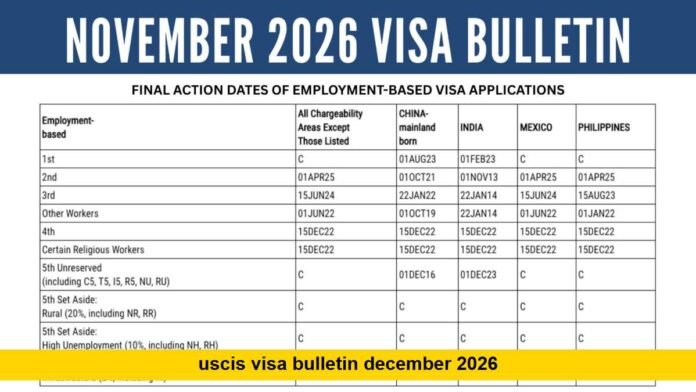
Employment-Based Final Action Dates
The December 2026 bulletin lists the following Final Action Dates:
| Category | Worldwide | China | India | Mexico | Philippines |
|---|---|---|---|---|---|
| EB-1 | Current | Aug. 1, 2023 | Feb. 1, 2023 | Current | Current |
| EB-2 | Apr. 1, 2025 | Oct. 1, 2021 | Nov. 1, 2013 | Apr. 1, 2025 | Apr. 1, 2025 |
| EB-3 | June 15, 2024 | Jan. 22, 2022 | Jan. 22, 2014 | June 15, 2024 | Aug. 15, 2023 |
| Other Workers | June 1, 2022 | Oct. 1, 2019 | Jan. 22, 2014 | June 1, 2022 | Jan. 1, 2022 |
| EB-4 | Dec. 15, 2022 | Dec. 15, 2022 | Dec. 15, 2022 | Dec. 15, 2022 | Dec. 15, 2022 |
| Certain Religious Workers | Dec. 15, 2022 | Dec. 15, 2022 | Dec. 15, 2022 | Dec. 15, 2022 | Dec. 15, 2022 |
| EB-5 Unreserved | Current | Jan. 1, 2017 | Dec. 1, 2023 | Current | Current |
| EB-5 Rural | Current | Current | Current | Current | Current |
| EB-5 High-Unemployment | Current | Current | Current | Current | Current |
| EB-5 Infrastructure | Current | Current | Current | Current | Current |
EB-1: Priority Workers
EB-1 includes people with extraordinary ability, certain outstanding professors and researchers, and qualifying multinational executives or managers.
The category is current for most countries, Mexico, and the Philippines. China has an August 1, 2023, cutoff date, while India has a February 1, 2023, cutoff date.
Applicants should review their specific EB-1 classification and supporting documentation because eligibility depends on the requirements of the underlying category.
EB-2: Advanced Degrees and Exceptional Ability
EB-2 includes qualifying professionals with advanced degrees and individuals who demonstrate exceptional ability.
The December Final Action Date is April 1, 2025, for most countries, Mexico, and the Philippines. China has October 1, 2021, and India has November 1, 2013.
India’s cutoff date remains significantly earlier than the dates listed for most other countries, reflecting the effects of visa demand and numerical limitations.
EB-3: Skilled Workers and Professionals
EB-3 covers qualifying skilled workers, professionals, and other workers.
The December Final Action Date is June 15, 2024, for most countries and Mexico. China has January 22, 2022, India has January 22, 2014, and the Philippines has August 15, 2023.
Applicants should carefully distinguish between the regular EB-3 category and the Other Workers subcategory because their cutoff dates are not the same.
EB-4: Special Immigrants
EB-4 includes certain special immigrant classifications established under immigration law.
The general EB-4 Final Action Date is December 15, 2022, for the listed countries. Certain religious workers also have the same cutoff date.
The religious worker category is subject to a legislative extension that runs through December 11, 2026. The bulletin states that no overseas visa issuance or final adjustment action for this category may take place after midnight on December 10 unless further legislative action extends the program.
EB-5: Immigrant Investors
The EB-5 program allows qualifying investors to pursue permanent residency by meeting applicable investment and job-creation requirements.
The unreserved category is current for most countries, Mexico, and the Philippines. China has a cutoff date of January 1, 2017, while India has December 1, 2023.
The rural, high-unemployment, and infrastructure reserved categories are listed as current across the countries shown in the bulletin.
Employment-Based Dates for Filing
The December Dates for Filing chart provides the following dates:
| Category | Worldwide | China | India | Mexico | Philippines |
|---|---|---|---|---|---|
| EB-1 | Current | July 1, 2024 | July 1, 2024 | Current | Current |
| EB-2 | March 15, 2026 | Jan. 1, 2023 | Jan. 15, 2015 | March 15, 2026 | March 15, 2026 |
| EB-3 | Aug. 1, 2024 | April 1, 2024 | Jan. 15, 2015 | Aug. 1, 2024 | Jan. 1, 2024 |
| Other Workers | July 1, 2022 | Oct. 1, 2020 | Jan. 15, 2015 | July 1, 2022 | June 1, 2022 |
| EB-4 | Jan. 1, 2025 | Jan. 1, 2025 | Jan. 1, 2025 | Jan. 1, 2025 | Jan. 1, 2025 |
| Certain Religious Workers | Jan. 1, 2025 | Jan. 1, 2025 | Jan. 1, 2025 | Jan. 1, 2025 | Jan. 1, 2025 |
| EB-5 Unreserved | Current | March 1, 2021 | May 1, 2024 | Current | Current |
| EB-5 Rural | Current | Current | Current | Current | Current |
| EB-5 High-Unemployment | Current | Current | Current | Current | Current |
| EB-5 Infrastructure | Current | Current | Current | Current | Current |
These dates may allow certain applicants to begin filing or documentation steps before their Final Action Dates become current, subject to the applicable rules.
USCIS Filing Chart: Can Applicants Submit Form I-485?
The Department of State publishes the monthly Visa Bulletin, but USCIS separately announces which chart adjustment-of-status applicants may use when filing Form I-485.
For November 2026, USCIS designated the Dates for Filing chart for family-sponsored and employment-based preference categories.
However, the December 2026 USCIS filing-chart designation was not yet confirmed in the latest available announcement. Applicants should therefore verify the December chart before submitting an adjustment-of-status application.
The USCIS Visa Bulletin December 2026 information should be reviewed together with the USCIS filing-chart decision, not as a standalone filing instruction.
Applicants should confirm:
- Their immigration preference category
- Their country of chargeability
- Their priority date
- The applicable December chart
- Their eligibility to adjust status
- Whether they have the required supporting documents
Submitting Form I-485 before becoming eligible can result in rejection or other complications.
How to Determine Whether Your Priority Date Is Current
Applicants can use a straightforward process to assess their eligibility.
First, identify the immigration category under which the petition was filed. Next, determine the country of chargeability, which is generally based on country of birth rather than citizenship. Then locate the corresponding cutoff date in the Visa Bulletin.
A priority date must generally be earlier than the cutoff date listed in the applicable chart. Applicants should not treat a date that falls on the cutoff date itself as automatically eligible.
If the category is listed as current, there is no cutoff date restriction for that category in that chart. Other eligibility requirements still apply.
Why Visa Bulletin Dates May Advance or Retrogress
Cutoff dates are not permanent. They can move forward, remain unchanged, or move backward depending on visa demand and availability.
The Department of State considers factors such as:
- Annual immigrant visa limits
- Number of pending applications
- Country-specific demand
- Applications reported by USCIS and consular offices
- Visa numbers already allocated
- Expected demand for the remainder of the fiscal year
The December bulletin warns that retrogression may become necessary in future months to keep visa issuance within annual limits. Categories may also become unavailable if their numerical limits are reached.
Applicants should therefore avoid assuming that a cutoff date will continue advancing at the same rate.
What Applicants Should Watch in January 2027
The January 2027 Visa Bulletin may introduce additional cutoff-date changes, but no specific future movement is officially guaranteed.
Applicants should monitor the next bulletin for updates to family-based and employment-based categories. They should also check whether USCIS changes its adjustment-of-status filing-chart designation.
A category that advances in one month may remain unchanged or retrogress in another month if demand changes. Keeping immigration records updated and monitoring the monthly bulletin can help applicants respond when their priority dates become eligible.
Frequently Asked Questions
Is the December 2026 Visa Bulletin released?
Yes. The Department of State has published the December 2026 Visa Bulletin with updated Final Action Dates and Dates for Filing for family-sponsored and employment-based categories.
Which chart should I use for Form I-485 in December?
Applicants must check the USCIS December 2026 adjustment-of-status filing-chart designation. The Department of State bulletin alone does not establish which chart USCIS permits applicants to use for adjustment of status.
Are India EB-2 dates current?
No. India’s EB-2 Final Action Date for December 2026 is November 1, 2013. Applicants should compare their priority dates with the cutoff date and also review the Dates for Filing chart.
Is EB-1 current for India?
No. India has a February 1, 2023, Final Action Date for EB-1 in December 2026.
What does “Current” mean?
Current means no priority-date cutoff is listed for the category in the applicable chart. Applicants may proceed based on visa availability, subject to all other eligibility requirements.
Can my priority date move backward?
Yes. Retrogression occurs when a cutoff date moves backward because of visa demand or numerical limitations. Applicants should not assume that a date will remain current or continue advancing.
Does filing Form I-485 guarantee a green card?
No. Filing an application does not guarantee approval. Applicants must meet the applicable eligibility requirements, provide required documentation, and have a visa number available when final action is taken.
Final Thoughts
The December 2026 Visa Bulletin provides an important update for immigrants waiting for permanent residency through family sponsorship, employment, or investment. The new cutoff dates allow applicants to assess their current position and determine whether they may be eligible to file documents or receive final action.
The biggest takeaway is that applicants must review their category, country of chargeability, and priority date carefully. The Final Action Dates chart and Dates for Filing chart serve different purposes, and adjustment-of-status applicants must also follow USCIS’s monthly chart designation.
Immigration cutoff dates can change based on demand and annual visa limits, making monthly monitoring essential. Applicants should rely on the latest official information when deciding whether to file or take the next step in their immigration process.
Share your questions or experiences in the comments, and stay updated for the latest green card and U.S. immigration developments.