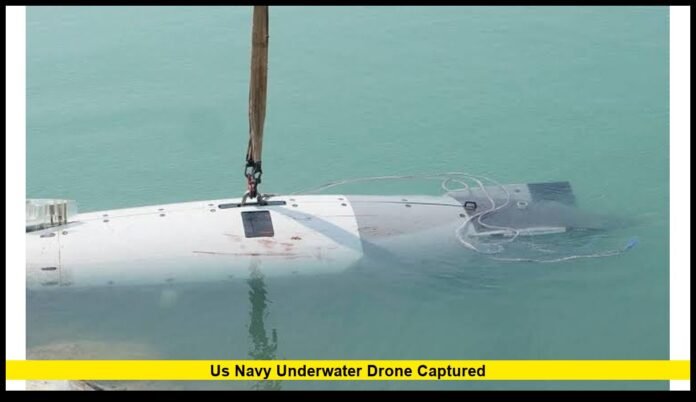

The us navy underwater drone captured near the Strait of Hormuz has become a major U.S. defense story after Iran said its forces recovered an American autonomous underwater vehicle. The vehicle has been identified as an Anduril Dive-LD, a large unmanned system used by the U.S. military for underwater missions. U.S. Central Command confirmed that an American underwater drone had been lost, but said the older-model vehicle had malfunctioned more than a day before Iranian forces recovered it.
The incident has drawn attention because the vehicle was recovered largely intact. Iran has presented the event as a successful intelligence operation, while the U.S. military has emphasized that the vehicle did not carry classified sonar or radar equipment and had not been collecting sensitive information.
The latest reporting also indicates that Iranian officials are interested in examining the recovered system. Defense analysts have said that physical access could allow Iranian engineers to study parts of its construction, even though that does not mean Iran has obtained classified U.S. technology.
What Happened to the U.S. Underwater Drone
Iran’s Islamic Revolutionary Guard Corps announced the recovery on September 8, 2026. Iranian officials said naval forces had captured an American unmanned underwater vehicle near the entrance to the Strait of Hormuz.
Images released after the announcement showed a large underwater vehicle with the distinctive appearance of the Dive-LD.
The photographs attracted immediate attention among naval analysts. The visible shape, rear control surfaces, nose section and other external features correspond with the known design of Anduril’s Dive-LD.
The U.S. military subsequently acknowledged that an underwater drone had been lost in the area.
However, the American account differs significantly from Iran’s description.
U.S. Central Command said the drone malfunctioned while surveying regional waters in support of ongoing operations. Navy Capt. Tim Hawkins said the vehicle had effectively been out of action for more than a day before Iranian forces recovered it.
The U.S. military also said the vehicle was an older model and did not collect sensitive information or carry classified sonar or radar equipment.
That distinction remains central to understanding the incident.
The Vehicle Was an Anduril Dive-LD
The recovered platform is the Dive-LD, an autonomous underwater vehicle developed by Anduril Industries.
The system measures about 5.8 meters, or 19 feet, in length. It has a diameter of approximately 1.2 meters and weighs around three metric tons.
Unlike a conventional submarine, the Dive-LD operates without people onboard.
It is designed to travel underwater autonomously while carrying different mission equipment. Its modular architecture allows the vehicle to be configured for different tasks.
Anduril lists an endurance of up to 10 days and a maximum operating depth of 6,000 meters, or approximately 19,700 feet.
Those figures describe the platform’s published capabilities. They do not establish the exact performance or configuration of the particular vehicle recovered by Iran.
The Dive-LD can support missions involving underwater surveillance, seabed mapping, mine warfare and other maritime tasks.
Its ability to remain underwater for extended periods makes it useful for operations where keeping crewed vessels away from dangerous areas can be advantageous.
Why the Dive-LD Matters to the U.S. Navy
The U.S. Navy has been increasing its use of unmanned systems across maritime operations.
Underwater drones offer an important advantage. They can operate in areas where sending sailors or crewed vessels could create additional risks.
An autonomous underwater vehicle can also remain submerged for long periods without requiring a crew to live inside the platform.
For missions involving mine detection, seabed surveys or underwater reconnaissance, that capability can provide another option alongside traditional naval assets.
The Dive-LD is part of this wider shift toward autonomous maritime technology.
The first Dive-LD was delivered to the U.S. Navy in 2025. Navy personnel have also conducted training with the platform.
The system therefore represents a relatively new generation of large autonomous underwater vehicles being integrated into U.S. naval operations.
What the U.S. Military Says About the Loss
Washington has sought to put the incident into context by stressing the condition of the vehicle.
The Pentagon’s description indicates that the drone was not functioning normally when Iranian forces recovered it.
U.S. Central Command said the vehicle had malfunctioned more than a day earlier. It had been surveying regional waters when the problem occurred.
Officials also said the older-model system did not carry classified sonar or radar equipment.
This means the capture should not automatically be interpreted as the loss of a major classified intelligence platform.
At the same time, the physical recovery still matters.
A complete military vehicle can reveal information through its mechanical construction, electrical components, propulsion arrangement and other physical characteristics.
That is different from gaining access to classified operational information.
Why Iran May Study the Captured Vehicle
The possibility of technical examination has become one of the most closely watched aspects of the incident.
Iran has a history of examining captured American unmanned systems. The country previously obtained an American RQ-170 Sentinel reconnaissance aircraft and publicly displayed its claimed work on that technology.
The underwater vehicle presents a different engineering challenge.
An autonomous underwater system combines pressure-resistant structures, propulsion, batteries, navigation equipment, sensors, communications technology and software.
Iranian engineers could potentially examine some of those physical elements.
That does not mean they can reproduce the entire system.
Modern autonomous vehicles depend on sophisticated manufacturing processes and software as well as individual components. Understanding the physical structure of a vehicle is only one part of reproducing its complete capability.
The U.S. military’s statement that this particular vehicle did not contain classified sonar or radar equipment also limits some of the concerns surrounding the recovery.
Still, analysts have said Iran could learn from the hardware.
The Capture Does Not Mean Iran Has Obtained Classified U.S. Technology
One of the most important distinctions in the current reporting is between recovering a military platform and obtaining classified technology.
The United States has specifically said the captured vehicle lacked classified sonar and radar equipment.
There is also no confirmed public evidence showing that Iran obtained classified U.S. software or sensitive mission data from the system.
Claims suggesting that Iran now possesses the full technological secrets of the U.S. underwater drone go beyond the confirmed facts.
The physical vehicle could still provide useful information.
Iran may be able to examine how the vehicle is constructed, how its systems are arranged and how various components are integrated.
But those possibilities should not be confused with confirmation that sensitive American technology has been compromised.
The Dive-LD Was Built for Risky Missions
The nature of the Dive-LD helps explain the U.S. response.
Anduril describes the system as an attritable autonomous platform. In practical terms, that means the vehicle is intended to operate in environments where losing individual systems is an accepted possibility.
That philosophy differs from the traditional approach to extremely expensive crewed platforms.
A large autonomous vehicle can take on dangerous underwater tasks without placing sailors directly in harm’s way.
If one system is lost, the military does not lose a crew.
That does not make a capture irrelevant. It means the cost and risk calculations are different.
The September incident demonstrates that even systems designed with attrition in mind can create a separate security challenge when an adversary recovers the vehicle.
How Capable Is the Dive-LD?
The platform’s publicly listed specifications provide a useful picture of what the system was designed to do.
| Feature | Published Dive-LD capability |
|---|---|
| Vehicle type | Autonomous underwater vehicle |
| Length | About 5.8 meters |
| Diameter | About 1.2 meters |
| Weight | About 3 metric tons |
| Endurance | Up to 10 days |
| Maximum depth | Up to 6,000 meters |
| Configuration | Modular |
| Propulsion | Electric |
| Mission flexibility | Multiple sensor and payload options |
The vehicle’s modular construction is particularly important.
Instead of creating a completely different underwater vehicle for every mission, operators can configure the platform with different payloads and sensors.
That flexibility allows the same basic vehicle design to support different underwater requirements.
However, the exact equipment installed on the captured unit has not been publicly established in full.
What Mission Was the Drone Performing?
The U.S. military has said the vehicle was surveying regional waters in support of ongoing operations.
Officials have not publicly provided a complete description of its mission.
That means it would be inappropriate to state that the recovered vehicle was performing a particular classified task.
The Dive-LD can support several different types of underwater missions, but the platform’s general capabilities do not prove what the captured vehicle was doing at the time it malfunctioned.
This distinction is especially important because underwater drones can be configured for different purposes.
A vehicle equipped for surveying may have a different payload from one configured for mine countermeasures or another mission.
Why the Strait of Hormuz Is Significant
The recovery occurred near the entrance to the Strait of Hormuz, one of the world’s most strategically important waterways.
The area has been at the center of heightened military activity involving the United States and Iran.
An underwater vehicle operating in such an environment faces unusual challenges.
The waterway is strategically important, heavily monitored and surrounded by military forces.
Underwater systems can be useful in such an environment because they can gather information without remaining visibly exposed on the surface.
The same operating environment also increases the consequences of a malfunction.
Once an autonomous vehicle becomes disabled, recovering it may not always be straightforward.
In this case, the disabled system ultimately came into Iranian possession.
Iran’s Public Presentation of the Capture
Iran has portrayed the recovery as an intelligence and operational success.
The IRGC described the vehicle in highly favorable terms and emphasized its advanced design.
Iranian officials also released images showing the recovered platform.
The images provided an important piece of evidence because they allowed independent observers to compare the vehicle with publicly known Dive-LD designs.
Naval analysts found multiple visible features consistent with the American platform.
The imagery therefore strengthened the identification of the vehicle.
However, photographs cannot establish every detail surrounding the recovery.
They do not independently prove precisely how Iranian forces located the drone, how they secured it or what condition every internal system was in when they recovered it.
Those details remain less clear publicly.
The Incident Is Also a Propaganda Victory for Iran
Beyond the technical questions, the capture has political significance.
Iran has used the incident to portray its forces as capable of obtaining an American military system in the waters around the Strait of Hormuz.
Iranian diplomatic accounts have publicly mocked the United States over the loss.
That messaging is separate from the technical value of the vehicle.
Even if the drone contained no classified equipment, physically displaying an American military platform can still serve as a propaganda tool.
For Washington, the incident creates an awkward public-relations problem.
The U.S. military can accurately state that the vehicle was malfunctioning and lacked classified equipment, but the fact remains that an American unmanned system was recovered by an adversary.
What Could Happen to the Vehicle Next
The immediate future of the recovered Dive-LD is not publicly known.
Iran is expected to have an interest in examining the system.
That could include studying its mechanical components, propulsion system, electrical architecture and other accessible hardware.
The amount of useful information that can be extracted depends on the condition of the vehicle and the systems installed on it.
Software and encrypted technologies can present additional barriers.
A physical examination also does not automatically provide the knowledge required to manufacture an equivalent platform.
Engineering teams would need to understand materials, manufacturing tolerances, software behavior, navigation and system integration.
Even so, a complete vehicle provides substantially more information than photographs or fragments.
What the Incident Means for Future U.S. Underwater Drones
The event may reinforce one of the central realities of autonomous warfare.
Unmanned systems reduce risks to personnel, but they do not eliminate operational risk.
An autonomous vehicle can be lost through malfunction, environmental conditions, enemy action or recovery problems.
The U.S. Navy’s continued investment in unmanned underwater systems suggests that the benefits remain important.
The Dive-LD was specifically designed to conduct missions without putting sailors directly into dangerous underwater environments.
The loss of one vehicle does not indicate that the broader concept has failed.
Instead, the incident illustrates why autonomous systems must be designed with both operational performance and potential capture in mind.
Latest Status of the Dive-LD Incident
As of September 12, 2026, the confirmed picture is clear on several key points.
Iran says it recovered an American autonomous underwater vehicle near the Strait of Hormuz. The vehicle has been identified as an Anduril Dive-LD.
The U.S. military acknowledges the loss but says the vehicle malfunctioned more than a day before Iranian forces recovered it.
Washington also says the older-model vehicle did not collect sensitive information and did not carry classified sonar or radar equipment.
The Dive-LD itself is a large autonomous underwater platform designed for long-duration missions. Its published capabilities include up to 10 days of endurance and a maximum depth of approximately 6,000 meters.
The most significant unresolved issue concerns what Iran can learn from the recovered hardware.
Analysts believe the physical system could provide useful engineering information, even if it does not contain classified technology.
For the United States, the episode highlights both the value and vulnerability of autonomous underwater systems. The technology allows the Navy to perform demanding underwater work without exposing sailors to the same risks, but an incapacitated vehicle can still become an intelligence and public-relations concern when an adversary recovers it.
The incident also demonstrates why the development of unmanned naval technology is about more than creating vehicles that can operate independently. Reliability, recovery, protection of sensitive components and the consequences of losing individual systems all matter.
What do you think the recovery of the Dive-LD means for the future of U.S. underwater drone operations? Share your thoughts and stay informed as verified details emerge.