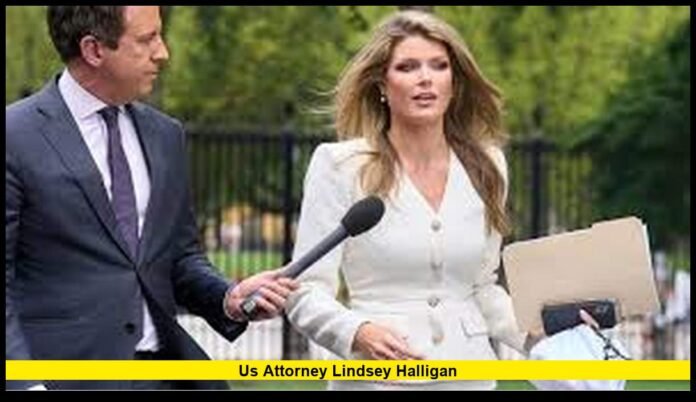

In a dramatic and closely watched chapter of U.S. legal and political history, us attorney lindsey halligan has officially departed from the U.S. Justice Department following a tumultuous stint as interim U.S. Attorney for the Eastern District of Virginia. What began as an unexpected appointment by then-President Donald Trump rapidly evolved into a courtroom battle that raised profound questions about constitutional appointment powers, prosecutorial authority, and the limits of executive influence on federal law enforcement.
This report details the confirmed sequence of events surrounding Halligan’s rise to one of the most powerful federal prosecutorial posts in the country, the legal challenges that followed, the dismissal of high-profile cases, and the judicial rulings that ultimately ended her tenure.
A Surprising Appointment to a Key Prosecutorial Post
Lindsey Halligan, a lawyer who previously worked in private practice and served in the White House as a senior associate staff secretary, was named interim U.S. Attorney for the Eastern District of Virginia in September 2025. The district is one of the most influential in the federal system, handling cases involving national security, public corruption, and major financial crimes.
Her appointment came after the resignation of then-U.S. Attorney Erik Siebert. Siebert had reportedly resisted pressure to pursue criminal cases against prominent political figures, a stance that placed him at odds with senior officials. Following his departure, the administration installed Halligan under the Justice Department’s interim appointment authority, a move that immediately drew scrutiny because she had not previously served as a federal prosecutor and had not been confirmed by the U.S. Senate.
High-Profile Indictments and Immediate Legal Challenges
Soon after taking office, Halligan authorized federal indictments against two nationally known officials:
- Former FBI Director James Comey, accused of making false statements to Congress.
- New York Attorney General Letitia James, charged in a case involving alleged mortgage-related fraud.
Defense attorneys in both matters challenged the legality of the prosecutions from the outset. They argued that Halligan did not possess lawful authority to act as U.S. attorney because the statutory time limit for an interim appointment had already expired. The cases quickly became a test of whether actions taken by an improperly appointed federal prosecutor could stand in court.
Court Rulings Declare Appointment Unlawful
In November 2025, U.S. District Judge Cameron McGowan Currie issued a decisive ruling that invalidated Halligan’s appointment. The court found that the 120-day period allowed for an attorney general’s interim appointment had already been used by a prior temporary officeholder, leaving no legal basis for Halligan to assume the position without Senate confirmation or judicial appointment.
Judge Currie concluded that the appointment violated both federal vacancy law and the Appointments Clause of the U.S. Constitution. As a result, the court dismissed the indictments against Comey and James, determining that the prosecutions had been initiated by an official who lacked constitutional authority.
The decision sent shockwaves through the legal community, reinforcing the principle that even temporary federal prosecutors must be installed in strict compliance with the law.
Escalating Tensions with the Federal Judiciary
Despite the ruling, Halligan continued to sign court filings using the title of U.S. Attorney, prompting sharp rebukes from the bench. Judges in the Eastern District of Virginia stated that the office was legally vacant and that no individual could claim its authority without a valid appointment.
In subsequent orders, the court directed Halligan to stop presenting herself as the district’s top federal prosecutor. Judges warned that continuing to do so could expose attorneys to professional discipline. These developments underscored the judiciary’s insistence that the constitutional process for appointments be respected, regardless of political considerations.
Official Departure from the Justice Department
On January 20, 2026, Attorney General Pam Bondi confirmed that Lindsey Halligan had left the Justice Department. Her exit followed weeks of legal pressure and court rulings that made it clear she could no longer exercise the powers of the office.
With her departure, the Eastern District of Virginia’s U.S. Attorney position was formally declared vacant. The process to identify a qualified replacement under lawful appointment procedures began immediately, restoring the traditional framework of Senate confirmation or judicial designation.
Broader Impact on Federal Prosecutions
The controversy surrounding us attorney lindsey halligan has had significant consequences beyond the fate of her own career.
Reinforcement of Constitutional Safeguards
The rulings reaffirmed that interim appointments cannot be used to bypass the Senate’s constitutional role in confirming senior federal prosecutors. Courts emphasized that the executive branch must adhere strictly to statutory limits and cannot extend temporary authority indefinitely.
Dismissal of Politically Sensitive Cases
The termination of the Comey and James indictments highlighted how procedural defects can derail even the most high-profile prosecutions. Any future effort to revive those cases would require action by a properly appointed U.S. attorney and could face additional legal hurdles related to evidence and grand jury proceedings.
National Debate Over Prosecutorial Independence
Legal scholars and lawmakers across the political spectrum pointed to the episode as a reminder of the importance of insulating federal prosecutors from political pressure. The case became a focal point in discussions about maintaining public confidence in the fairness and independence of the Justice Department.
Transition and the Road Ahead
With the office now vacant, the Eastern District of Virginia is entering a period of transition. Qualified candidates are expected to be considered under procedures that comply fully with constitutional and statutory requirements. Observers anticipate that restoring stability and credibility to the district will be a top priority for the next officeholder.
The Justice Department’s handling of the vacancy, as well as the outcome of any appeals related to the dismissed cases, will continue to shape the national conversation about the balance of power between the executive branch and the judiciary.
A Defining Moment in Modern Federal Law
The events surrounding Lindsey Halligan’s brief and controversial tenure illustrate how appointment law, constitutional limits, and prosecutorial authority can converge in ways that alter the course of major legal actions. Her rise and fall from one of the nation’s most influential prosecutorial posts now stands as a prominent example of the judiciary’s role in enforcing the rule of law, even amid intense political pressure.
Share your thoughts on how this case may influence future federal appointments and stay connected for further developments.