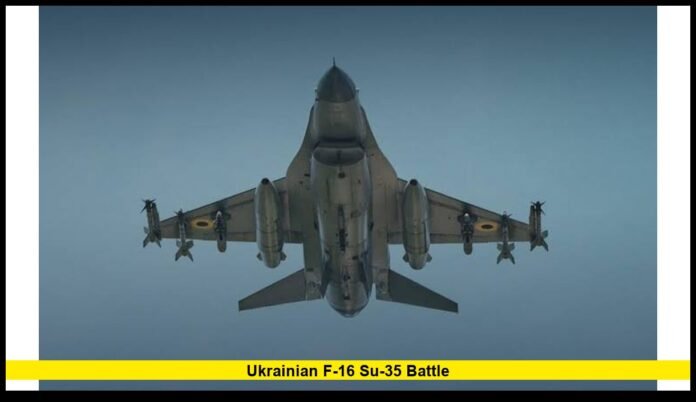

The Ukrainian F-16 Su-35 battle has become one of the most discussed air combat incidents of the Russia-Ukraine war. In July 2026, senior U.S. military officials confirmed that a Ukrainian-operated F-16 achieved its first confirmed air-to-air victory by shooting down a Russian fighter aircraft. Multiple reports indicate that the aircraft destroyed was a Russian Su-35 Flanker-E, one of Moscow’s most advanced fourth-generation fighters.
While many operational details remain classified, the engagement represents a major milestone for Ukraine’s Western-supplied F-16 fleet and demonstrates how modern tactics, intelligence sharing, and integrated air defense can influence aerial warfare.
Key Points Summary
╔════════════════════════════════════════════════════════════════════╗
║ – A Ukrainian F-16 achieved its first confirmed air-to-air victory. ║
║ – U.S. Chairman of the Joint Chiefs Gen. Dan Caine confirmed the milestone. ║
║ – Reports indicate the Russian aircraft destroyed was a Su-35 fighter. ║
║ – The engagement reportedly occurred on July 8, 2026, over eastern Ukraine. ║
║ – Analysts believe the mission combined F-16 operations with Ukraine's integrated air defenses. ║
╚════════════════════════════════════════════════════════════════════╝
What Happened in the Ukrainian F-16 Su-35 Battle?
According to Ukrainian military announcements and later confirmation by U.S. Chairman of the Joint Chiefs of Staff General Dan Caine, a Ukrainian Air Force F-16 recently scored its first air-to-air kill by destroying a Russian fighter aircraft. During congressional testimony, Caine described it as an important milestone for Ukraine’s evolving air combat capability.
Ukraine announced on July 8, 2026, that its forces had shot down a Russian Su-35 operating in the eastern sector of the front. Although Ukrainian officials did not immediately disclose the exact method used, subsequent reporting connected the event to the country’s F-16 fleet.
Why Is the Su-35 Significant?
The Sukhoi Su-35 (Flanker-E) is widely regarded as one of Russia’s most capable non-stealth fighter aircraft. It features:
- Advanced Irbis-E radar
- Long-range air-to-air missiles
- High maneuverability with thrust-vectoring engines
- Multi-role strike capability
For years, military analysts considered the Su-35 among Russia’s premier air-superiority fighters.
Because of its advanced sensors and missile range, many observers expected it to hold an advantage over legacy F-16 variants in a traditional one-on-one engagement.
How Did Ukraine’s F-16 Succeed?
Neither Ukraine nor the United States has released a complete tactical breakdown of the battle.
However, defense analysts believe the victory likely resulted from networked warfare rather than a simple dogfight. Reports suggest Ukraine may have combined:
- F-16 fighter operations
- Ground-based Patriot air defense systems
- Real-time battlefield intelligence
- Coordinated command and control
Some military analysts have described the engagement as an integrated ambush rather than a classic close-range turning fight, though the precise sequence of events has not been officially confirmed.
Was It a Traditional Dogfight?
Not necessarily.
The word dogfight often suggests two aircraft maneuvering at close range. Modern aerial combat rarely unfolds this way.
Instead, today’s engagements typically involve:
- Long-range radar tracking
- Beyond-visual-range missiles
- Data links
- Airborne or ground-based targeting support
- Electronic warfare
Available information suggests the Ukrainian F-16 engagement reflected these modern combat principles rather than an old-style turning battle.
Why This Victory Matters
The reported victory is significant for several reasons.
1. First Confirmed F-16 Air-to-Air Kill for Ukraine
Since receiving Western-supplied F-16s, Ukraine has used them primarily for:
- Air defense
- Missile interception
- Drone defense
- Precision strike missions
The reported Su-35 shootdown marks the first publicly confirmed air-to-air success for the aircraft in Ukrainian service.
2. Demonstrates Growing Pilot Experience
Training Ukrainian pilots to operate NATO aircraft has required extensive preparation.
Successfully integrating Western fighters into an active combat zone demonstrates increasing operational maturity.
3. Highlights Integrated Air Defense
Military experts increasingly emphasize that modern air warfare depends on cooperation among fighters, missile batteries, surveillance assets, and intelligence networks rather than aircraft acting independently.
F-16 vs Su-35 Comparison
| Feature | Ukrainian F-16 | Russian Su-35 |
|---|---|---|
| Generation | Fourth generation | Advanced 4++ generation |
| Primary Role | Multirole fighter | Air superiority and multirole fighter |
| Radar | Modern NATO-compatible systems (configuration varies) | Irbis-E passive electronically scanned array radar |
| Weapons | AIM-series Western missiles and precision weapons | R-77, R-73 and other Russian missiles |
| Strength | NATO integration and interoperability | Powerful radar, maneuverability and long-range weapons |
Performance comparisons depend heavily on pilot training, supporting assets, electronic warfare, and mission planning—not simply aircraft specifications.
International Reaction
General Dan Caine’s confirmation drew widespread attention because it represented the first public acknowledgment from a senior U.S. military official that a Ukrainian F-16 had successfully destroyed a Russian fighter aircraft in air combat.
Defense analysts have described the event as evidence that Ukraine’s layered air defense network continues to improve through the integration of Western aircraft, missiles, and command systems.
Frequently Asked Questions
Did a Ukrainian F-16 shoot down a Russian Su-35?
According to statements from Ukraine and confirmation by U.S. General Dan Caine, a Ukrainian F-16 recently achieved its first confirmed air-to-air kill, with reports indicating the aircraft destroyed was a Russian Su-35.
When did the battle occur?
The reported engagement occurred on July 8, 2026, in eastern Ukraine.
Was it a close-range dogfight?
Official authorities have not released detailed tactical information. Analysts believe the engagement likely involved coordinated air-defense assets and beyond-visual-range tactics rather than a traditional close-range dogfight.
Why is the battle important?
The event marks Ukraine’s first confirmed F-16 air-to-air victory and highlights the growing effectiveness of its integrated Western-supported air defense network.
Final Thoughts
The Ukrainian F-16 Su-35 battle represents an important milestone in modern aerial warfare. While many tactical details remain undisclosed, official confirmation that a Ukrainian F-16 achieved its first air-to-air victory underscores how technology, pilot training, and integrated battlefield coordination can reshape air combat. As the conflict continues, this engagement is likely to be studied as a notable example of modern networked warfare.
What do you think this milestone means for the future of air combat? Share your thoughts in the comments and stay tuned for the latest defense and aviation updates.