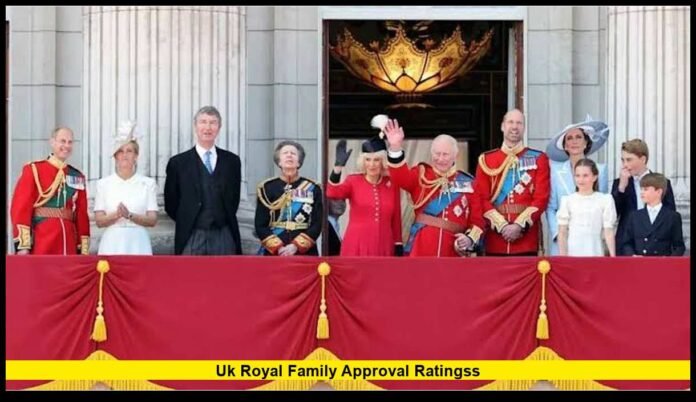

The uk royal family approval ratings offer a revealing look at how Britons view King Charles III, Prince William, Catherine, Princess of Wales, and the other prominent members of the monarchy. The latest polling available in October 2026 suggests that public support remains resilient, but popularity varies significantly across the Royal Family, with Princess Anne emerging as a particularly strong figure in the latest quarterly rankings.
The findings come amid continuing discussion about the monarchy’s relevance, the conduct of individual royals, and the expectations placed on the institution in modern Britain. Although the monarchy continues to attract majority support in several national surveys, differences between age groups and individual royal figures highlight the challenges facing the institution over the longer term.
Princess Anne Emerges as a Leading Royal Favourite
Princess Anne has strengthened her position in the latest YouGov Ratings data, with reporting published on October 14 indicating that she overtook Prince William and Catherine in the third-quarter popularity rankings.
Anne has long been associated with a demanding schedule of official engagements, charitable commitments, and public service. Her relatively low-key approach to celebrity culture distinguishes her from other prominent members of the Royal Family.
Her popularity is particularly significant because she is not the direct heir to the throne and does not occupy the same public position as William or Catherine. Her standing suggests that the public values reliability and a visible commitment to royal responsibilities, rather than measuring popularity solely through succession or media attention.
The latest development does not mean that William and Catherine have lost their broad public appeal. Instead, it indicates that royal rankings can shift even when several senior members remain considerably more popular than unpopular.
Quarterly ratings should also be interpreted as a snapshot of public sentiment, rather than proof of a permanent change in the hierarchy of royal popularity.
Prince William and Catherine Remain Central to the Monarchy’s Future
Prince William and Catherine, Princess of Wales, continue to occupy important positions in public life. As the future King and Queen, they are central to the monarchy’s efforts to maintain continuity between the present reign and the next generation.
YouGov’s detailed July 2026 favourability tracker placed William at 76% positive and Catherine at 74%. These results showed that both retained strong public support, even as attention continued to focus on other members of the Royal Family.
Their public responsibilities include attending national ceremonies, supporting charitable organisations, meeting community groups, and representing the monarchy at official events. These activities give the public regular opportunities to assess their work and public conduct.
Catherine’s public role has also attracted considerable attention because of her family responsibilities and health-related absence from some engagements in recent years. Her continued popularity illustrates the importance of public goodwill, although polling alone cannot establish why individual respondents hold particular opinions.
William faces a different but related challenge. As heir apparent, he must demonstrate that the monarchy can remain relevant while preserving the traditions associated with the institution.
For the Royal Family, maintaining public confidence in the Prince and Princess of Wales will be important as expectations surrounding the future reign develop.
King Charles III Receives Strong Approval for His Performance
King Charles III continues to receive broadly positive assessments in the latest detailed polling.
YouGov’s July 2026 tracker found that 62% of Britons held a favourable opinion of the King, while 31% held an unfavourable opinion. The same survey found that 68% believed he was doing a good job as monarch, compared with 16% who believed he was doing a bad job.
The distinction between these results matters. Favourability measures personal opinion, while the job-performance question asks respondents to evaluate how Charles is carrying out his constitutional and public responsibilities.
The King’s performance rating reached the highest level recorded by that particular YouGov tracker at the time. It suggests that many people who may have reservations about aspects of the monarchy still consider Charles’s performance positively.
His role involves constitutional duties, official audiences, state occasions, charitable interests, and public representation. Unlike an elected political leader, the monarch does not campaign on a party platform or govern through a personal electoral mandate.
Public expectations are therefore different, with attention often directed toward continuity, impartiality, dignity, and the ability to represent the country.
Nevertheless, the King’s popularity remains connected to the wider reputation of the institution. Controversies involving members of the Royal Family can create difficult questions about accountability and the way royal responsibilities are managed.
Queen Camilla Faces a Divided Public
Queen Camilla’s ratings reveal a more divided picture than those of the King or the Prince and Princess of Wales.
In YouGov’s July tracker, 43% of respondents viewed Camilla favourably, while 44% expressed an unfavourable opinion. The narrow difference indicates that public sentiment toward the Queen Consort remains mixed.
Her position reflects the fact that individual members of the Royal Family can attract different reactions even when they appear together at official engagements.
Camilla’s responsibilities include accompanying the King on selected engagements and supporting charitable causes. However, public perceptions of her have developed over many years and cannot be understood solely through her current duties.
The latest figures do not establish that her popularity will continue to decline. They show instead that she remains a more divisive figure than several other senior royals.
Future surveys will help establish whether her public standing improves, deteriorates, or remains close to the current balance between positive and negative opinions.
Prince Edward and Sophie Maintain a Positive Public Profile
Prince Edward, Duke of Edinburgh, and Sophie, Duchess of Edinburgh, continue to receive generally positive assessments.
YouGov’s July 2026 tracker recorded favourable opinions of 53% for Edward and 51% for Sophie. Their unfavourable ratings were considerably lower, at 18% and 14%, respectively.
The couple undertake official engagements and support charitable organisations, often without receiving the same level of media attention as the immediate heirs to the throne.
Their results suggest that public visibility and public approval are not identical. A royal can receive relatively limited attention while maintaining a positive reputation among people who have an opinion about their work.
Their position also matters as the monarchy considers how to distribute responsibilities among working royals. A smaller group of active members can face significant demands, making the contributions of Edward and Sophie relevant to the institution’s long-term operation.
Prince Harry and Meghan Continue to Face Public Opposition
Prince Harry and Meghan, Duchess of Sussex, remain among the more negatively viewed prominent figures in the latest detailed favourability survey.
YouGov’s July tracker recorded a favourable opinion of 33% for Harry, compared with 58% who viewed him unfavourably. Meghan received a favourable rating of 22%, while 65% expressed an unfavourable opinion.
Harry’s figures nevertheless showed a modest improvement compared with May 2025. His favourable rating had increased by six percentage points, while his unfavourable rating had fallen by five points.
That movement suggests that public perceptions can change over time, even when negative views remain more common than positive ones.
The couple’s decision to step back from senior working royal duties continues to shape how their relationship with the institution is understood. Their independent public activities also mean that their roles differ from those of royals who regularly undertake official duties on behalf of the monarch.
Public debate about Harry and Meghan often extends beyond their personal popularity to questions about reconciliation, family relationships, and their possible future involvement in royal life.
Recent Ipsos polling conducted in late August 2026 found that 38% of Britons thought a reconciliation between Harry and Meghan and other members of the Royal Family would be a good thing. Seventeen percent believed it would be bad, while 33% said it would make no difference.
The results suggest that reconciliation could be welcomed by a substantial portion of the public, but they do not establish that a reunion will occur.
Andrew Mountbatten-Windsor Remains Deeply Unpopular
Andrew Mountbatten-Windsor continues to occupy a distinctly negative position in public opinion.
YouGov’s July 2026 tracker found that just 2% of Britons held a favourable opinion of him, while 92% viewed him unfavourably. The figures place him far below other prominent members of the Royal Family.
His public reputation has been severely damaged by controversy surrounding his association with Jeffrey Epstein and the scrutiny of related matters. The removal of his royal titles and the broader questions surrounding his conduct have contributed to continuing public attention.
Andrew’s ratings should not be treated as a direct measure of the King’s personal popularity or the standing of every other royal. The data show that respondents distinguish between individuals, even when they are associated with the same institution.
However, the monarchy cannot entirely avoid the reputational consequences of controversies involving people connected to it. Public expectations about accountability and transparency can influence confidence in the institution as a whole.
Does the British Public Still Want a Monarchy?
The popularity of individual royals does not tell the whole story. Public opinion about the monarchy as a constitutional institution provides a separate measure of whether Britons believe the country should retain its hereditary head of state.
YouGov’s July 2026 tracker found that 64% wanted Britain to continue having a monarchy, while 23% preferred an elected head of state. The survey also found that 57% to 60% viewed the Royal Family and the institution favourably, depending on the question asked.
Ipsos’s findings from August 2026 offered another perspective. More than four in ten respondents believed Britain would be worse off if the monarchy were abolished, compared with 22% who thought abolition would benefit the country. Another 29% believed it would make no difference.
These results suggest that the monarchy retains substantial support, but the strength of that support depends partly on how questions are framed. Wanting to retain the monarchy is not necessarily the same as feeling enthusiastic about every royal or believing the institution offers good value for money.
For the Royal Family, the challenge is to convert broad acceptance into lasting public confidence.
Younger Britons Raise Questions About the Monarchy’s Future
One of the most important developments in recent polling is the difference between younger and older Britons.
Ipsos’s March 2026 research found that just 33% of adults aged 18 to 34 preferred a monarchy, compared with 45% who favoured a republic. Among people aged 55 and older, 74% supported the monarchy, while 14% preferred a republic.
The findings suggest that the institution’s strongest supporters are concentrated among older generations. Younger adults are more likely to question whether hereditary public office remains appropriate in contemporary Britain.
That difference does not mean every young person opposes the monarchy. Nor does it guarantee that younger adults will maintain the same views throughout their lives. It does, however, identify an important issue for the next generation of royal leadership.
Prince William and Catherine will eventually inherit an institution whose future may depend partly on persuading younger citizens that it continues to serve a meaningful public purpose.
Their popularity provides a potential advantage, but personal appeal alone may not resolve questions about accountability, representation, public spending, or constitutional reform.
Public Spending and Accountability Remain Important Issues
Royal popularity is also shaped by perceptions of public money and institutional transparency.
In YouGov’s July tracker, 54% of Britons considered the monarchy good value for money, while 31% believed the country received a poor return from the Sovereign Grant.
Ipsos research published in February 2026 found a more divided public. Respondents were evenly split, at 35% each, on whether the Royal Family represented good or bad value for money. The same research found that 41% believed Parliament had provided too little scrutiny of how the Royal Family spends money received from taxpayers.
The difference between these surveys illustrates why polling results must be considered within their specific context. Questions, fieldwork dates, and research methods can produce different estimates of public sentiment.
Nevertheless, the underlying issue is clear: financial accountability remains part of the wider debate about the monarchy’s place in British society.
Supporters often point to ceremonial responsibilities, charitable work, tourism, and the monarchy’s international profile. Critics question the costs associated with maintaining the institution and argue that public spending should face rigorous scrutiny.
Future public opinion may depend partly on whether the Royal Family can demonstrate that its work provides a clear benefit while meeting expectations of transparency.
What the Latest Ratings Mean for the Royal Family
The latest uk royal family approval ratings reveal three important trends.
First, several senior royals continue to enjoy positive public reputations. Princess Anne, William, Catherine, and King Charles retain substantial support, although their precise positions vary according to the survey and measurement used.
Second, popularity remains uneven. Camilla’s divided ratings, the negative assessments of Harry and Meghan, and Andrew’s exceptionally poor standing demonstrate that the public does not judge all members of the family in the same way.
Third, support for the institution remains stronger than the long-term outlook might suggest, but generational differences deserve attention. The monarchy still has more supporters than opponents in several national surveys, while younger adults express greater openness to republican alternatives.
These trends do not establish that the monarchy faces an immediate constitutional crisis. They do show why the institution must continue to respond to public expectations rather than relying solely on tradition.
What to Watch in Upcoming Royal Popularity Polls
Future surveys will help establish whether the latest changes represent lasting shifts or temporary movements in public opinion.
The next important indicators include Princess Anne’s position in quarterly popularity rankings, the favourability of William and Catherine, and whether King Charles maintains strong ratings for his performance as monarch.
Pollsters may also continue examining public views of the Sussexes, the possibility of family reconciliation, royal expenditure, and the monarchy’s long-term future.
Comparisons between younger and older respondents will be particularly important. If the generational gap persists, the Royal Family may need to consider how its public role can remain relevant to citizens who feel less connected to traditional institutions.
Researchers will also need to distinguish between personal favourability, satisfaction with royal performance, and support for retaining the monarchy. These measures address different questions and should not be combined into a single approval score.
Conclusion: A Popularity Lead Does Not Guarantee Long-Term Support
Britain’s monarchy continues to enjoy meaningful public backing, but its popularity is not uniform. Princess Anne’s strong position, the continuing appeal of William and Catherine, and positive assessments of King Charles demonstrate that several senior royals retain public goodwill.
At the same time, divided opinions about Camilla, negative perceptions of Harry and Meghan, and the controversy surrounding Andrew highlight the reputational challenges facing the institution.
The larger question is whether the monarchy can maintain its support as public expectations change. Younger generations, financial accountability, and the perceived value of royal responsibilities will all influence the debate.
For now, the evidence points to an institution that retains considerable support while facing questions about its long-term relevance. Future polling will show whether the popularity of its leading figures can help sustain public confidence in the monarchy itself.
What is your view of Britain’s Royal Family? Share your opinion in the comments and return for the latest updates on royal popularity and public sentiment.