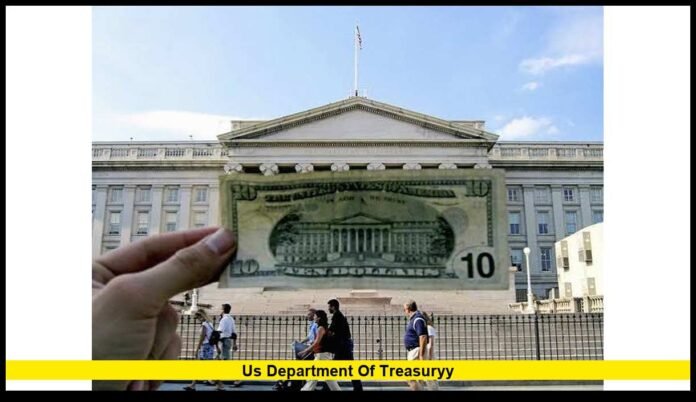

The us department of treasury is entering a closely watched period as the federal government begins a new fiscal year, financial markets face sharply higher Treasury yields, and officials advance new tax, student-loan, sanctions and debt-management initiatives. The department remains central to the federal government’s finances and plays a major role in taxation, borrowing, financial regulation, sanctions enforcement and economic policy.
What Is the U.S. Department of the Treasury?
The U.S. Department of the Treasury is a cabinet-level federal department responsible for managing many of the government’s most important financial operations.
Its responsibilities extend well beyond the collection of taxes. Treasury manages federal borrowing, oversees government financial accounts and payments, administers economic sanctions, works to combat illicit finance and financial crimes, produces U.S. currency and coins through its bureaus, and provides economic and financial advice to the president.
Treasury also works with the Federal Reserve, Congress, other federal agencies, foreign governments and international financial institutions on matters involving the U.S. and global financial systems.
Because of this broad role, Treasury announcements can affect households, businesses, investors, banks and governments around the world.
Who Leads the Treasury Department?
Scott Bessent is serving as U.S. Treasury secretary. He became the 79th secretary of the Treasury in January 2025.
The Treasury secretary is responsible for directing the department and advising the president on domestic and international economic, financial and tax matters.
Bessent has remained particularly visible in discussions involving government borrowing, Treasury markets, trade and international economic relations. His role has also placed him at the center of the administration’s efforts to address financial-market conditions and broader economic policy.
The Treasury secretary also chairs the Financial Stability Oversight Council, an interagency group that monitors potential threats to the stability of the U.S. financial system.
Latest Treasury Development: Education Freedom Tax Credit
One of the most significant new Treasury announcements came on October 1, 2026, when the Treasury Department and Internal Revenue Service released proposed regulations for the new federal Education Freedom Tax Credit.
The program is scheduled to begin on January 1, 2027.
Under the proposed rules, eligible taxpayers could receive an annual federal income tax credit of as much as $1,700 for qualifying contributions to eligible scholarship-granting organizations. Married couples filing jointly could potentially receive a credit of up to $3,400.
The initiative is designed to establish a federal tax incentive for qualifying contributions supporting scholarships for K-12 students.
Treasury and the IRS also released temporary regulations establishing procedures that states and scholarship-granting organizations can use as they prepare for the program.
The rules are still part of a regulatory process, meaning the final implementation details may change following consideration of public comments and additional administrative steps.
The new tax credit is expected to become an important area of attention for families, education organizations, states and taxpayers before the January 2027 launch.
Treasury and IRS Prepare for New Tax Rules
The Treasury Department and IRS have an especially important role in turning new federal tax legislation into practical rules.
Treasury develops regulations and guidance explaining how tax provisions are supposed to operate, while the IRS administers the tax system and processes taxpayer filings, payments and refunds.
The agencies have also published a 2026-2027 Priority Guidance Plan covering numerous tax-related projects.
The plan includes work involving recently enacted tax legislation, digital assets, tax-exempt organizations, tax administration and efforts to reduce regulatory burdens.
For taxpayers, Treasury regulations can be important because legislation often establishes broad requirements while subsequent regulations explain how those requirements will work in specific situations.
Treasury’s Role in Federal Debt Management
Managing federal debt is another core responsibility of Treasury.
When the federal government spends more money than it receives in revenue, it generally finances the resulting deficit by borrowing. Treasury raises money by selling government securities to investors.
These securities include Treasury bills, Treasury notes, Treasury bonds, Treasury Inflation-Protected Securities and Floating Rate Notes.
The department determines borrowing schedules and works to maintain reliable access to financial markets.
Treasury debt management matters because the government’s borrowing costs can influence the amount of money required to service federal debt. When market interest rates rise, newly issued government debt generally becomes more expensive.
That relationship has become increasingly important as long-term Treasury yields have climbed sharply.
10-Year Treasury Yield Hits a Multi-Year High
The U.S. bond market has been one of the biggest financial stories entering October 2026.
On October 1, the yield on the benchmark 10-year Treasury note rose to roughly 5.34%, reaching its highest level since 2002.
The move came during a broader global bond-market selloff.
Treasury yields are closely watched because the 10-year yield serves as an important reference point for many other borrowing rates. Changes can influence mortgage rates, corporate borrowing costs, consumer loans and financial-asset valuations.
Higher yields can benefit investors purchasing newly issued or higher-yielding bonds, but they can also increase borrowing costs across the economy.
The recent rise has therefore placed Treasury debt management under particularly close scrutiny.
Why Are Treasury Yields Rising?
Treasury yields can move for many reasons, and no single factor explains every market movement.
Recent market pressure has been associated with concerns about inflation, government borrowing requirements, expectations for interest rates, energy prices and demand for longer-term government bonds.
Strong economic expectations can also affect yields because investors may demand higher returns when they believe growth and inflation could remain elevated.
Another factor is the supply of government debt. When governments issue large amounts of bonds, market participants assess whether investor demand will be sufficient to absorb the additional securities without requiring higher yields.
The October bond-market movement is not limited to the United States. Government bond yields have also risen in several major overseas markets, highlighting the global nature of the current fixed-income environment.
Treasury Bond Buybacks Remain Under the Spotlight
Treasury’s bond buyback program is another important development for financial markets.
The program allows the government to repurchase certain previously issued Treasury securities. One of its key objectives is to improve liquidity in older and less actively traded securities.
Treasury has increased the potential size of some longer-term buyback operations, but recent purchases have not always reached the maximum amount available.
That has generated discussion among investors about how Treasury is using the program and what role it should play in debt management.
Treasury officials have described buybacks primarily as a tool for improving market liquidity and supporting the functioning of the Treasury market.
The program will remain an area to watch as Treasury evaluates market conditions and prepares future debt-management decisions.
New Defaulted Student Loan Support Center
Student-loan administration is another area where Treasury has recently expanded its involvement.
On September 30, 2026, the Treasury Department and Department of Education announced a new Defaulted Loans Support Center through StudentAid.gov.
The online resource is intended to help borrowers with defaulted federal student loans understand available pathways for addressing their loan status and returning to repayment.
The initiative is part of a partnership between Treasury and the Department of Education involving federal student assistance operations.
Treasury and Education have highlighted increased activity involving loan rehabilitation and consolidation among borrowers dealing with default.
For borrowers, the development is significant because default can create serious financial consequences, including collection activity and restrictions associated with federal student-loan programs.
Anyone dealing with a defaulted federal student loan should rely on official federal information when determining which repayment or rehabilitation option applies to their circumstances.
Treasury Expands Sanctions Enforcement
Economic sanctions continue to be a major component of Treasury’s national-security and foreign-policy responsibilities.
The Office of Foreign Assets Control, commonly known as OFAC, administers and enforces many U.S. economic sanctions programs.
On September 30, Treasury announced sanctions targeting a financial network connected to Tren de Aragua, a foreign terrorist organization designated by the U.S. government. Treasury said the network was involved in financial activity that generated funds for the organization.
The department has also recently announced sanctions involving criminal organizations, Iranian procurement networks, cartel leadership and other targets.
Sanctions can restrict access to U.S. financial institutions and assets subject to U.S. jurisdiction. Their exact effects depend on the legal authority and specific designation involved.
Businesses operating internationally therefore pay close attention to OFAC announcements because sanctions compliance can affect payments, investments, banking relationships and international transactions.
Treasury’s Financial Crimes Mission
Treasury also plays a major role in combating money laundering, terrorist financing, fraud and other forms of illicit finance.
The Financial Crimes Enforcement Network, or FinCEN, is one of the department’s key components in this area.
FinCEN collects and analyzes financial information and works with law-enforcement and regulatory partners to identify potentially suspicious financial activity.
The department’s financial-crime responsibilities have become increasingly important as criminals use digital payments, cryptocurrency, complex corporate structures and international financial networks to move money.
Treasury’s sanctions and financial-intelligence operations therefore form an important part of the government’s broader effort to protect the U.S. financial system.
Major Treasury Bureaus
The department contains several major bureaus and offices, each with specialized responsibilities.
Internal Revenue Service
The IRS administers the federal tax system, processes tax returns, collects federal taxes and provides taxpayer services.
Office of Foreign Assets Control
OFAC administers and enforces U.S. economic sanctions programs.
Financial Crimes Enforcement Network
FinCEN focuses on financial intelligence and efforts to combat money laundering and illicit finance.
Bureau of the Fiscal Service
The Bureau of the Fiscal Service handles important government financial operations, including federal payments, collections and debt-related services.
U.S. Mint
The U.S. Mint produces circulating coins, commemorative coins and other numismatic products.
Bureau of Engraving and Printing
The Bureau of Engraving and Printing produces U.S. paper currency.
Office of the Comptroller of the Currency
The OCC supervises national banks and federal savings associations and plays a significant role in the federal banking regulatory system.
Why Treasury Matters to Everyday Americans
Although Treasury decisions can appear focused on financial markets and government operations, they can have direct consequences for households.
Tax regulations can change how individuals and businesses comply with federal tax laws. Treasury borrowing costs can influence broader interest rates. Sanctions can affect international transactions. Federal payment systems help move money to government beneficiaries and contractors.
Treasury securities are also widely held by investors, banks, pension funds, mutual funds and foreign institutions.
As a result, changes in Treasury policy can ripple through financial markets and eventually affect borrowing, saving and investment decisions.
What Investors Are Watching Now
Investors are paying particular attention to several Treasury-related issues as October begins.
The first is the direction of long-term Treasury yields. The recent rise to levels not seen in more than two decades has increased attention on the cost of government borrowing.
The second is Treasury’s debt-management strategy, including the size and structure of future debt issuance and bond buybacks.
The third is inflation and interest-rate expectations. Persistent inflation can put upward pressure on long-term yields, while changing expectations about Federal Reserve policy can produce rapid moves in bond markets.
The fourth is demand for U.S. government debt. Treasury securities remain a central component of global financial markets, making investor demand an important factor for borrowing conditions.
What to Watch From the Treasury Department Next
The coming weeks could bring additional developments across several areas.
The Education Freedom Tax Credit will remain important as Treasury and the IRS move toward the program’s January 2027 launch. Taxpayers and scholarship organizations will be watching for additional guidance.
The Treasury market will also remain a major focus, particularly after the sharp rise in long-term yields.
Debt issuance, Treasury buybacks and the government’s broader financing requirements will receive continued attention from investors.
At the same time, Treasury is expected to continue its sanctions and financial-crime enforcement activities, while its partnership with the Department of Education will remain relevant to borrowers dealing with federal student loans.
The Bottom Line
The Treasury Department sits at the center of America’s financial infrastructure, with responsibilities ranging from federal borrowing and tax administration to sanctions enforcement, financial intelligence and government payments.
The latest developments show how broad that role has become. New education tax-credit regulations, student-loan assistance, financial sanctions and significant movements in Treasury yields are all occurring at the same time.
With the new fiscal year underway and financial markets closely watching long-term borrowing costs, Treasury decisions are likely to remain an important source of economic and financial news throughout the coming months.
Stay with us for the latest verified Treasury developments, and share your thoughts on which financial issue deserves the most attention next.