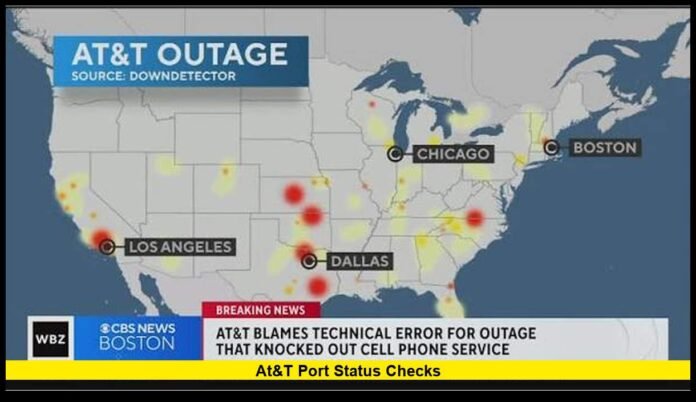

AT&T port status remains a closely watched search as customers look for the latest information about connectivity problems, local interruptions, and the availability of AT&T services across the United States. The latest confirmed information shows that AT&T does not have a nationwide service outage affecting all customers, although individual users in some locations continue to report problems with wireless and internet connections.
The current picture is therefore more localized than national. Customers in different parts of the country can experience very different service conditions at the same time. One neighborhood may have normal connectivity while another nearby area deals with a fiber interruption, cellular problem, equipment failure, or network congestion.
For customers trying to determine whether their AT&T service is affected, checking the status for their specific location remains more useful than relying on broad reports from other areas.
Latest AT&T Service Situation
AT&T continues to operate its nationwide network, but isolated service issues can still affect customers.
Recent reports have included problems involving mobile connectivity and home internet. Some customers have reported intermittent connections, while others have experienced complete service interruptions.
The reports do not point to one single problem affecting the entire AT&T network.
Instead, the latest situation involves separate issues that can vary by location and service type.
This distinction is important for customers searching for the latest AT&T port status information. A rise in complaints from one city does not automatically mean customers throughout the United States have lost service.
Service availability can change at the neighborhood level.
AT&T’s own outage tools remain the most useful place for customers to determine whether an interruption has been identified for their account or address.
No Nationwide AT&T Outage Confirmed
The latest available information does not show a confirmed nationwide AT&T outage.
AT&T customers across the country continue to use mobile, broadband, and fiber services normally. At the same time, reports from individual customers show that some areas can experience disruptions.
This difference explains why customers may see conflicting information online.
One outage-monitoring service might show an increase in complaints, while another customer in a different state may have completely normal service.
Both can be true.
Network problems often develop in specific geographic areas. A damaged cable, failed piece of equipment, maintenance issue, or local infrastructure problem can affect customers without disrupting the wider network.
Customers should therefore avoid assuming that a nationwide outage exists simply because other AT&T users are reporting problems.
Recent Texas Service Problems
Texas has recently experienced some of the most visible AT&T service disruptions.
Customers in the Houston area reported significant problems involving home internet and related services during an earlier outage. Reports also appeared from other communities across the state.
The disruptions affected customers differently.
Some users reported losing internet access completely. Others experienced unstable connections or extended periods of poor service.
Dallas-Fort Worth also experienced a major interruption.
AT&T later stated that the Dallas incident was connected to an attempted cable theft that damaged network infrastructure. The company rejected claims that the outage resulted from a cyberattack.
Service was subsequently restored in the affected area.
That event remains relevant because online discussions can sometimes combine separate incidents. A previous major outage does not automatically explain every new complaint appearing in the same region.
Current service reports should be evaluated separately.
Dallas-Fort Worth Connectivity Has Improved
The earlier Dallas-Fort Worth disruption was significant, but the affected network was restored.
Customers who experienced the outage may still see isolated connectivity problems from time to time. However, there is no confirmed indication that the earlier large-scale incident represents an ongoing nationwide failure.
Wireless and home internet services can also experience different problems.
A customer may have working cellular service while their home internet connection remains unavailable. Another customer may experience the opposite situation.
This is why identifying the exact service affected is an important part of checking AT&T availability.
Reports From California
California has also appeared in recent customer discussions about AT&T connectivity.
Some customers in the Los Angeles area have reported continuing fiber problems. Reports have included intermittent service and extended interruptions.
Individual customer reports provide useful insight into how an outage is being experienced locally. However, they do not establish the cause of a problem on their own.
An outage can involve network infrastructure serving only a limited number of homes.
That means a customer several miles away may have no interruption at all.
Customers in affected areas should check their own address through AT&T’s service-status tools rather than relying exclusively on reports from social media or outage websites.
Why Location Matters So Much
AT&T operates a large network covering millions of customers.
Because the infrastructure is distributed across numerous locations, service problems can occur at different levels.
A local interruption may affect only a few streets. A larger infrastructure problem can affect an entire neighborhood or community.
A regional incident can reach much farther.
The scale depends on what part of the network has been affected.
Several factors can contribute to an interruption, including:
- Damaged fiber infrastructure
- Cable damage
- Equipment failures
- Problems at individual cell sites
- Local power-related issues
- Network congestion
- Maintenance activity
- Physical infrastructure damage
The presence of an outage in one area does not mean every AT&T customer is affected.
Wireless Problems Can Look Different From Internet Problems
Customers searching for AT&T port status may encounter reports describing different types of connectivity issues.
Wireless service problems can include:
- No cellular signal
- Calls that fail or disconnect
- Slow mobile data
- Phones displaying SOS
- Difficulty sending messages
- Intermittent cellular connectivity
Home internet problems can produce different symptoms.
Customers may see:
- No internet connection
- Slow download speeds
- Frequent disconnections
- Wi-Fi interruptions
- Gateway connection errors
- Several devices losing access simultaneously
These symptoms can have different causes.
A phone showing SOS, for example, does not automatically prove that AT&T’s entire wireless network is down. It can also result from a localized network problem or a device-specific issue.
Likewise, a home Wi-Fi problem does not necessarily mean AT&T’s broadband network has failed.
How Customers Can Check Their Current Status
The first step for customers experiencing an interruption is to check AT&T’s official outage information.
The company’s system can identify known service problems associated with a customer’s location or account.
Home internet customers can also use Smart Home Manager to examine their connection and identify potential problems with their home network.
This approach can save time.
If AT&T has already identified an outage, repeatedly restarting equipment will not repair damaged network infrastructure.
If no outage appears, troubleshooting becomes more useful.
Customers can restart their gateway, check cables, test another device, and determine whether the problem affects every connection in the home.
Wireless customers can restart their phone and check whether cellular service returns.
If the problem continues, contacting AT&T support can help identify whether the issue involves the device, account, local network, or connection.
What an AT&T Outage Report Actually Means
An outage report does not always mean that every customer in a particular city has lost service.
Outage systems generally identify reported or confirmed problems. Online monitoring services also collect reports from users.
Those reports can rise sharply when a popular service experiences a disruption.
However, the number of reports should not be interpreted as a direct count of affected customers.
One person can submit multiple reports. A small group of customers can also generate a noticeable increase in online complaints.
The geographic distribution matters more than a single number.
A concentrated cluster can indicate a local problem. A broad increase across multiple regions can indicate a larger incident.
Even then, official confirmation remains important.
Why Customers May See Different Information Online
People often turn to social media when their service stops working.
This can quickly reveal whether other users are seeing similar problems.
However, social media posts can mix current incidents with older outages, unrelated technical issues, and speculation.
A customer may post about an outage several hours after it occurred. Another person may continue discussing an older incident after service has already returned.
This creates confusion for people trying to determine the current AT&T port status.
The safest approach is to use recent customer reports as an indication that problems may exist, then verify the situation through AT&T’s official tools.
How to Recognize a Local Network Problem
Several signs can suggest that an issue is broader than one device.
If multiple phones on AT&T lose cellular service in the same location, a local wireless network problem becomes more likely.
If several homes in the same neighborhood lose AT&T internet at approximately the same time, an area-level interruption may be involved.
A single device behaving differently from other devices points toward a more limited problem.
Home users can test this by checking multiple devices.
For example, if a phone connects successfully through cellular data but a home computer cannot access the internet through the household Wi-Fi, the problem may be limited to the home connection.
These simple checks can help customers determine what to do next.
Why Restoration Times Can Change
Customers often become frustrated when an estimated restoration time changes.
Network repairs can be difficult to predict.
Technicians may need to locate damaged infrastructure, access equipment, replace components, or complete additional work before service can return.
An initial estimate may therefore change as the repair progresses.
Customers should treat an estimated restoration time as a target rather than a guarantee.
If the outage remains active after the expected time, checking the status again can provide updated information.
What Recent Outages Show About AT&T Service
The recent disruptions demonstrate that AT&T service problems can vary significantly in scale.
Some incidents have affected large groups of customers.
Others appear limited to smaller geographic areas.
The Texas incidents illustrate how infrastructure damage can produce major connectivity problems. Reports from California show that localized fiber issues can continue even while the broader network remains operational.
These examples also highlight the importance of distinguishing confirmed information from online claims.
The Dallas incident is particularly notable because AT&T disputed claims that hackers caused the outage and instead identified attempted cable theft as the cause.
Customers should rely on confirmed information when determining why an outage occurred.
What Customers Should Do If Service Is Still Unavailable
Customers experiencing an AT&T interruption should begin with the service-status checker.
If an outage is confirmed, there may be little need for extensive equipment troubleshooting.
Customers can monitor the outage for restoration updates.
If no outage appears, basic troubleshooting is appropriate.
For home internet customers, that can include restarting the gateway and checking physical connections.
For wireless users, restarting the phone and checking service from another nearby location can help determine whether the issue is localized.
Customers should also consider whether only one device is affected.
If other AT&T customers nearby have working service, the problem may require individual troubleshooting rather than waiting for a network repair.
AT&T Port Status Remains Location-Specific
The latest AT&T port status information points to a network that is broadly operational but still experiencing isolated customer problems.
There is no confirmed nationwide outage affecting all AT&T customers.
Recent major disruptions in Texas have been restored, while some customers in other locations continue to report connectivity problems.
The key takeaway is simple: service status depends heavily on location, service type, and the specific account or connection.
Customers should avoid treating every online outage report as evidence of a national failure.
The most reliable way to determine whether service is currently affected is to check AT&T’s outage information for the relevant location.
For customers who continue to experience problems without a listed outage, troubleshooting and contacting AT&T support remain the appropriate next steps.
As service conditions can change during the day, customers should check for updated information if an interruption continues.
Have you experienced an AT&T service problem today? Share what you’re seeing in your area and stay informed as the latest status develops.