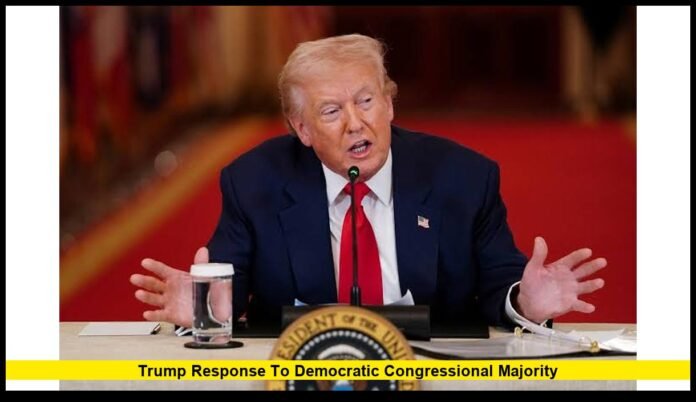

Trump’s response to a possible Democratic congressional majority has become clearer as the 2026 midterm elections approach. President Donald Trump said he would act as a “blocker” against Democratic priorities if Democrats take control of Congress, while also saying he could work out deals with them on some issues.
The comments came during a Fox News interview as Republicans gathered in Dallas for their first national midterm convention. Trump was asked about the possibility that Democrats could win the House and Senate in November and whether such an outcome would damage his remaining time in office.
His answer focused on his ability to oppose legislation he does not support. Trump said he would block what he called “bad stuff” for the final two years of his presidency. At the same time, he said he would probably be able to make deals with Democrats.
The comments provide the clearest recent description of how Trump says he would respond to divided government. Republicans currently control Congress, but Democrats are campaigning to change that balance in the November 2026 elections.
Trump Says He Would Become a Blocker
Trump’s central message is straightforward. If Democrats win control of Congress, he says he would use his presidential powers to oppose Democratic legislation that conflicts with his agenda.
During the Fox News interview, Trump described himself as a “blocker” and said he would spend the remaining two years of his presidency blocking Democratic initiatives he considers unacceptable.
The statement represents a significant shift in the political environment Trump could face after the midterms.
At present, Trump has Republican majorities working with him in Congress. That gives his administration a legislative partner on major policy priorities.
A Democratic takeover would change that relationship.
Trump would remain president, but Democrats would control the congressional agenda if they captured both chambers. That could make passage of administration-backed legislation considerably more difficult.
His remarks show that he expects confrontation to become a major feature of the relationship if Democrats take control.
Trump Still Says Deals Could Be Possible
Trump’s comments did not amount to a promise that he would reject every Democratic proposal.
After describing himself as a blocker, he said he would probably be able to make deals with Democrats.
That qualification is important.
Presidents regularly negotiate with members of Congress from the opposing party. Even when political disagreements are substantial, legislation can move forward when both sides find areas of agreement.
Trump’s latest comments leave that door open.
His stated approach would therefore combine opposition and negotiation. He would seek to stop Democratic initiatives he opposes while potentially supporting agreements that advance issues he considers acceptable.
The exact issues that could produce bipartisan agreements cannot be known before the next Congress is elected.
For now, Trump’s confirmed position is that a Democratic majority would not prevent him from using presidential authority to challenge legislation, but it also would not eliminate the possibility of negotiations.
Why a Democratic Majority Would Change Trump’s Situation
A Democratic takeover of Congress would create a divided federal government.
The president would remain in the White House. Democrats would control Congress. That arrangement would give each side significant constitutional powers.
The House would have authority over legislation, federal spending measures and congressional oversight.
The Senate would control its legislative agenda and committee structure. It would also retain its constitutional role in confirming presidential nominees.
Trump would continue to have veto authority over legislation that reaches his desk.
That means a Democratic Congress could pass bills that Trump opposes, while Trump could reject those bills through the veto process.
Congress could attempt to override a presidential veto, but doing so requires a two-thirds vote in both chambers.
With normal partisan margins, that would be difficult.
Trump’s description of himself as a “blocker” therefore reflects a real constitutional mechanism available to a president facing an opposing Congress.
However, Congress would retain its own powers. A president cannot simply prevent lawmakers from introducing, debating or voting on legislation.
The resulting relationship would depend on the election results, congressional margins and the willingness of lawmakers to negotiate.
The Midterm Election Is Driving the Conversation
The November 2026 midterm election is now at the center of the debate.
Every House seat is being contested, while 35 Senate seats are on the ballot.
Republicans are defending narrow congressional majorities. Democrats are seeking to regain control of one or both chambers.
Recent reporting indicates that Democrats see an opportunity to take the House and potentially compete for the Senate. Republicans, meanwhile, are using Trump’s influence and campaign appearances to motivate their voters.
Trump’s comments came at a Republican convention designed to energize the party ahead of the election.
The two-day gathering in Dallas featured Trump and Vice President JD Vance, along with Republican candidates and lawmakers.
Trump used the event to urge Republican voters to support the party in November.
His remarks about becoming a blocker add another argument to the Republican campaign.
The message is that the election could determine whether Trump spends the final two years of his presidency working with Republican majorities or confronting Democratic majorities.
Trump Has Already Discussed Democratic Control
Trump’s latest comments were not the first time he has talked about his ability to resist a Democratic Congress.
In August, he described himself as having significant “blocking power” when discussing the possibility that Republicans could lose control of the House.
Trump said he could prevent Democrats from accomplishing their agenda even if they gained a congressional majority.
The September interview went further by pairing that resistance message with his willingness to negotiate.
That creates a consistent theme in Trump’s recent remarks.
He does not view a Democratic congressional victory as ending his ability to influence federal policy.
Instead, he argues that presidential authority would give him substantial leverage over legislation during the final two years of his term.
House Control Could Bring Major Investigations
One of the most significant consequences of a Democratic House would involve congressional oversight.
Democratic lawmakers have already discussed investigations they could pursue if they win the House.
Those plans include investigations involving the Trump administration, Trump’s business interests and other matters involving the federal government.
Rep. Robert Garcia of California, the ranking Democrat on the House Oversight Committee, is positioned to lead that panel if Democrats gain the majority.
Democrats have described oversight as an important responsibility of Congress.
A Democratic House could therefore create a very different relationship between the White House and congressional committees.
Committee chairs have substantial authority to conduct hearings and request information within the scope of congressional oversight.
That possibility is one reason Trump’s response extends beyond legislation.
A Democratic majority could challenge the administration through both lawmaking and oversight.
Recent reporting indicates that Democratic lawmakers are preparing for that possibility and have publicly discussed investigations they could pursue if voters give them control of the House.
Trump Would Still Have Presidential Powers
A Democratic congressional majority would not remove Trump from office.
He would continue serving as president through the remainder of his term.
The change would be in the political balance between the executive and legislative branches.
Trump would retain powers granted to the presidency by the Constitution and federal law.
Those powers include the ability to veto legislation passed by Congress.
He would also continue directing the executive branch within the limits imposed by law.
Congress, meanwhile, would retain its authority over legislation, federal funding and oversight.
That separation of powers explains why a Democratic Congress could create significant obstacles for Trump without taking control of the presidency itself.
The president and Congress would have to operate within their respective constitutional authorities.
Trump’s description of himself as a blocker reflects his intention to use those presidential powers aggressively against Democratic legislation he opposes.
The Senate Would Be Especially Important
Control of the Senate would also have major consequences.
The Senate has a different role from the House and could affect Trump’s administration in areas beyond legislation.
Senate control determines which party leads committees and controls the chamber’s legislative agenda.
The Senate also confirms presidential nominees.
A Democratic Senate could therefore influence the confirmation process for executive branch officials and federal judges.
That would create another point of tension between Trump and Congress.
If Democrats controlled only the House, Trump could still work with a Republican Senate.
If Democrats controlled only the Senate, the White House would face a different set of challenges.
If Democrats controlled both chambers, Trump would face the strongest form of divided government available during the remainder of his term.
His comments about becoming a blocker were specifically directed at the possibility of Democrats taking both chambers.
Trump Is Framing the Election Around Congressional Control
Trump’s recent campaign activity has focused heavily on keeping Republicans in control.
At the Republican midterm convention in Dallas, he encouraged voters to support Republican candidates.
His message was built around the differences between the two parties and the consequences of a Democratic takeover.
The approach reflects the importance Trump places on congressional control during the final part of his presidency.
A Republican Congress gives him lawmakers who generally support his legislative priorities.
A Democratic Congress would force him to deal with lawmakers whose agenda could directly conflict with his administration.
Trump has therefore made the congressional election part of his broader political message.
Recent coverage of the Republican convention showed Trump and other Republican leaders directing substantial attention toward Democratic candidates and the possibility of a Democratic congressional takeover.
Trump Has Downplayed the Impact of a Democratic Victory
Despite his warnings about blocking Democratic legislation, Trump has also downplayed the idea that Democrats winning Congress would cripple his presidency.
During the Fox News interview, he said a Democratic victory would not necessarily end his ability to govern.
His reasoning centered on presidential authority.
Trump argued that he could still prevent major parts of the Democratic agenda from becoming law.
That position is consistent with his repeated emphasis on veto power and executive authority.
It also explains why he described himself as a blocker rather than suggesting that a Democratic victory would end his administration’s influence.
The president would still have two years remaining in his term.
A Democratic Congress could make the legislative process more difficult, but it would not eliminate presidential authority.
Democrats Are Preparing for a Different Agenda
Democratic lawmakers campaigning for control of Congress have presented their own priorities.
Their message includes economic issues, health care, congressional oversight and accountability.
Democrats have also indicated that investigations of the Trump administration would be part of their responsibilities if they win the House.
Rep. Robert Garcia has said Democrats could combine oversight with legislation rather than choosing between the two.
That would place Trump and a Democratic House on a collision course over both policy and congressional investigations.
The two parties therefore have sharply different descriptions of what a post-election Congress could look like.
Trump emphasizes his ability to block legislation.
Democrats emphasize their authority to investigate the administration and pursue their own legislative agenda.
Neither side can determine the outcome before voters cast their ballots.
The $5,000 Payment Has Become Part of the Election Debate
Trump has also connected congressional control to his proposal for a $5,000 payment to American adults.
During the Republican convention, he promoted the idea as an incentive connected to retaining Republican control of Congress.
Trump has argued that revenue from tariffs could support such payments.
The proposal has not become an enacted federal program.
Its implementation would require congressional action if legislation were necessary.
That makes congressional control relevant to the proposal.
A Republican-controlled Congress could provide a more supportive legislative environment for Trump’s proposal.
A Democratic-controlled Congress would have its own priorities and could challenge or reject the plan.
Trump has used the proposal alongside his broader argument that Republicans should retain control.
The proposal is therefore part of the larger debate over what voters could expect from Congress after November.
What Trump’s Position Means for the Final Two Years
Trump’s current term has another two years remaining after the 2026 election.
The congressional results could therefore shape the remainder of his presidency.
A Republican victory in both chambers would allow Trump to continue working with congressional majorities from his own party.
A split result would create divided control.
A Democratic victory in both chambers would place the president in direct conflict with congressional leaders from the opposing party.
Trump has already said how he would approach that scenario.
He would seek to stop Democratic priorities he considers unacceptable.
He would also look for opportunities to negotiate.
The exact balance between confrontation and cooperation would depend on the legislation before Congress and the positions of individual lawmakers.
Why the Current Statements Matter
Trump’s remarks matter because they remove some uncertainty about his preferred response to a Democratic congressional victory.
Rather than suggesting that he would simply accept a Democratic agenda, he has openly said he would attempt to block it.
At the same time, he has not ruled out negotiations.
That distinction is important for understanding what his comments actually establish.
They do not show that Democrats will win either chamber.
They do not establish that every Democratic bill would fail.
They do not mean Trump could unilaterally stop Congress from exercising its constitutional powers.
They show only what Trump says he would do if Democrats gained control.
The election results will determine whether that situation becomes reality.
The Election Will Determine the Next Congress
For now, Republicans continue to control Congress.
Democrats are campaigning to change that.
Trump is campaigning to help Republicans retain their majorities and has made congressional control a major part of his message.
The latest comments give voters a direct description of how he says he would respond to a Democratic victory.
Trump says he would become a blocker, oppose Democratic priorities he considers unacceptable and still seek deals when possible.
A Democratic majority would create a new balance between the White House and Congress.
The House could pursue investigations and new legislation. The Senate could shape legislation and nominations. Trump could use his veto power and other presidential authorities.
The outcome will depend on the votes cast in November.
Until then, the political debate remains centered on whether Republicans can retain control or whether Democrats will take over one or both chambers.
Bottom Line
Trump has made his position clear: if Democrats win control of Congress, he plans to resist legislation he considers unacceptable while remaining open to selected agreements. His comments came as Republicans intensified their midterm campaign and Democrats prepared for a possible return to congressional majorities.
The statement does not determine what the next Congress will look like. Voters will decide that in November. The results will determine whether Trump spends the final two years of his presidency working with Republican majorities or facing a Democratic-controlled Congress.
What do you think about Trump’s response to a possible Democratic congressional majority? Share your thoughts and stay updated as the 2026 midterm election approaches.