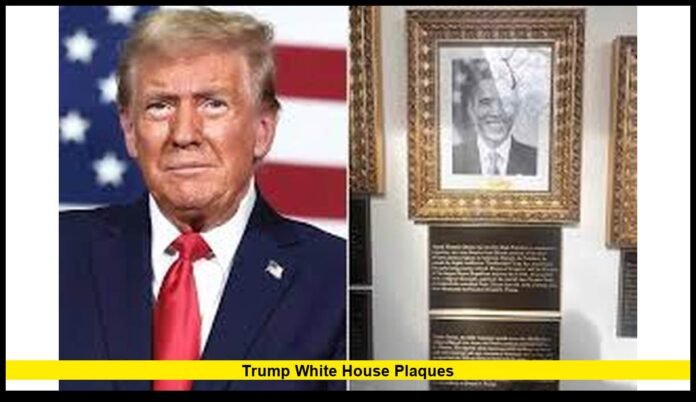

Trump White House plaques have reshaped how presidential history is presented inside the White House, marking one of the most consequential and debated changes to the building’s internal displays in modern times. Installed along the West Colonnade as part of the Presidential Walk of Fame, these bronze markers deliver blunt, opinionated descriptions of every U.S. president, reflecting the current administration’s approach to leadership, legacy, and historical accountability.
This article offers a fully original, deeply detailed, long-form examination of the plaques, written for a U.S. audience and grounded in confirmed developments as of today. It explores their origin, design, messaging, reception, political meaning, and potential long-term impact on how Americans encounter presidential history.
A New Chapter in White House Storytelling
For generations, the White House has served as both a functioning seat of government and a symbolic museum of American democracy. Its portraits, furnishings, and historical displays traditionally aimed to honor the presidency as an institution rather than spotlight ideological disputes between administrations.
The Trump White House plaques represent a major shift away from that approach. Instead of neutral summaries, the plaques offer decisive judgments. They praise, criticize, and classify presidents in unmistakable terms. The result is a presidential display that feels less like a museum gallery and more like a narrative statement etched into metal.
This change did not happen quietly. Once the plaques were installed, discussion spread quickly across political, cultural, and historical circles.
Understanding the Presidential Walk of Fame
The plaques are part of a larger installation officially named the Presidential Walk of Fame. This display runs along the West Colonnade, a covered outdoor corridor connecting the West Wing to the White House residence.
Every U.S. president is represented. Each display includes:
- A portrait mounted in a gold-toned frame
- A bronze plaque beneath the portrait
- A concise but assertive description of that president’s legacy
The walkway is used daily by senior staff, visiting officials, and foreign leaders. It is not a ceremonial dead end. It is an active artery of the executive branch, which gives the plaques daily visibility and symbolic power.
Why the Plaques Were Created
The Trump administration has consistently argued that American history has been softened or distorted by institutional caution. From this perspective, traditional displays avoid controversy at the expense of truth.
The plaques were introduced as part of a broader effort to present history more directly. Administration officials described the goal as honesty rather than harmony. The idea was not to offend for its own sake, but to present firm conclusions about presidential performance.
By choosing permanent bronze rather than temporary signage, the administration signaled that these interpretations were meant to endure.
Design Choices That Signal Permanence
The physical design of the Trump White House plaques reinforces their intent.
Bronze was selected for its durability and historical association with monuments and memorials. The lettering is deeply engraved, not printed or etched lightly. Each plaque appears built to last decades, if not longer.
The consistent layout across all presidents creates a sense of equality in form, even as the content varies sharply in tone. No president is omitted. No legacy is left undefined.
The gold-framed portraits above the plaques add another layer of symbolism, aligning with a visual style President Trump has favored throughout his career.
Language That Breaks With Tradition
What separates these plaques from earlier White House displays is not their presence, but their voice.
Many plaques use plain, forceful language. Some offer strong praise, highlighting leadership, resolve, or economic success. Others deliver pointed criticism, labeling presidencies as failures or sources of division.
The tone is confident and unapologetic. It leaves little room for ambiguity. This approach contrasts sharply with the cautious phrasing commonly used in historical institutions.
The Biden Display and Its Significance
One of the most discussed elements of the Presidential Walk of Fame is the display associated with President Joe Biden.
Instead of a painted portrait, the display features an image of an autopen. The plaque beneath it delivers a harsh assessment of Biden’s presidency, focusing on inflation, border security, and foreign policy challenges from the Trump administration’s viewpoint.
The symbolism is deliberate. The autopen image visually separates Biden from other presidents while reinforcing the message conveyed in the plaque’s text.
Supporters describe this choice as commentary. Critics see it as ridicule. Either way, it has become a focal point of national attention.
How Other Modern Presidents Are Presented
The plaques addressing recent presidents draw strong reactions due to their proximity to current political memory.
- Barack Obama is described in terms that emphasize political division and contested policies.
- George W. Bush receives a more balanced but still direct assessment, acknowledging leadership during crises alongside controversial decisions.
- Bill Clinton is framed through a mix of economic growth and personal scandal, with emphasis on consequences rather than tone.
These descriptions reinforce the administration’s view that presidential legacies should be judged on outcomes, not intentions.
Treatment of Earlier Presidents
The Trump White House plaques do not reserve judgment only for recent figures.
Early presidents are assessed through the lens of national strength, constitutional impact, and long-term consequences. Some are praised as builders of American power. Others are criticized for decisions the administration views as weak or harmful.
This approach applies a modern evaluative framework to historical figures, creating a unified narrative across centuries of leadership.
Official White House Response to Criticism
The administration has responded firmly to criticism of the plaques.
Officials have stated that disagreement is not evidence of inaccuracy. They argue that history is inherently interpretive and that presidents should not be shielded from judgment simply because they once held office.
The White House has emphasized that the plaques are part of a living building, not a frozen museum. As such, they reflect the values and priorities of the current administration.
Public Reaction Across the Political Spectrum
The response to the Trump White House plaques has been intense and sustained.
Supportive Views
Supporters praise the plaques for clarity and courage. Many argue that previous displays avoided accountability and that the new plaques finally speak plainly about presidential success and failure.
Some supporters see the plaques as educational tools that encourage visitors to question conventional narratives.
Critical Views
Critics argue that the plaques politicize a shared national space. They worry that presenting opinion as permanent record undermines the White House’s role as a unifying symbol.
Others express concern that future generations may encounter these descriptions without understanding the broader historical context.
Impact on Historical Memory
The plaques have reignited a longstanding debate: who decides how history is remembered?
By installing permanent markers with explicit judgments, the administration has taken a direct role in shaping historical memory. This contrasts with the slower, more collective process through which legacy is usually formed.
The plaques do not wait for historians to decide. They declare conclusions now.
Relationship to Other White House Changes
The Presidential Walk of Fame exists alongside other changes introduced during the Trump administration.
Interior redesigns, aesthetic updates, and proposals for new event spaces all reflect an emphasis on visibility and legacy. The plaques fit naturally into this pattern.
They are not isolated decorations. They are part of a broader effort to leave a lasting imprint on the presidency itself.
Preservation and Future Alterations
Because the plaques are permanently mounted, their future remains an open question.
Historically, new administrations adjust White House displays. However, removing or rewriting bronze plaques would require a deliberate decision and could provoke controversy.
Some believe the plaques will remain as historical artifacts representing one administration’s worldview. Others expect future leaders to revise the display.
Cultural Meaning Beyond Politics
The Trump White House plaques have moved beyond political news into cultural symbolism.
They are discussed as examples of how leadership, authority, and narrative power operate in modern America. They raise questions about permanence in an era of rapid change.
For many Americans, the plaques symbolize a moment when political divisions became physically embedded in national space.
International Implications
Foreign dignitaries walking the West Colonnade encounter these plaques during official visits.
This exposure shapes how international audiences perceive American leadership history. It presents a candid, confrontational narrative rather than a diplomatic one.
The plaques thus become part of America’s image abroad.
Legal Authority and Presidential Discretion
There is no legal barrier preventing a president from altering White House displays. The building serves as both residence and workplace.
This discretion has long allowed presidents to redecorate and personalize the space. The Trump White House plaques push that authority further than most predecessors, but they remain within presidential power.
Historical Uniqueness of the Plaques
While past presidents have influenced decor, few have left such explicit judgments about predecessors inside the White House itself.
This makes the plaques historically unusual. They may one day be studied not just for what they say about past presidents, but for what they reveal about the era in which they were installed.
Media Attention and Enduring Debate
The plaques continue to generate attention months after installation.
Each public comment, photograph, or visitor reaction renews debate. The discussion shows no sign of fading, suggesting the plaques have secured a lasting place in political conversation.
What the Plaques Ultimately Represent
Beyond metal and text, the Trump White House plaques represent a philosophy of leadership.
They reflect a belief that history should be assertive, not cautious. That judgment is unavoidable. That neutrality can obscure truth.
Whether admired or criticized, the plaques force engagement. They demand a response.
Looking Ahead
Future administrations will decide the plaques’ fate. They may preserve them, modify them, or replace them. Whatever happens, the plaques have already changed how presidential history is experienced inside the White House.
They stand as a record not only of past presidents, but of a presidency determined to define history on its own terms.
How do you think presidential history should be presented inside the White House? Share your perspective and stay connected as this story continues to unfold.