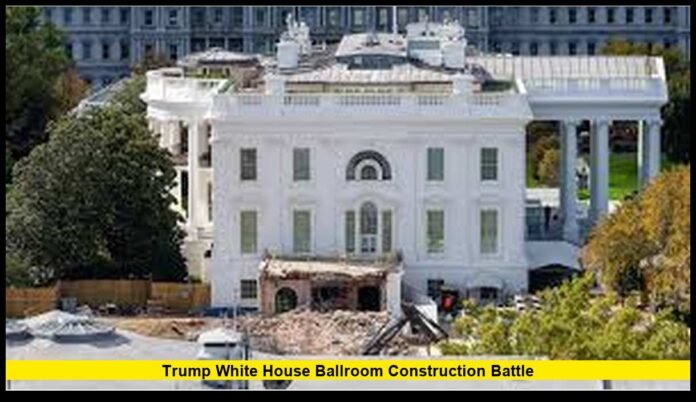

The trump white house ballroom construction project has entered a pivotal stage, with court decisions allowing work to proceed while deeper legal questions remain unresolved. The development has sparked intense debate in Washington and across the country, as officials, preservationists, and legal experts weigh the implications of one of the most ambitious changes ever proposed for the White House complex.
Court Decision Keeps Project Alive—for Now
A federal appeals court recently stepped in to temporarily allow construction to continue on the proposed ballroom. The ruling paused an earlier order that had required work to stop unless lawmakers gave formal approval.
This decision gives the administration additional time to continue building while judges review whether the project falls within presidential authority. The appeals court made clear that its ruling is temporary, signaling that further legal scrutiny is still ahead.
The case has quickly become a focal point for broader constitutional questions, particularly regarding how much power a president holds over changes to federally owned historic property.
Stay with us as we break down what this means and what could happen next in this fast-moving situation.
Inside the Vision for a New White House Ballroom
The proposed ballroom represents a dramatic expansion of the White House’s event capabilities. For decades, administrations have relied on temporary structures—often large tents—to host state dinners and major gatherings due to space limitations inside the historic residence.
The new ballroom is designed to eliminate that need.
Plans outline a structure of roughly 90,000 square feet, with the ability to host around 650 guests in a single indoor setting. The design aims to reflect the architectural character of the White House, blending classical elements with modern functionality.
Beyond its size, the project includes updated infrastructure beneath the building. These enhancements are intended to support operations tied to presidential security and continuity.
Supporters say the ballroom would bring the White House in line with other global residences that host large-scale diplomatic events indoors. Critics, however, question whether the scale fits within the historic footprint of the property.
Why the Project Triggered a Legal Showdown
At the center of the dispute is a fundamental legal issue: whether the president can authorize such a major structural change without Congress.
A lower federal court initially ruled that the administration likely overstepped its authority, ordering construction to halt. That ruling cited the need for legislative approval for significant alterations to nationally recognized historic sites.
The lawsuit challenging the project was brought by a preservation group, which argued that the demolition of the East Wing and its replacement with a large ballroom bypassed established review processes.
Opponents have raised several key concerns:
- The White House is both a working government building and a historic landmark
- Major changes should involve congressional oversight
- Existing preservation procedures must be followed
The appeals court’s decision to allow construction to continue does not resolve these issues but keeps the project moving while they are examined.
Security Arguments Complicate the Case
One of the most influential aspects of the legal battle involves national security.
Government lawyers have argued that parts of the construction involve sensitive infrastructure beneath the surface. These elements, they say, are essential for maintaining presidential safety and ensuring continuity during emergencies.
According to these arguments, stopping construction midway could create vulnerabilities or disrupt planned upgrades tied to security operations.
Judges reviewing the case have indicated that they need clearer information on whether these security components are dependent on the ballroom itself or could proceed independently.
This has added a layer of complexity to the case, as courts attempt to balance preservation concerns with potential risks tied to halting construction.
Approvals and Oversight Under Scrutiny
Despite the legal challenge, the ballroom project received approvals from federal planning bodies responsible for development in Washington, D.C.
These approvals allowed the project to move forward administratively, even as questions about legality surfaced in court.
However, critics have pointed to the approval process itself as a source of concern. They argue that leadership changes within oversight agencies may have influenced the outcome.
Supporters counter that the project followed established procedures and received proper clearance.
The clash between administrative approvals and judicial review now sits at the heart of the dispute, raising questions about how federal projects should be evaluated and authorized.
A Signature Initiative With Long-Term Impact
The ballroom proposal has been described as a defining initiative tied to President Donald Trump’s broader vision for the White House.
Throughout his career, Trump has emphasized large-scale construction and design projects. The ballroom reflects that background, aiming to deliver both practical benefits and a lasting physical addition to the presidential residence.
The administration has also highlighted funding arrangements as a distinguishing feature. Officials have said private contributions would cover the ballroom itself, while government funding would support related security enhancements.
That distinction has played a key role in public discussions, particularly as critics examine how the project aligns with federal spending priorities.
Historic Preservation vs. Modern Needs
The debate surrounding the ballroom extends beyond legal arguments and into a broader cultural conversation.
Supporters of the project argue that:
- The White House must evolve to meet modern diplomatic demands
- Indoor event space is essential for hosting global leaders
- The design respects the building’s historic character
Critics respond that:
- The scale of the ballroom could alter the visual balance of the complex
- Removing the East Wing represents a significant loss
- Changes of this magnitude should be approached with extreme caution
This tension reflects a larger challenge faced by historic sites across the country—how to adapt to present-day needs without compromising their legacy.
Political and Public Reaction Intensifies
The ballroom project has become a highly visible issue in national politics.
Lawmakers have expressed differing views, with some calling for congressional involvement and others defending the administration’s approach. The issue has also drawn attention from historians, architects, and preservation advocates.
Public opinion appears divided.
Some Americans see the ballroom as a necessary upgrade that enhances the White House’s functionality. Others view it as an overreach that risks altering one of the nation’s most recognizable landmarks.
As construction continues, the debate is expected to remain a prominent topic in political discussions.
What Comes Next in the Legal Process
The legal battle is far from settled.
The appeals court has requested further clarification from the lower court regarding its earlier decision. At the same time, additional legal steps remain possible, including further appeals that could bring the case before the nation’s highest court.
In the meantime, construction continues under the temporary order.
The outcome will likely hinge on several key questions:
- Does the president have authority to approve such a project independently?
- Were required review processes properly followed?
- How should courts weigh preservation against security considerations?
The answers to these questions could shape not only the future of the ballroom but also how similar projects are handled in years to come.
Why the Story Reaches Beyond Washington
The trump white house ballroom construction controversy carries implications that extend far beyond the White House grounds.
It raises important issues about:
- The balance of power between branches of government
- The protection of historic landmarks
- The role of courts in overseeing executive actions
These questions are likely to influence future decisions involving federal property, infrastructure, and preservation efforts.
As the case continues, it may serve as a benchmark for how the nation approaches major changes to its most iconic buildings.
A Project at the Center of a National Debate
For now, the sound of construction continues near the White House, even as legal arguments unfold in courtrooms.
The ballroom project stands at the intersection of history, politics, law, and design—making it one of the most closely watched developments in the country.
Whether it ultimately becomes a permanent addition or a halted effort will depend on decisions still to come.
The stakes are high, and the outcome will likely leave a lasting mark on both the White House and the broader conversation about preserving America’s heritage while preparing for the future.
What’s your take on this controversial project? Join the conversation and keep checking back as new developments unfold.