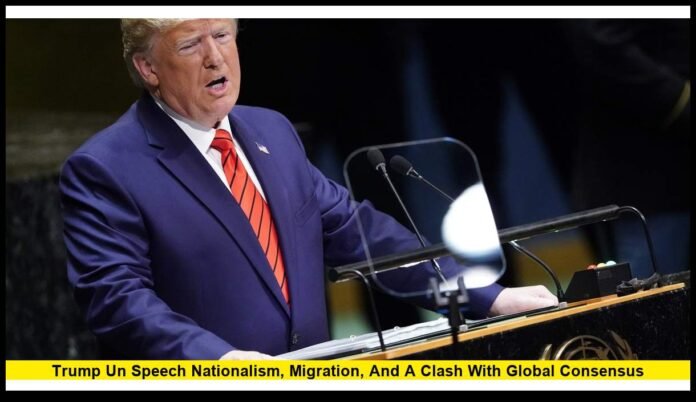

The Trump UN speech at the 80th United Nations General Assembly in New York has dominated headlines, bringing Donald Trump’s nationalist vision to the world stage once again. His remarks touched on migration, climate change, energy, and foreign conflicts, offering a clear picture of how he views global cooperation versus national sovereignty. For supporters, the speech was a reaffirmation of “America First.” For critics, it was a rejection of multilateral solutions to pressing challenges.
A Defiant Tone from the Start
Donald Trump began his U.N. address with characteristic bluntness. Standing before world leaders, he declared that countries failing to control migration and abandoning traditional energy would “go to hell.” The statement set the tone for what would be a fiery and uncompromising speech.
Instead of diplomatic subtlety, Trump leaned into direct warnings. His focus was not on building consensus but on urging individual nations to prioritize their own people, borders, and resources above all else.
Immigration as the Central Theme
At the core of the Trump UN speech was immigration. Trump argued that uncontrolled migration destroys national identity and drains resources. He presented the United States as a model, boasting about the “strongest borders” and urging other nations to follow the same path.
His message was simple: a nation without secure borders cannot survive. He urged leaders across Europe, Latin America, and Africa to take bold steps to secure their frontiers, deport illegal migrants, and protect their cultural identity.
For his supporters back home, this reinforced a familiar campaign theme. But for many leaders in the hall, the message ran counter to the humanitarian approach promoted by the United Nations.
Climate Change Rejection Sparks Debate
Another headline-making moment of the Trump UN speech was his attack on climate policies. Trump dismissed climate change initiatives as a “con job,” accusing global leaders of using environmental concerns to control economies and strip nations of independence.
He called on countries to double down on fossil fuels—oil, gas, and coal—arguing that these resources are the backbone of strong economies. According to Trump, the push toward green energy leaves nations vulnerable, especially when rivals like Russia and China continue to exploit traditional energy markets.
European leaders in attendance reacted visibly to this statement, as many of them have invested heavily in renewable energy programs. Trump, however, insisted that energy independence through fossil fuels is the only way nations can maintain strength.
A New Posture on Ukraine
Perhaps the most surprising section of the Trump UN speech involved Russia and Ukraine. In contrast to past ambiguity, Trump took a stronger stance. He said Ukraine should reclaim all its territory, including Crimea, and warned Russia that further aggression would be met with stronger measures.
He described Russia as a “paper tiger” and urged NATO allies to respond decisively if Russian aircraft threatened their airspace. Trump even suggested heavy tariffs on Russia until peace is restored.
This marked a significant shift in tone, suggesting that Trump is now positioning himself as tougher on Moscow than in the past. For Ukraine and its allies, his words provided reassurance, though skepticism remains over whether such rhetoric would be matched by policy.
Sharp Criticism of Europe
Europe came under heavy fire in Trump’s remarks. He accused European nations of “destroying their heritage” through open-border migration policies and weakening themselves with aggressive climate goals.
According to Trump, these choices leave Europe vulnerable to cultural decline and economic instability. He urged them to adopt the U.S. model: tighter borders, expanded fossil fuel production, and less reliance on international agreements.
These criticisms underscored his broader message that nations should prioritize sovereignty over global cooperation. For European leaders, however, his words were yet another reminder of the sharp divide in transatlantic policy views.
Tense Exchanges with the UN Itself
In typical Trump fashion, the speech included moments of tension beyond policy. He complained about technical issues, including a malfunctioning teleprompter, and joked about a broken escalator. While these remarks lightened the mood for some, they also highlighted his often combative relationship with the U.N. as an institution.
The U.N. leadership emphasized afterward that their mission is rooted in cooperation, not confrontation. Secretary-General António Guterres defended the role of international institutions in tackling global crises, standing in stark contrast to Trump’s nationalist stance.
Key Highlights from Trump’s UN Speech
Several clear messages emerged from Trump’s address:
- National sovereignty first: Each nation should put its people, borders, and interests above international agreements.
- Migration as a threat: Open borders and uncontrolled migration undermine stability and identity.
- Rejection of climate action: Fossil fuels are essential, and climate change policies are a form of manipulation.
- Tougher on Russia: Ukraine should recover all lost land, and NATO must respond more aggressively to aggression.
- Criticism of Europe: Green energy and migration policies are destroying European economies and cultures.
Domestic Impact of the Speech
For American audiences, the Trump UN speech reinforced familiar themes of sovereignty, energy dominance, and border security. His base saw it as proof that he would never bow to international pressure.
At the same time, his stronger position on Ukraine gave him new ground to appeal to voters who value a tough foreign policy stance. By rejecting climate initiatives and criticizing Europe, he also highlighted his willingness to take positions that challenge global norms.
The speech, therefore, was not just directed at world leaders but also at voters in the United States.
Global Reaction and Polarization
World leaders offered mixed responses. Some applauded Trump’s clarity and defense of sovereignty. Others criticized him for dismissing climate concerns and rejecting international cooperation.
European officials were particularly vocal in pushing back against his remarks on energy and migration. Meanwhile, leaders from nations dealing with mass migration saw his words as unsympathetic.
This polarization is exactly what many observers expected: Trump’s words were designed not to unify but to draw clear lines between his vision and the vision of global institutions.
Historical Context of Trump’s UN Speeches
The 2025 address was not Trump’s first time clashing with the U.N. His speeches in 2017, 2018, and 2019 all carried nationalist themes.
- In 2017, he warned North Korea of “total destruction” if it threatened the U.S.
- In 2018, he declared he was proud to put “America first,” even as other leaders laughed at the boast.
- In 2019, he attacked globalism directly, saying the future belongs to “patriots, not globalists.”
The 2025 speech followed this same trajectory, but with sharper focus on migration, climate, and the war in Ukraine. It showed that his core themes have not changed—only the global context around them.
Why the Speech Matters
The Trump UN speech matters because it lays out how the U.S. could interact with the world under his leadership. It suggests:
- A harder line on border security worldwide.
- A rollback of climate commitments.
- Increased pressure on Russia.
- Less cooperation with the U.N. as an institution.
For allies, this means preparing for a United States that prioritizes sovereignty over shared agreements. For critics, it raises concerns about the weakening of international unity at a time of multiple crises.
Conclusion
The Trump UN speech was bold, confrontational, and unmistakably nationalistic. It rejected climate consensus, attacked open-border migration, and challenged Europe to change course. At the same time, it marked a new position on Ukraine, signaling tougher rhetoric toward Russia.
For Americans, it was a reminder that Trump’s worldview has not softened with time. For the world, it was a declaration that U.S. leadership under Trump means sovereignty first and global consensus second.
Whether praised as strength or criticized as division, the speech left one undeniable truth: when Donald Trump speaks at the U.N., the world listens.
What’s your take on Trump’s speech at the United Nations? Share your perspective in the comments below.