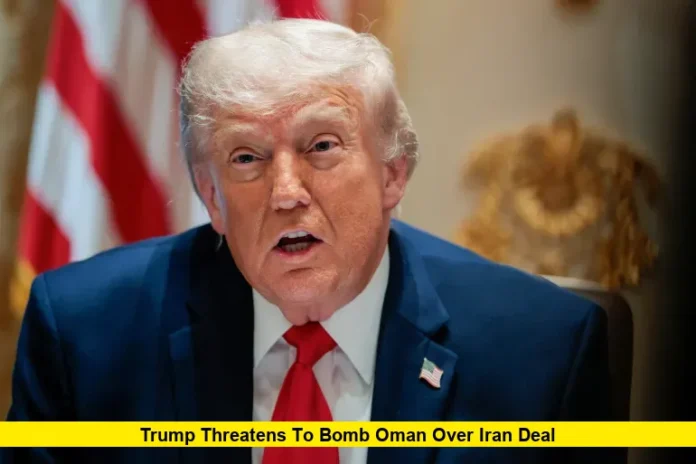

President Donald Trump threatens to bomb Oman over Iran deal tensions after the 60-day window for a U.S.-Iran peace agreement closed on August 17, 2026, without a resolution. The president made the explosive remarks in a phone interview with Fox News correspondent Trey Yingst, warning that Washington would strike the Gulf nation if it interfered with American efforts to reopen the Strait of Hormuz.
Trump’s comments landed as the war between the United States and Iran, which began on February 28, 2026, dragged into its sixth month with no clear endpoint in sight. The president’s threat against Oman, a longtime U.S. ally, marks one of the sharpest escalations of rhetoric in weeks and comes at a delicate moment for regional diplomacy.
What Trump Said About Oman
Speaking to Yingst on Monday, Trump did not mince words when describing what would happen if Oman blocked American operations in the strait. “If Oman gets in the way, we’ll bomb the s*** out of them,” the president said, according to Yingst’s account of the call.
The remark centers on the Strait of Hormuz, a narrow waterway between Oman and Iran that carries roughly one-fifth of the world’s oil shipments. The U.S. Navy has maintained a blockade aimed at pressuring Iran, and Trump made clear he sees any outside involvement in managing the strait as a threat to that strategy.
Trump added that he has “no time schedule” for ending the conflict with Iran, insisting he is in no hurry to reach an agreement. He also said the upcoming midterm elections have no bearing on his approach to the war.
Why Oman Became a Target
Oman’s role in the dispute grew more complicated in the days leading up to Trump’s threat. Iran’s Foreign Ministry spokesman, Esmaeil Baghaei, told reporters that Tehran had reached an agreement with Muscat regarding future shipping routes through the strait, though he offered few specifics.
Iran and Oman have held talks for several weeks aimed at creating a framework to manage the strategic waterway going forward. Both nations have floated the idea of charging fees to ships passing through the strait, a proposal that would directly challenge the U.S. position that Hormuz should remain open to unrestricted global traffic.
Trump’s Oman threat is not an isolated incident. Earlier this year, in May 2026, he made a similar warning during a White House cabinet meeting, saying the U.S. would “blow up” Oman if it worked with Iran to control passage through the strait. That comment came after Iranian state media suggested a joint Iran-Oman shipping arrangement, a claim the Trump administration dismissed as fabricated at the time.
The 60-Day Deadline and Its Collapse
The latest flashpoint traces back to a memorandum of understanding signed by the U.S. and Iran roughly two months ago. That agreement set a 60-day window for both sides to negotiate a broader peace deal and restore normal shipping through Hormuz. Monday marked the expiration of that period, and no concrete plan to end the war has emerged.
Despite the deadline passing, Trump indicated back-channel communication remains active. He confirmed to Fox News that the U.S. maintains an informal line of contact with members of Iran’s Islamic Revolutionary Guard Corps, though he declined to share details about the substance of those exchanges.
The president described Iranian negotiators in blunt terms, calling them “good poker players” while adding that “they’re dying.” He repeated his call for Iran to raise “the white flag of surrender,” a phrase he has used repeatedly throughout the conflict.
Military Posture and Weapons Stockpiles
Trump also addressed questions about America’s military capacity during the same interview. He rejected concerns that the extended conflict has strained U.S. weapons reserves, describing what has been used against Iran so far as “peanuts.” The president said the U.S. still holds deep stockpiles, though he acknowledged that some of the more advanced systems, including certain air-defense equipment, were previously sent to Ukraine under the Biden administration.
The blockade of Iranian shipping in the strait has been central to U.S. strategy since fighting began. American officials have argued the pressure campaign is designed to force Tehran back to the negotiating table, though the approach has also driven up global energy prices and disrupted trade far beyond the immediate region.
Oman’s Position as a Longtime U.S. Partner
The threat against Oman carries added weight because of the country’s decades-long relationship with Washington. Oman has served as a strategic U.S. partner for more than 50 years and has often played the role of quiet intermediary in disputes involving Iran, including past nuclear negotiations. Analysts following the region say Trump’s warning appears aimed less at Oman itself and more at discouraging any Gulf state from giving Iran diplomatic or logistical cover.
Regional experts note that most of the Strait of Hormuz actually runs through Iranian and Omani territorial waters rather than international waters, complicating Trump’s repeated framing of the strait as a fully open international passage. That distinction has fueled debate over how much legal standing the U.S. blockade actually holds, even as American forces continue enforcing it.
Broader Regional Context
Trump’s remarks on Oman arrived alongside other fast-moving developments in the region. Jared Kushner, the president’s son-in-law and senior adviser, met with Hamas leaders in Egypt over the weekend to discuss a U.S.-backed proposal for ending the war in Gaza, an initiative that Israeli Prime Minister Benjamin Netanyahu rejected last week. While separate from the Iran conflict, the timing underscores how many overlapping crises the Trump administration is managing simultaneously across the Middle East.
Iran, for its part, signaled Monday that its talks with Oman over the strait remain ongoing despite being described as complex. Tehran has not issued a formal response to Trump’s latest threat, though Iranian officials have previously dismissed similar warnings as posturing.
What Comes Next
With the 60-day negotiation window now closed and no peace framework in place, attention turns to whether Trump follows through on his warning or whether the threat functions primarily as pressure tactic aimed at Muscat and Tehran alike. The Strait of Hormuz remains a flashpoint that could determine how the broader war between the U.S. and Iran develops in the coming weeks.
Oman has not issued a public response to Trump’s latest comments as of Monday. Given the country’s historical preference for quiet diplomacy over public confrontation, officials in Muscat may choose to address the threat through private channels rather than open statements.
The situation remains fluid, and further developments involving the Strait of Hormuz, Iran’s ongoing talks with Oman, and the broader U.S.-Iran conflict may shift the picture in the days ahead.
What do you think Oman’s next move should be? Share your thoughts in the comments below.