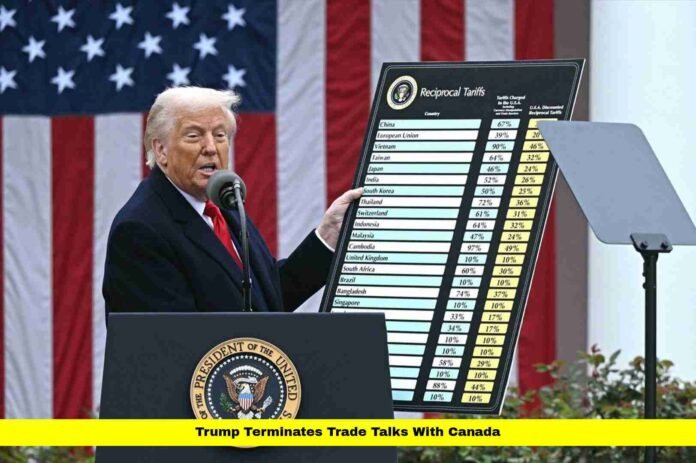

President Donald Trump has officially terminated all trade negotiations with Canada, a decision that has sent shockwaves through political and economic circles across both nations. The move follows a sharp dispute involving an advertisement released in Ontario, which Trump called “fraudulent” and “interfering.”
Why Trump Terminated Trade Talks With Canada
The breaking point came after a television advertisement funded by the Ontario government used edited audio of former U.S. President Ronald Reagan speaking against tariffs. Trump claimed the ad was “fraudulent” and accused Canadian officials of attempting to sway an ongoing U.S. Supreme Court case regarding his authority on tariffs.
In a public post, Trump declared:
“Based on their egregious behavior, ALL TRADE NEGOTIATIONS WITH CANADA ARE HEREBY TERMINATED.”
This statement effectively froze months of ongoing discussions between the two countries, which had been aimed at resolving disputes over tariffs, technology taxes, and other trade barriers.
The Controversial Advertisement at the Heart of the Dispute
The advertisement in question aired across U.S. media markets and featured Reagan’s 1987 remarks opposing tariffs. The video was reportedly shortened and edited to portray Canada’s argument that tariffs harm American consumers. Trump and his advisors viewed the ad as misleading and politically motivated.
The Ronald Reagan Presidential Foundation also criticized the ad, stating that it was used “without permission” and “took Reagan’s message out of context.” Ontario Premier Doug Ford defended the campaign, saying it was meant to highlight the negative impact of tariffs on Canadian industries, not to interfere with U.S. politics.
Canada’s Response to Trump’s Decision
Following the announcement, Canadian Prime Minister Mark Carney expressed disappointment and said Canada would continue to act in its own economic interest. He emphasized the importance of diplomacy but hinted that Canada would begin exploring new global markets to reduce reliance on the United States.
Doug Ford doubled down on his defense of the ad, saying,
“We’ll always stand up for Ontario workers. Our campaign was about fairness, not politics.”
The abrupt termination has left Canadian trade officials scrambling to assess the immediate consequences, especially for industries dependent on U.S. exports such as automotive manufacturing, steel, and agriculture.
Impact on Trade and Economy
The United States and Canada are each other’s largest trading partners, with bilateral trade exceeding $800 billion annually. Terminating negotiations at this stage could disrupt several key sectors:
- Automotive Industry: Supply chains between Detroit and Ontario are tightly linked. Any tariff escalation could delay production and increase costs.
- Agriculture: Canadian farmers depend heavily on U.S. buyers. A breakdown in talks may trigger retaliatory tariffs on dairy, beef, and grain.
- Technology and Energy: The dispute over digital taxes and energy exports could expand, potentially affecting multinational firms on both sides.
Economists warn that the move could trigger market uncertainty. Stocks in logistics and manufacturing sectors showed signs of mild volatility following the announcement.
Political and Diplomatic Consequences
The decision to terminate trade talks adds new strain to U.S.–Canada relations, traditionally among the most stable bilateral partnerships in the world. Political observers note several major implications:
- Diplomatic Tension: Canada is likely to appeal through international forums such as the WTO or seek mediation through allies.
- Public Backlash: Canadian citizens, particularly in border provinces, may view this as a hostile act from Washington.
- U.S. Domestic Politics: Trump’s stance may energize supporters who favor tough trade policies but alienate business groups that rely on Canadian trade.
Foreign policy analysts warn that this move could mark the most severe downturn in U.S.–Canada relations in decades, surpassing disputes from the NAFTA renegotiation era.
What This Means for U.S. Consumers
While the full economic impact remains to be seen, American consumers could experience higher prices on everyday products imported from Canada, including lumber, packaged food, and vehicles.
Key points include:
- Lumber and Housing Costs: Canada supplies a significant share of lumber for U.S. housing construction. Any tariff increase could drive up homebuilding costs.
- Automobile Prices: Car parts often cross the border multiple times during production; disruptions could raise sticker prices.
- Food Imports: Dairy, seafood, and meat imports may face delays or price increases.
Short-term inflation pressures could worsen depending on how long trade relations remain frozen.
Business Community Reactions
Business groups across North America reacted swiftly to the termination. The U.S. Chamber of Commerce called for “restraint and renewed dialogue,” while Canadian manufacturers urged their government to secure alternate trade routes through Europe and Asia.
Small business owners in border states such as Michigan and New York expressed concern over supply chain disruptions. Many depend on just-in-time deliveries from Canadian suppliers, and uncertainty over tariffs could lead to cost hikes or job losses.
Potential Future Scenarios
Analysts have outlined several possible next steps:
- Reinstatement of Talks: Under pressure from businesses, both sides may agree to restart negotiations within months.
- Retaliation From Canada: Canada could impose mirror tariffs or launch trade disputes under international law.
- Diversification: Canada may expand partnerships with the European Union, United Kingdom, or Asian markets to offset losses.
- Prolonged Stalemate: If political tensions continue, North American supply chains could see a gradual decoupling.
Each outcome carries different risks for businesses and consumers, making the situation a critical watchpoint for the global economy.
Public Opinion and Political Impact
Public opinion remains sharply divided. Supporters of Trump’s decision applaud his “America First” stance, viewing it as a strong defense of national interests. Critics argue that the move undermines a key ally and weakens North American economic stability.
In Canada, reactions have been similarly polarized. Some see the U.S. response as overblown, while others fear a long-term economic setback. The debate has reignited calls for economic independence and greater diversification in trade policy.
Conclusion
Trump’s decision to terminate trade talks with Canada has opened a new chapter of uncertainty in North American relations. With the two economies deeply intertwined, the ripple effects will likely be felt for months, if not years.
As markets adjust and diplomatic efforts unfold, both countries face a critical choice—whether to rebuild trust or double down on confrontation. Readers and business leaders alike will be watching closely for the next move from Washington and Ottawa.