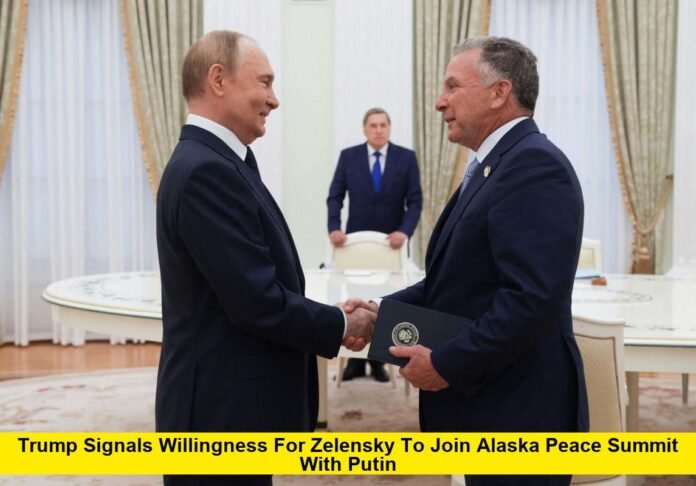

U.S. President Donald Trump is preparing for a landmark meeting with Russian President Vladimir Putin in Alaska on August 15, 2025, aimed at exploring potential steps toward ending the ongoing war in Ukraine. In a significant shift from earlier plans, the White House has indicated Trump is open to inviting Ukrainian President Volodymyr Zelensky to join the talks, raising the possibility of transforming a bilateral meeting into a three-way summit.
Summit Details and Strategic Shifts
- Date & Venue: The Alaska summit is set for August 15, marking the first U.S.–Russia meeting on American soil in nearly four decades.
- Original Format: Initially, the talks were planned as a bilateral discussion between Trump and Putin, with no confirmed role for Ukraine.
- Shift in Approach: Trump, who previously suggested he would only meet Putin if Zelensky were also present, later softened this stance, saying he would proceed with or without Ukraine’s leader. However, recent signals from the White House suggest that including Zelensky is now a strong possibility.
The change reflects growing international pressure and the recognition that any lasting resolution to the conflict must include direct Ukrainian participation.
Ukraine’s Firm Rejection of Territorial Concessions
The upcoming summit has sparked debate over potential proposals, including ideas for territory swaps as part of a ceasefire deal. Trump has floated the notion of Ukraine ceding certain occupied areas to Russia in exchange for an end to hostilities.
President Zelensky has firmly rejected any such arrangement. In recent public remarks, he declared that Ukraine would not agree to any settlement that involves giving up sovereign territory. He stressed that legitimizing Russia’s control over occupied regions would only encourage further aggression and undermine international law.
Zelensky also made clear that any peace deal negotiated without Ukraine’s direct involvement would be unacceptable and unenforceable. His position has strong backing from much of the Ukrainian public and government, who view territorial integrity as a non-negotiable principle.
Europe’s Role and Pressure Ahead of Talks
European leaders have stepped up diplomatic engagement ahead of the Alaska summit. The EU, United Kingdom, France, and Germany have all reiterated that Ukraine must be a full participant in any discussions that shape the country’s future.
Their demands include:
- Security guarantees to prevent future Russian offensives.
- Ceasefire terms that reflect current battlefield realities.
- No recognition of Russia’s annexation of Ukrainian territories.
The message from European capitals is clear: any agreement that redraws borders in Russia’s favor will face united opposition.
The Stakes for All Sides
The Alaska summit carries high stakes not just for the war, but for global geopolitics.
For Trump, the talks represent an opportunity to claim a breakthrough in a major international crisis during his presidency. However, entering negotiations without clear commitments from both Kyiv and Moscow risks producing an agreement that is either short-lived or politically divisive.
For Putin, the meeting offers a chance to ease international pressure and potentially secure recognition—formal or informal—of Russian gains in Ukraine. But inviting Zelensky to the table could complicate any attempts to push through territorial concessions.
For Ukraine, direct participation is essential to defend its sovereignty and ensure that any peace deal reflects its national interests. Without this, Kyiv fears being sidelined in decisions that could shape its borders and future security.
Possible Scenarios for the Summit
- Bilateral Format: Trump meets only with Putin, aiming to broker a framework deal, with Ukraine brought in later.
- Trilateral Talks: Zelensky joins, allowing for direct negotiation but likely making compromises harder to reach.
- Staged Process: Initial bilateral meeting followed by broader peace conference involving Ukraine and other international partners.
Analysts note that while a trilateral format may slow the pace of talks, it is the only realistic path toward a deal that all parties can commit to.
Key Challenges to Peace
Even if Zelensky attends, several issues remain unresolved:
- Control over occupied regions in eastern and southern Ukraine.
- The status of Crimea, annexed by Russia in 2014.
- Future security arrangements to prevent renewed conflict.
- Reconstruction funding and responsibility for war damages.
Each of these topics carries deep political sensitivities, and none are likely to be settled in a single meeting.
Looking Ahead
As the summit date approaches, diplomatic maneuvering is accelerating. Invitations, agendas, and talking points are being carefully negotiated. Whether Zelensky joins or not could be decided just days before the meeting, depending on last-minute developments.
The world will be watching Alaska closely—not just for handshake photos, but for signs of genuine progress toward ending a war that has reshaped global security and tested international unity.
If all three leaders sit at the same table, it could mark a rare moment of direct engagement in one of the world’s most dangerous conflicts. If not, the risk remains that any deal struck might fail to deliver lasting peace.
In either case, the Alaska summit will be a pivotal moment, with consequences likely to echo far beyond the snowy peaks where the talks will take place.