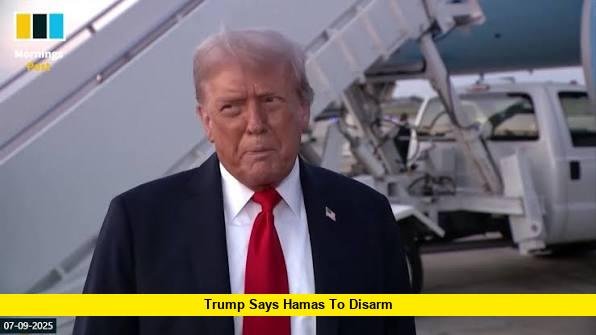

President Donald Trump says a breakthrough has been reached over the future of Gaza, announcing that an agreement calls for the complete disarmament of Hamas and other armed groups in the territory. The Trump says Hamas to disarm development has quickly drawn international attention because disarmament has remained one of the most difficult unresolved parts of the U.S.-backed Gaza peace process.
Trump presented the latest negotiations as a major step toward implementing the next phase of the Gaza plan, which would link the removal of weapons and military infrastructure to a gradual Israeli withdrawal and the transfer of civilian authority to a new Palestinian administration.
However, the situation remains more complicated than Trump’s announcement alone may suggest. Hamas representatives have been participating in negotiations in Cairo, and mediators have reported significant progress, but questions remain about the precise terms, implementation and acceptance of the plan by all parties.
Israel has also raised concerns about whether the proposed arrangements guarantee the full demilitarization of Gaza.
That means Trump’s announcement represents an important diplomatic development, but implementation will ultimately determine whether the agreement produces a lasting change on the ground.
Trump Announces Agreement for Hamas Disarmament
Trump said his Board of Peace had reached an agreement concerning the complete disarmament of Hamas and other armed groups operating in Gaza.
The announcement followed negotiations involving Hamas representatives and mediators in Cairo. Egypt, Qatar and Turkey have played important roles in the diplomatic process, with Trump publicly crediting the countries for helping advance the negotiations.
Under the framework described by Trump, disarmament would not necessarily happen in a single event. Instead, the process would occur in phases alongside other elements of the Gaza peace plan.
Those elements are expected to include the dismantling or neutralization of military infrastructure, changes to security arrangements and the gradual withdrawal of Israeli forces.
Trump described the development as a major step toward creating a Gaza that is no longer controlled militarily or politically by Hamas.
The distinction between announcing an agreement and successfully implementing one is important. Disarmament requires detailed verification, enforcement and security arrangements, making the next stage potentially more difficult than reaching a negotiating framework.
Hamas Position Requires Careful Interpretation
Reports surrounding the negotiations indicate substantial progress, but claims that Hamas has already fully disarmed would be inaccurate.
The issue currently concerns an agreement or proposed framework for future disarmament.
Hamas leaders have been involved in Cairo talks with mediators, and officials familiar with the negotiations have described the discussions as positive. Reports have also indicated progress on weapons, Gaza’s future administration and the conditions surrounding an Israeli withdrawal.
At the same time, Hamas has treated elements of the arrangement as part of an ongoing negotiating process. The group’s position has historically connected disarmament with Israeli withdrawal and broader guarantees concerning Gaza’s political and security future.
Consequently, the most accurate description of the latest development is that Trump says an agreement has been reached for Hamas to disarm, while implementation details and acceptance of specific provisions remain critical.
There is no basis yet for describing Gaza as fully demilitarized.
What the Disarmament Plan Could Involve
The central objective of the U.S.-backed framework is broader than simply collecting weapons from individual Hamas fighters.
Previous versions of the Gaza peace framework have envisioned a phased process addressing the wider military infrastructure developed in Gaza.
Implementation may involve:
- Hamas and other armed factions surrendering weapons in stages
- dismantling military infrastructure and weapons-production capabilities
- destroying or permanently disabling tunnels used for military purposes
- creating mechanisms to verify compliance
- deploying an International Stabilization Force
- developing a reorganized Palestinian police force
- gradually reducing the Israeli military presence as security benchmarks are met
- transferring civilian administration to a Palestinian technocratic structure
The precise sequence matters because Israel has insisted that Gaza cannot return to a situation in which Hamas retains the ability to rebuild its military capabilities.
Hamas, meanwhile, has sought guarantees concerning Israeli withdrawal and Gaza’s political future.
Reconciling those positions remains essential to transforming the diplomatic framework into a functioning agreement.
Israel Has Concerns About the Proposed Terms
Trump’s declaration should not be interpreted as confirmation that every Israeli concern has been resolved.
Israeli officials have continued to demand the complete disarmament of Hamas and the broader demilitarization of Gaza. Reports surrounding the negotiations indicate concerns about whether proposed mechanisms would eliminate all relevant weapons and military infrastructure.
The treatment of different categories of weapons may be particularly important.
Israel wants arrangements strong enough to prevent Hamas or another armed faction from rebuilding a military presence after Israeli forces withdraw. Verification and enforcement mechanisms are therefore likely to become central issues.
Trump’s framework links Hamas disarmament with a gradual Israeli withdrawal rather than treating the two issues separately.
That creates a difficult sequencing problem: each side wants evidence that the other will fulfill its commitments before taking potentially irreversible steps of its own.
International mediators may consequently have a major role in overseeing the process.
Hamas Has Already Moved Away From Governing Gaza
The disarmament negotiations follow another significant political development earlier in July.
Hamas announced the dissolution of the governing body it had led in Gaza, clearing the way for a Palestinian technocratic administration to assume civilian responsibilities.
Hamas had governed Gaza since taking control of the territory in 2007.
Its decision to step away from direct civilian administration was therefore a major change, although it did not by itself resolve the separate issue of Hamas’s weapons or military organization.
The planned replacement is the National Committee for the Administration of Gaza, or NCAG, a Palestinian technocratic structure intended to handle civilian governance.
The U.S.-backed Board of Peace has been involved in the broader transition framework.
Hamas’s withdrawal from civilian government and negotiations over disarmament are related but distinct developments. Giving up administrative control does not automatically mean giving up military capabilities.
That is why the current negotiations are so consequential.
Trump’s Gaza Peace Plan Enters a Decisive Phase
The latest announcement represents another stage in a peace process that began with the U.S.-brokered Gaza ceasefire framework.
Disarmament has long been expected to be among its hardest components.
Earlier phases focused heavily on ending large-scale fighting, hostage and detainee arrangements, humanitarian access and establishing conditions for a broader political transition.
The process has now moved toward longer-term questions.
Who governs Gaza?
Who provides security?
How will armed factions be demobilized?
What conditions must be met before Israeli forces withdraw?
And how can the international community verify that military infrastructure is not rebuilt?
The latest Trump says Hamas to disarm announcement attempts to address several of those issues simultaneously.
Success would fundamentally change Gaza’s political and security structure. Failure to settle the details, however, may leave the peace process vulnerable to renewed disputes.
International Stabilization Could Become Crucial
An international security presence is expected to play an important role if the disarmament framework proceeds.
The International Stabilization Force envisioned under the broader peace plan could help provide security while Palestinian institutions are reorganized.
This matters because an immediate security vacuum would carry serious risks.
Removing Hamas from both military and governmental control without establishing a functioning replacement could leave local authorities unable to maintain order. The peace framework therefore attempts to coordinate disarmament with the creation of alternative security institutions.
A Palestinian police force is expected to form part of those arrangements.
International involvement may also provide a mechanism for verifying compliance, particularly if Israeli withdrawals occur gradually according to agreed milestones.
The effectiveness of any international mission will depend on its mandate, personnel, access and ability to operate throughout Gaza. Those details remain important parts of the implementation challenge.
Israeli Withdrawal Is Tied to the Process
Trump has said Israel would withdraw from Gaza as the agreement is implemented.
The wording is important because the proposal does not appear to envision an immediate, unconditional Israeli military departure.
Instead, withdrawal would take place progressively as the disarmament and security arrangements advance.
For Israel, maintaining security guarantees is a central priority.
For Palestinians and Hamas negotiators, obtaining a credible pathway toward an Israeli withdrawal is similarly central to the negotiations.
A phased structure may provide a compromise by requiring reciprocal steps rather than demanding that either side fulfill every commitment at the beginning.
Even so, disagreements over timelines, verification or compliance could delay individual stages.
Fighting Has Not Completely Disappeared
Diplomatic progress has occurred against a backdrop of continued violence in Gaza.
Israeli strikes have continued despite the wider ceasefire framework, with Palestinian casualties reported during the period in which negotiations were advancing.
That contrast illustrates why political announcements should not automatically be interpreted as conditions on the ground.
A successful disarmament agreement would require sustained compliance from multiple parties and mechanisms for addressing alleged violations without allowing the broader arrangement to collapse.
The humanitarian situation and reconstruction of Gaza are also closely connected to the political negotiations.
Years of fighting have caused enormous destruction, leaving housing, infrastructure and essential public services requiring extensive reconstruction.
A durable security settlement would potentially make a larger international rebuilding effort more feasible.
Why Hamas Disarmament Matters
Hamas’s military future has been one of the central obstacles to a permanent postwar settlement.
Israel has consistently maintained that Hamas cannot remain an armed military force capable of carrying out future attacks.
For Trump’s peace framework, allowing Hamas to retain substantial military capabilities would also undermine the proposed transfer to a new Palestinian administration.
Disarmament therefore sits at the intersection of several major objectives: Israeli security, Palestinian governance, reconstruction and the long-term stability of Gaza.
If Hamas fully disarms under a verified arrangement, it would represent a dramatic transformation of the organization after decades in which its armed wing has been central to its identity and influence.
But that outcome cannot be treated as complete until the agreed measures are actually implemented and independently verified.
What Happens Next
Attention now shifts from announcements toward implementation.
Negotiators must settle the details governing weapons, tunnels, verification, Israeli withdrawal, international security forces and the authority of Gaza’s new Palestinian administration.
Several developments will be especially important to watch:
- whether Hamas formally and publicly confirms the final disarmament terms
- whether Israel accepts the implementation framework
- how weapons and military infrastructure will be surrendered or dismantled
- who will verify that Hamas and other factions comply
- when the new Palestinian administration can operate fully inside Gaza
- how Israeli withdrawals will be linked to each stage
- whether the process reduces continuing violence on the ground
These questions will determine whether the agreement becomes a durable political settlement or remains primarily a negotiating framework.
Latest Outlook
The latest developments provide more concrete evidence of diplomatic movement than earlier periods when disarmament appeared largely deadlocked.
Hamas’s decision to dissolve its Gaza governing body earlier in July removed one major political obstacle. The Cairo negotiations have now brought the more difficult military question directly into the process.
Trump’s declaration that his Board of Peace has reached a complete disarmament agreement is therefore significant.
Still, the language surrounding the announcement requires precision.
Hamas has not already been disarmed. Israel has not necessarily accepted every detail of the arrangements. And important implementation mechanisms still need to function successfully.
The coming stages may reveal whether the differences between the parties have genuinely narrowed enough to sustain the plan.
Final Thoughts
The Trump says Hamas to disarm development marks a potentially consequential moment in efforts to determine Gaza’s postwar future. Trump’s announcement indicates that negotiators have moved closer to resolving an issue that has repeatedly threatened to stall the peace process.
Hamas’s earlier decision to relinquish direct civilian governance, combined with progress in Cairo over weapons and Israeli withdrawal, suggests the political landscape in Gaza is changing.
Yet an agreement on paper and disarmament in practice are very different milestones.
The durability of the process will depend on whether Hamas actually relinquishes its military capabilities, whether Israel accepts and follows the withdrawal mechanism, and whether international and Palestinian institutions can establish effective governance and security.
For now, the announcement represents significant diplomatic progress, but the next phase—verification and implementation—will determine its lasting importance.
Stay updated as the Hamas disarmament negotiations develop, and share your thoughts on whether the latest Gaza agreement can produce a lasting peace.