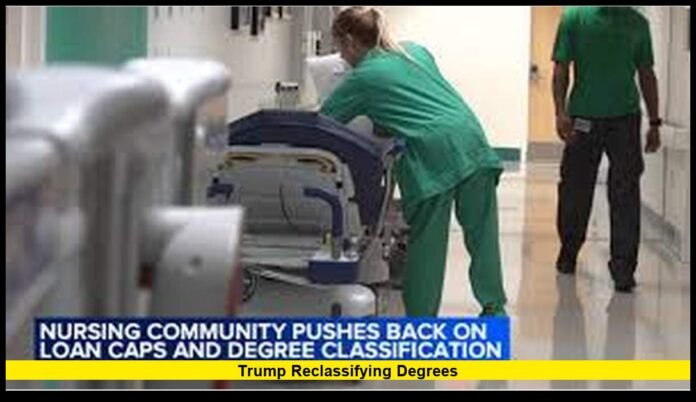

Trump reclassifying degrees has quickly become one of the most significant developments in U.S. education policy, reshaping how graduate programs are categorized and how students in those fields can borrow money for advanced study. The changes, now confirmed and moving toward implementation, are prompting strong reactions from universities, professional organizations, and Americans who rely on graduate training to enter essential professions.
A Major Redefinition That Changes the Education Landscape
The new federal guidance updates how the government defines graduate programs and assigns loan eligibility. Instead of treating a wide range of advanced degrees as professional, the administration now uses a narrower interpretation that applies only to a limited set of programs.
This change creates a distinct dividing line. One side includes the reduced list of professional programs that retain access to higher federal borrowing limits. The other side contains the many programs now treated as standard graduate degrees with lower loan caps and lifetime borrowing restrictions.
The shift is not symbolic. It alters financial planning for future students across the country and may influence career pathways for years to come.
Programs No Longer Treated as Professional
A significant number of academic fields will soon lose access to the professional classification under federal rules. These adjustments affect programs that have traditionally required intensive graduate-level training, licensure exams, and clinical or supervised practice hours.
The list includes:
- Nursing
- Physician Assistant Studies
- Physical Therapy
- Occupational Therapy
- Counseling
- Education
- Social Work
- Accounting
- Architecture
Each of these fields has long been tied to advanced study beyond the undergraduate level. Yet under the new rules, they will be grouped into the standard graduate category rather than the professional tier.
Loan Limits Will Shift for Many Graduate Students
The most immediate impact of the reclassification involves federal borrowing. Graduate students in affected programs will face new loan limits beginning in July 2026.
Standard graduate students will have:
- A yearly loan cap of $20,500
- A total federal borrowing limit of $100,000
This is a major change for fields such as nursing, physical therapy, physician assistant studies, and architecture, where tuition and training costs often exceed the new caps. Many students in these programs previously relied on federal loans tied to professional classification, which allowed borrowing up to the full cost of attendance.
Now, those students will need to look beyond traditional federal options and consider a mix of personal funds, scholarships, employer support, or private loans to bridge the gap.
How the Redefinition Affects Students Planning Their Careers
Students preparing for graduate school must now evaluate their educational and financial goals with more precision. Many programs on the reclassified list require several years of coursework, field placements, and exams to reach licensure. The financial burden of this training will shift more heavily onto students unless institutions create new forms of support.
Individuals pursuing nursing, therapy, counseling, or social work careers may reconsider their timelines or compare schools based on affordability rather than program features. Others may delay enrolling or explore entry-level roles instead of advanced credentials.
Universities anticipate a period of adjustment as students examine how the new guidelines align with their long-term goals.
Why Health-Related Fields Are Voicing Strong Concerns
Many of the programs losing professional designation are core components of the U.S. healthcare workforce. Nursing leaders, therapy educators, and physician assistant faculty members stress that graduate-level preparation is not optional in their fields. It is fundamental to patient safety, clinical competency, and secure, specialized care.
A change in borrowing access may affect:
- Enrollment pipelines
- Workforce diversity
- Advanced practice readiness
- Staffing stability in hospitals and clinics
- Availability of training placements
Healthcare professionals worry that limiting loan access could discourage new students at a moment when demand continues to rise. Hospitals depend on nurse practitioners, physical therapists, occupational therapists, and physician assistants to fill essential roles across specialties. Communities with limited healthcare access may feel the impact most directly.
Education and Social Services Face Their Own Challenges
Education programs, counseling pathways, and social work degrees also rely on graduate training to meet licensure requirements. Teachers seeking specialized endorsements, counselors preparing for clinical practice, and social workers aiming for advanced licensure all depend on graduate study.
These fields already experience staffing shortages in many states. The financial constraints tied to reclassification could widen those gaps. Many educators worry that potential students may not pursue graduate credentials if the funding structure becomes more restrictive.
School districts and service agencies are also preparing for possible long-term impacts on recruitment and retention.
Architecture and Accounting Prepare for Financial Repercussions
Architecture and accounting are two other fields facing consequences due to the new rules. These professions involve structured pathways requiring advanced coursework and rigorous examinations.
Architecture programs are typically lengthy and resource-intensive, often including studio work, design laboratories, and extended practicum experiences. The shift in federal classification may influence the appeal of graduate architecture programs, especially for students without financial support from employers or families.
Accounting departments share similar concerns. Graduate accounting coursework is a key component of licensure pathways, and many students rely on federal aid to reach the credit requirements for certification. Financial limits could influence enrollment patterns and career planning for future professionals.
Universities Take Stock of the Coming Changes
Academic institutions across the United States are now reviewing the implications of the new guidance. Financial aid offices are preparing updated materials for incoming students, while program directors evaluate how the reclassification will affect enrollment, budgets, and long-term planning.
Several trends are emerging:
1. Institutions are reassessing tuition structures.
Some may adjust the cost of graduate programs to align more closely with federal loan caps.
2. Schools are exploring internal scholarship programs.
Universities could expand merit-based or need-based funding to help offset the borrowing gap.
3. More emphasis is being placed on employer partnerships.
Hospitals, clinics, accounting firms, and public agencies may strengthen tuition-support programs to attract students in affected fields.
4. Enrollment shifts are expected.
Programs losing professional classification may see slower growth, while those retaining the designation could become more appealing to budget-conscious students.
The next year will likely shape how colleges adapt to maintain program access and stability.
Why the Federal Government Adopted the New Categories
The administration has stated that the new categories bring federal guidance in line with older statutory definitions. Officials argue that limiting federal borrowing may help reduce long-term student debt and encourage institutions to manage tuition more responsibly.
Supporters of the shift believe that reforming degree classification is part of a broader effort to simplify federal aid, create clearer program distinctions, and reduce reliance on unlimited government-backed loans.
However, those who oppose the changes maintain that the revised framework does not recognize the academic rigor or professional necessity of many programs that now fall outside the professional category.
Broader Implications for the U.S. Workforce
The reclassification may influence workforce development over the long term. Many of the affected programs feed directly into fields where the United States faces shortages or increasing demand.
Key areas that could experience ripple effects include:
- Advanced nursing
- Rehabilitation therapy
- Mental health services
- Educational leadership
- Community social services
- Architectural design
- Professional accounting
Reducing federal financial access could influence how schools staff these roles and how communities receive essential services.
Students and Institutions Await Further Implementation Details
With the loan adjustments set to take effect in 2026, students and university advisors are watching closely for more updates. Many expect additional clarifications on the transition timeline, loan processing rules, and guidance for currently enrolled students.
As more information becomes available, institutions will continue preparing their students and adjusting internal planning to align with the new federal landscape.
As this policy continues to unfold, readers are encouraged to share their thoughts and stay connected for the latest developments.