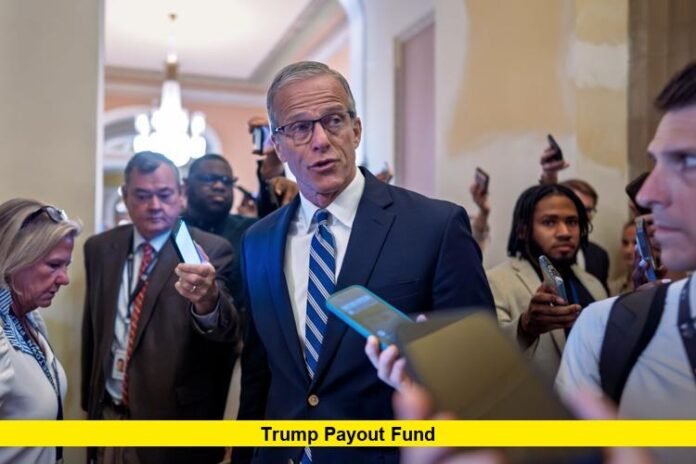

The United States Senate was thrust into a marathon of high-stakes votes on June 4, 2026, as Democrats mounted a series of challenges to block President Donald Trump’s controversial $1.8 billion “Anti-Weaponization Fund.” Republicans narrowly prevailed, defeating Democrat-led efforts to permanently shut down the fund — but not without significant fractures within the GOP becoming publicly visible.
What Is the Trump Payout Fund?
The so-called “Trump Payout Fund” — officially known as the Anti-Weaponization Fund — is a $1.776 billion fund established by the Department of Justice as part of a settlement between President Trump and the Internal Revenue Service. The civil lawsuit, originally filed by Trump and his sons, concerned the leak of his tax returns by an independent contractor.
Rather than proceeding to trial, both parties agreed to settle — and as part of that settlement, the Trump administration agreed to stand up a taxpayer-supported fund designed to compensate individuals who allege they were unfairly targeted or prosecuted by past administrations.
According to the DOJ, the fund draws from the federal Judgment Fund, a permanent Treasury appropriation typically used to pay court judgments and legal settlements against the federal government. The fund’s stated goal is to “provide a systematic process to hear and redress claims of others who suffered weaponization and lawfare.”
Who Could Receive Payouts?
This is where the controversy intensifies. When the fund was announced in May 2026, reporting from the New York Times and ABC News suggested it could be used to compensate Trump allies — including nearly 1,600 individuals charged in connection with the January 6, 2021, Capitol attack who claim they were unfairly prosecuted.
Both Vice President J.D. Vance and Acting Attorney General Todd Blanche declined to rule out making payouts to January 6 rioters, even those accused of attacking law enforcement officers. Vance stated at a White House press briefing: “We do have people who are accused of attacking law enforcement officers… That doesn’t mean that we’re going to completely ignore their claims.”
Blanche similarly gave open-ended answers during a Senate hearing, declining to confirm whether members of far-right groups like the Proud Boys or Oath Keepers could qualify for compensation.
Legal Questions Surrounding the Fund
The fund immediately drew sharp criticism from legal experts who questioned its legality and oversight.
Georgetown Law’s Rupa Bhattacharyya, legal director for the Institute for Constitutional Advocacy and Protection, said: “What is incredibly unusual is that taxpayer money would be paid out under circumstances like this without any criteria having been established for how that’s going to happen or how much people might get. It lends itself to abuse and corruption.”
Critics noted that while the federal government has administered other payout programs — such as the 9/11 Victim Compensation Fund and the National Vaccine Injury Compensation Program — those funds were created by Congress and included rigorous safeguards. The Anti-Weaponization Fund, by contrast, was established through an executive settlement with no congressional approval.
A federal judge in Virginia, U.S. District Judge Leonie Brinkema, temporarily froze the fund, ordering Trump officials to stop setting it up to “ensure that no funds are irreversibly disbursed.” A June 12 hearing was set for arguments over whether to extend that order. A second federal judge also agreed to review the fund’s legitimacy after a group of former federal judges questioned it.
DOJ Reversal: “Not Moving Forward With the Fund”
Amid mounting political and legal pressure, Acting Attorney General Todd Blanche told lawmakers on June 2, 2026 that the Justice Department is “not moving forward” with the Anti-Weaponization Fund — “period.”
His statement marked a striking reversal for the administration, which had previously stood firmly behind the fund. However, Blanche stopped short of formally rescinding the underlying settlement agreement with the IRS, and he reaffirmed a second component of the deal that bars the IRS from bringing future claims against Trump, his family, or his businesses for past tax issues.
Adding further confusion, President Trump himself appeared to contradict the reversal just hours later. On June 3, Trump told reporters that the settlement is “very important” and said “I don’t know” when asked whether it was dead or on hold.
The Senate Vote-a-Rama: Republicans Hold the Line
The drama reached a peak on June 4, 2026, as the Senate entered a “vote-a-rama” — a marathon session of rapid-fire amendment votes tied to a $70 billion GOP immigration enforcement bill. The legislation, advancing through the filibuster-proof budget reconciliation process, is one of Trump’s top domestic policy priorities and funds agencies like ICE and Customs and Border Protection.
Senate Minority Leader Chuck Schumer opened with a motion to send the immigration bill back to the Judiciary Committee, with instructions to add language permanently banning the Anti-Weaponization Fund. He framed the vote starkly: “My very first amendment offers Republicans a choice: Do you support Donald Trump’s two-billion-dollar, taxpayer-funded slush fund, or do you want to protect the American people?”
The motion failed 49-50, with Republican Senators Susan Collins (Maine), Jon Husted (Ohio), and Dan Sullivan (Alaska) crossing the aisle to vote with Democrats. Collins, Husted, and Sullivan are among a handful of GOP senators who have expressed public discomfort with the fund.
Critically, Senator Bill Cassidy of Louisiana — who recently lost his primary race after public disputes with Trump — initially held out for over three hours before ultimately voting against the Democratic motion, providing the deciding margin that kept the immigration bill alive.
A Divided Republican Party
The votes exposed deep fractures within the Republican caucus. Senate Majority Leader John Thune acknowledged the uncertainty heading into the vote-a-rama, telling reporters: “I can’t predict how it comes out.”
The immigration bill had been stalled for weeks specifically because of the Anti-Weaponization Fund controversy. A bloc of Republican senators — concerned about the fund’s lack of oversight, its potential beneficiaries, and its political optics — had refused to support the broader immigration legislation unless the fund issue was resolved.
The administration’s attempt to reassure Congress by announcing the fund was “dead” worked — barely. But with Trump publicly casting doubt on that claim, the underlying tension remains very much alive.
Democrats also used the vote-a-rama to force Republicans on record regarding other controversial issues, including Trump’s White House ballroom project. An amendment from Senator Jeff Merkley to block funding for Trump’s ballroom was defeated, though nearly six Republican senators crossed over to support it.
What Happens Next With the $70 Billion Immigration Bill?
The Senate’s $70 billion immigration enforcement bill, known as the Secure America Act, remains the centerpiece of the Republican legislative agenda heading into the 2026 midterms. The bill would fund expanded immigration enforcement operations, including hiring additional ICE and CBP officers and ramping up deportations.
If the Senate passes the final legislation, it will still need to be approved by the House of Representatives before reaching President Trump’s desk. Any House amendment would require the bill to return to the Senate — and potentially face another vote-a-rama process.
Some Republicans predict this immigration bill could be Trump’s last major legislative victory before the 2026 midterm elections, adding enormous pressure on GOP leadership to navigate the ongoing divide over the Anti-Weaponization Fund.
Frequently Asked Questions (FAQ)
What is the Trump Payout Fund? The Trump Payout Fund — officially called the Anti-Weaponization Fund — is a $1.776 billion fund established by the DOJ as part of a settlement between Trump and the IRS. It is designed to compensate individuals who claim they were unfairly targeted by past government administrations.
Who is eligible to receive money from the Anti-Weaponization Fund? The DOJ states there are “no partisan requirements,” but the fund’s origins and the administration’s statements suggest Trump allies, January 6 defendants, and others the president considers victims of political persecution may benefit.
Did the Senate vote to eliminate the Trump Payout Fund? No. On June 4, 2026, the Senate defeated Democratic efforts to permanently ban the fund by a 49-50 vote, with three Republican senators joining Democrats in favor of the ban.
Is the Anti-Weaponization Fund currently active? The fund is in legal limbo. A federal judge in Virginia temporarily froze it, and Acting AG Blanche announced the DOJ is “not moving forward” with it — but President Trump has cast doubt on that reversal.
Is the fund legal? Legal experts have raised serious questions about the fund’s legality, noting it was created through an executive settlement without congressional authorization and lacks established criteria for how payouts would be determined.
How does the fund connect to the $70 billion immigration bill? The controversy over the fund stalled the Senate’s $70 billion immigration enforcement bill for weeks. The vote-a-rama on June 4 was part of the reconciliation process needed to advance that legislation.
The battle over Trump’s Anti-Weaponization Fund is far from over — drop your thoughts in the comments below and bookmark this page for the latest updates as the Senate showdown continues.