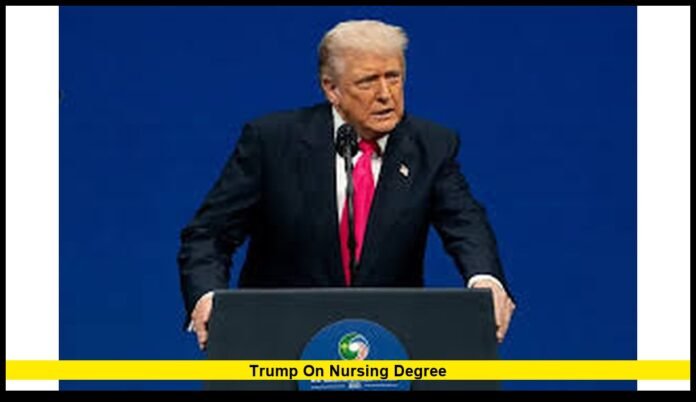

Public discussion surrounding trump on nursing degree has grown rapidly in recent weeks as online conversations, political commentary and social-media reactions continue to circulate. Many Americans have been searching for clarification, hoping to understand what is factual, what is misunderstanding, and why the topic is gaining so much attention. As of today, the verified record remains clear: Donald Trump has not issued any formal policy statement targeting nursing degrees, nor has he introduced proposals that alter or diminish the value of nursing education.
Even with that confirmed, the topic has become a major point of conversation. The momentum behind it reflects larger national questions about professional recognition, workforce shortages and the future of health-care education. This article breaks down what is verified, why searches have surged, and which issues within the nursing field are being discussed alongside the topic.
Why the discussion is growing online
Interest in this subject did not develop in a vacuum. Several factors have pushed the term into public view, creating confusion and sparking debate:
- Viral posts claiming Trump made statements about nursing degrees
- Ongoing national arguments about higher education and workforce standards
- Public concern over nursing shortages and burnout
- Misinterpretations tied to unrelated policy discussions
- Increased awareness of how misinformation spreads during election years
Because health-care workers play a central role in American life, any suggestion about the value or legitimacy of their education quickly gains traction online. Even when the underlying claim is inaccurate, it can fuel concern until facts are clearly communicated.
What is verified right now
The confirmed facts remain simple and important:
- There is no documented speech, interview, rally comment or policy draft where Trump questions the legitimacy of nursing degrees.
- No national policy connected to Trump has modified nursing degree requirements.
- State licensure rules, which define the path to becoming an RN, LPN/LVN or APRN, remain unchanged.
- Nursing continues to be recognized as a profession grounded in rigorous education, training and licensure.
These points have been repeated by nursing educators, state boards and health-care leaders whenever confusion arises.
Why this topic touches a nerve in the health-care community
Nursing is a profession built on high-stakes responsibility. Nurses manage patient care, handle complex clinical tasks, support physicians, and provide emotional and practical guidance to patients and families.
Because of that, anything that appears to question the value or legitimacy of nursing education can feel deeply personal to:
- Nursing students
- Working nurses
- Faculty members
- Clinical leaders
- Administrators
- Families of health-care workers
In a field already dealing with stress, shortages and increased responsibilities, the fear of public misunderstanding is real. Even a misinterpreted claim can create unnecessary anxiety.
Understanding the structure of nursing education
To make sense of the conversation, it helps to revisit the actual structure of nursing degrees in the U.S. These pathways are standardized and heavily regulated:
Licensed Practical Nurse (LPN/LVN)
Requires completion of an approved program and state licensing exam. LPNs typically work in long-term care, outpatient clinics and supportive hospital roles.
Registered Nurse (RN)
Requires either an associate degree in nursing (ADN) or a bachelor of science in nursing (BSN), followed by successful completion of the NCLEX-RN exam.
Advanced Practice Registered Nurse (APRN)
Requires a graduate-level degree such as a master’s or doctorate. Nurse practitioners, nurse anesthetists and clinical nurse specialists fall into this category.
Nurse Educators and Leadership Roles
Require additional graduate-level preparation and certifications.
None of these structures have been altered by Trump or by any current federal action related to him. The career ladder remains stable and widely respected.
Why health-care policy debates often spill into education topics
Although there has been no action from Trump targeting nursing degrees, larger health-care policy discussions sometimes get tangled with educational issues, including:
- Debates about student-loan policies
- National conversations about professional licensing
- Workforce shortages tied to burnout and early retirement
- State-level differences in scope-of-practice rules
- Public arguments about the rising cost of college degrees
These broader debates sometimes get incorrectly linked to specific public figures, fueling misunderstandings.
When topics overlap—like student loans and nursing education—people may assume certain statements were made when they were not. The combination of politics, health care and online platforms creates the perfect environment for misunderstanding to grow quickly.
Why this matters to nursing students
Prospective and current nursing students often feel the greatest pressure when public conversations question their field. Many already balance:
- Demanding coursework
- Clinical rotations
- Tuition and financial planning
- Family responsibilities
- Work schedules
When social media pushes claims—even incorrect ones—about changes to education requirements or the value of nursing credentials, it can disrupt academic confidence and create uncertainty.
Students rely on stable, predictable pathways. Accurate communication helps them stay focused on coursework and career planning without fear of sudden shifts in recognition or degree value.
How working nurses view the situation
Professional nurses often respond to online claims with frustration. Many have spent years developing clinical mastery and building relationships with patients. Their responsibilities are immense, including:
- Medication management
- Emergency response
- Patient education
- Coordination with physicians
- Wound care and assessments
- Charting and regulatory compliance
Nurses take pride in their educational preparation. When inaccurate statements circulate suggesting anyone has dismissed their degree, many respond to set the record straight.
For nurses, the core concern is not politics—it is the integrity of their profession.
The danger of misinterpreted claims
In the digital age, information spreads in seconds, but corrections spread slowly. Misinterpreted claims about political figures and professions often create:
- Emotional distress for workers
- Confusion for students
- Distrust in public communication
- Divisions within online communities
A misleading post can gain thousands of shares, even if debunked later. This is why clarity is essential when topics involve licensed professionals.
The challenge is not tied to any one political figure; it is a broader issue tied to how online conversations evolve.
Why nursing remains one of the most trusted professions
Despite online noise, nursing consistently ranks as one of the most respected professions in the U.S. Public trust remains strong because:
- Nurses often spend the most time with patients
- They balance clinical skill with emotional support
- They play a central role in every type of health-care setting
- Families rely on them during the most vulnerable moments
- Their education and training prepare them for high-pressure decisions
This long-standing trust is not easily shaken by public debate.
Clarifying the present situation
To reiterate the verified record:
- Trump has not announced or promoted any policy to alter nursing degrees.
- Viral posts claiming otherwise lack supporting evidence.
- Nursing education remains unchanged and fully recognized at every level.
- Professional licensure and accreditation continue to operate exactly as before.
The discussion online reflects a mixture of confusion, political commentary and concerns tied to other topics—not an actual policy stance from Trump.
Looking forward
As the conversation continues, several actions can help keep the public accurately informed:
- Sharing verified information rather than speculation
- Highlighting the stability and importance of nursing education
- Encouraging students to consult their programs or state boards
- Correcting misunderstandings before they spread further
The national health-care system depends on a strong nursing workforce. Clear communication supports that stability.
Conclusion
The topic referred to as trump on nursing degree has gained attention because of social-media conversations, not because of actual changes, proposals or statements from Trump. Nursing degrees remain intact, fully respected and unchanged. The profession continues to hold a central place in the nation’s health-care system, supported by well-established educational pathways and rigorous state licensing standards.
Have you come across conflicting posts about nursing degrees? Share your experience below so others can stay informed with clarity and confidence.