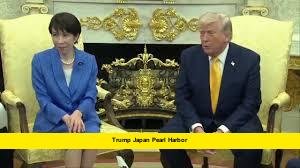

When President Donald Trump sat down with Japanese Prime Minister Sanae Takaichi in the Oval Office on Thursday, March 19, 2026, the meeting was supposed to be a carefully managed show of alliance solidarity. Instead, it became one of the most talked-about diplomatic moments of Trump’s presidency — all because of a single joke about Pearl Harbor.
The exchange, which involved trump, japan, and pearl harbor all in the same breath, happened in front of cameras, aides, and reporters from both nations. Its impact was immediate and unmistakable.
Stay with this article — what happened next in that room tells you everything about where the U.S.-Japan alliance stands right now.
What Trump Actually Said
A Japanese reporter asked Trump directly why the United States had not warned allies like Japan before launching military strikes against Iran. It was a pointed question, and the reporter made clear that Japanese citizens were confused and concerned.
Trump’s answer was unapologetic. He said the U.S. did not tell anyone about the operation because the entire strategy depended on surprise. Then he turned to Takaichi and delivered the line that stopped the room: “Who knows better about surprise than Japan? Why didn’t you tell me about Pearl Harbor?”
Some people in the room laughed at first. Then the laughter faded. An audible gasp was heard from the back. Takaichi, Japan’s first female prime minister, sat with her hands clasped, her eyes widening. Her demeanor visibly stiffened. She had come to Washington hoping to reaffirm the U.S.-Japan alliance — not to field a World War II joke directed at her nation.
Trump followed up by saying the U.S. believed in the element of surprise, and that because of the surprise achieved in the first two days of military operations, American forces knocked out significantly more targets than anticipated. He framed the secrecy as strategy, not slight.
Why This Meeting Was Always Going to Be Tense
Takaichi had warned Japanese lawmakers before leaving Tokyo that the Washington visit would be “very difficult.” She promised to do everything possible to maximize Japan’s national interest. That was not an exaggeration.
Trump had spent the days leading up to the meeting publicly calling out Japan and other Indo-Pacific allies for not doing enough to help the United States reopen the Strait of Hormuz — the narrow waterway through which nearly one-fifth of the world’s oil supply passes. Iran had effectively shut down traffic through the strait after the U.S. launched military operations against it on February 28, 2026 — an operation officially named Operation Epic Fury. The closure sent global oil prices sharply higher and sent economic shockwaves through Asia.
Japan is uniquely exposed. It imports the vast majority of its energy, and the strait’s closure hits its economy hard and fast. At the same time, Japan’s postwar constitution — written in 1947 under U.S. guidance — commits the country to pacifism and renouncing war. Sending combat forces to a conflict in the Middle East faces steep legal and political barriers at home. The Japanese public is deeply opposed to the war.
Takaichi’s challenge was to appear supportive of the United States without committing Japan to actions it legally and politically cannot take.
What Japan Offered Instead
Rather than military commitments, Takaichi brought economic ones. Japanese companies have outlined plans for $36 billion in investments across liquefied natural gas infrastructure, critical mineral firms, and a deep-water crude export facility in the United States. That figure represents only the first installment of an anticipated $550 billion in total Japanese investment in the U.S. over coming years.
Takaichi also pledged to coordinate with Washington to help stabilize global energy markets, aligned Japan with the International Energy Agency’s release of emergency oil reserves, and reiterated that Iran must never be allowed to develop nuclear weapons. She noted that Tokyo had been in direct communication with Tehran in an effort to help resolve the conflict diplomatically.
Inside the Oval Office, she told Trump through an interpreter that the world was facing “a very severe security environment” and that the global economy was “about to experience a huge hit.” She also offered a striking personal compliment — saying she believed Trump was the only world leader capable of achieving global peace.
Trump, for his part, praised Japan warmly in public remarks. He said the two nations had “tremendous support and relationship on everything” and declared that Japan was “stepping up to the plate” — pointedly adding, “unlike NATO.”
The Historical Weight Behind the Joke
The Pearl Harbor attack took place on December 7, 1941, when Japanese naval forces launched a surprise aerial assault on the U.S. naval base in Hawaii. More than 2,400 Americans were killed. The attack brought the United States into World War II. Four years later, the U.S. dropped atomic bombs on Hiroshima and Nagasaki, killing hundreds of thousands of Japanese civilians.
The two countries have been formal allies since 1952. In 2016, then-Prime Minister Shinzo Abe made a historic and emotionally charged visit to the Pearl Harbor memorial alongside President Barack Obama, offering his “sincere and everlasting condolences” to the Americans who died in the attack. It was a moment of solemn reconciliation.
Trump’s casual invocation of Pearl Harbor in front of Takaichi landed in an entirely different register — not solemn, but sharp, used as a punchline to deflect a reporter’s question. Whether it was diplomacy, humor, or provocation depended entirely on who was watching.
What Comes Next for the Alliance
The broader stakes of Takaichi’s visit extend well beyond one jarring moment. She is among the very first leaders of a major American ally to meet with Trump since Operation Epic Fury began on February 28. The Pentagon has requested at least $200 billion from Congress to fund ongoing military operations in Iran. Trump acknowledged that figure but said the request was tied to broader national security needs beyond just the Iran conflict.
Meanwhile, Japan and five European nations released a joint statement pledging to consider “appropriate efforts” to help reopen the Strait of Hormuz and stabilize global energy markets, while calling on Iran to halt its actions. The statement stopped well short of a commitment to military force.
Takaichi had originally planned her Washington visit to land just before Trump’s trip to China, hoping to be the last ally voice Trump heard before meeting with President Xi Jinping. Trump postponed that China visit this week to focus on the Iran situation, which reshuffled the diplomatic calendar significantly.
The U.S.-Japan alliance remains one of the most important security relationships in the world. But Thursday’s meeting made clear that the Iran war is testing it in ways neither government was fully prepared for — and that the distance between public friendship and private friction is narrower than it appears.
Did Trump cross a line with the Pearl Harbor quip, or was it just his signature style? The comments section is open — share your take and keep checking back as this story develops.